Before we shut down our blog and social media activities for a well-earned break, we want to share with you all some highlights from the year and our plans for 2026.
The academic year began with the Border Criminologies’ annual workshop at Clare College, Cambridge. Hosted by Dr Alpa Parmar, co-lead of the thematic strand on Law and the Courts, the workshop refreshingly focused on border resistance and utopian futures. Over two days, sustained by the college’s excellent catering, we heard from a range of colleagues, predominantly early career researchers, about their research and activism. As ever this was a collegial and uplifting event, and one made even more enjoyable by the more optimistic topic. Participants at the workshop gave their thoughts on the role of hope in researching hostile borders: watch the video.
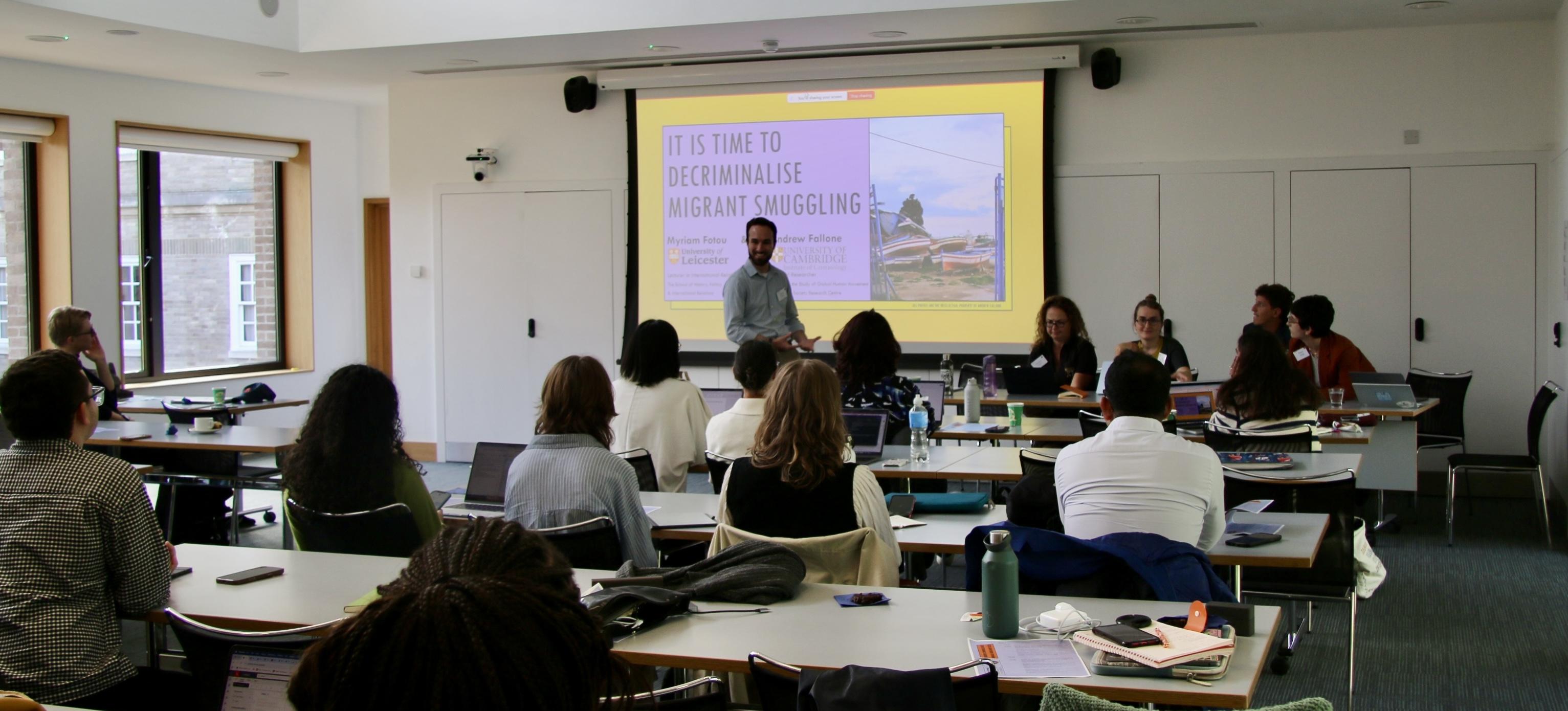
Next year, in response to requests from colleagues with children, for whom the school term usually commences in September, we are moving the workshop earlier to May 11-12. It will also return to Oxford. Organised around the theme of Bordered Care, it will take place at St Antony’s College and will be offered as a hybrid event. We are currently finalising the programme and will circulate details in the new year. We warmly encourage you to add the dates to your calendars and register.
As the report makes clear, our members have been as busy as ever in publishing, research and teaching. There have been a number of new books produced by members of the core team this term, including ones by Andriani Fili, Hyab Yohannes, Samuel Singler, and Catherine Briddick. Some have already been celebrated; others will be launched in the new year. A number of our student members have completed their doctorates, moving onto postdoctoral fellowships and jobs. Congratulations to Vicky Taylor, David Suber, and Diana Volpe to name just three.
As usual, colleagues have also been busy with other forms of dissemination. In November, Vicky Canning launched her innovative Toolkit, Supporting Survival, developed in collaboration with colleagues at DIGNITY, to help asylum seeker and refugee survivors of torture and torturous violence. In October, Monish Bhatia presented No Release, a short film that explores the impact of GPS surveillance enforced by the UK immigration system. Border Criminologies also hosted a local screening of Removed! co-produced by Francesca Esposito, AVID and the Unchained Collective.
Building on that work, on March 16, Mary Bosworth will host a panel event bringing together artists and social scientists at the Centre for Criminology to discuss creative methodologies, showcasing three different examples from Network members – graphic novels, animation, and a podcast.
Despite this vibrant activity, this year has been financially challenging. While we were fortunate to receive support from UNIQ+ for one funded student over the summer, and from Clare College and the Oxford Law Faculty towards the expenses of the workshop, Border Criminologies is at a low ebb with internal funding. While we have some research grants under consideration, we remain in urgent need of external support to ensure the network’s sustainability.
Changes in personnel are also afoot. We give thanks to Ibrahim Ince, who has organised a number of book launches this term. He will be replaced by Anna Tsui. We also welcome a new group of MSc student interns, Antonia Brillemburg, Maria Cecilia Smurr Ferrer and Hailun Li, who have offered to help support our communications and blog editing. Thanks also to Michel Viner, who will work with AVID as a Border Crim volunteer. We are also trying to revive our earlier foray into the media, with support from the student volunteers and from Oxford Criminology colleague Emily Rose Hay.
As we welcome new colleagues and transitions, we also mark some important shifts in leadership. We extend our deep thanks to Dr Diana Volpe, who has masterfully managed the blog and website for the past few years. While Diana will now be stepping back from editing to focus on their postdoctoral fellowship at the Free University of Brussels, they are moving into a new role in the network as co-director. Their former editorial duties will now be covered by Melissa Pawson, supported by a team of student volunteers. Melissa has consolidated the work that had begun in developing our communications, and has fit seamlessly into the team. She has done much to rebuild our social media community on BlueSky and Linked-In, even as we continue to recover the readership lost after our departure from X.
We will also say goodbye to Sanja Milivojevic, who is soon stepping down from her co-director role. Her energy, generosity, and above all her optimism have profoundly enriched the network. Sanja will remain with us through a brief handover period, concluding in February, to ensure a smooth transition.
In her new role, she will focus on expanding our work on border tech and digital futures, an area of growing significance for border governance and critical scholarship alike. We remain deeply grateful for her contributions and look forward to continuing this collaboration in new ways and Sanja’s leadership in this critical domain!
There are some other changes in the thematic strands. David Suber is leading a new thematic group on migrant smuggling and decriminalisation of free movement. Please contact him if you would like to get involved. The criminology of asylum strand is also relaunching, under the leadership of Hyab Yohannes. He also can be contacted if you would like to join.
Finally, Border Criminologies is pleased to announce a new research partnership with the Association of Visitors to Immigration Detainees (AVID). Mary Bosworth was awarded a Social Sciences Engagement Fellowship from the University of Oxford for a project with Gee Manoharan, co-director of AVID, on ‘immigration detainees in police custody’. Other partner organisations include the Independent Custody Visiting Association (ICVA) and Disrupt Detention, a lived-experience policy think tank. The fellowship will engage with individuals who have been detained in police custody under immigration powers to explore their experiences of arrest, custody conditions, access to legal and welfare support, language and communication barriers, mental health impact, and treatment by police staff. Their testimonies will be combined with information drawn from FOIs and other documents gathered already by AVID, the Independent Monitoring Boards, (IMB) and ICVA, to establish a better evidence base about the nature, extent and impact of police custody on people held for immigration matters.
As we close the year, we extend our gratitude to all members, collaborators, and supporters for their continued commitment to critical scholarship and engagement. Your contributions sustain the network and make its work possible. We look forward to reconvening in 2026 with renewed energy, fresh ideas, and ongoing determination to challenge the harms of border control. Until then, we wish you all a restorative and peaceful break.
Mary, Sanja, Andriani and Diana
For more updates from the thematic groups and wider network, read the full holiday newsletter (pdf). Alternatively, scroll down to read the newsletter as plain text.
Blog updates
This term, our blog has been as busy as always! We published 39 blog posts, including 4 book reviews, and 3 blog posts from our From the Field mini-series. This section highlights experiences of those on the ground, activists, community advocates and people directly affected by border violence. In the last few months, we published a post by Madiha Ansari, a translator discussing his work translating testimonies from Indian nationals in the US, as well as a piece from Rooj Ali and Leah Montange about their visit to the US-Mexico border at Whiskey 8. The last blog post, by Mónica Ruiz House, provided reflections from her work as a humanitarian looking for migrants who have disappeared along the US-Mexico border.
Our book reviews section, managed by our book reviews editor Nayera El Bar, saw pieces on recently published books such as Unsettled Families by Sophia Balakian, The Shape of Belonging by Özlem Ögtem-Young, Supply Chain Justice by Mary Bosworth, and Monitoring Border Violence in the EU edited by Elspeth Guild.
Since we reopened in September, we ran several themed series, including one on methodological reflections on studying border policing, edited by Maartje van der Woude and Eva van Gemert, as part of our thematic group on Border Policing and Emotions. This series included reflections on members’ work regarding navigating access in difficult spaces, interacting with police, as well as interrogating bureaucracy and unpacking transparency.
Another thematic series on Scandinavian Penal Aid, edited and written by Kjersti Lohne, Andreea Ioana Alecu and Katrine Antonsen, collected descriptive statistics to map the intersections of humanitarian reason and penal governance through development aid. It included pieces from Norway, Sweden and Denmark.
We also continue to publish posts as part of our collaboration with Geopolitics, aimed at promoting open-access platforms. In September, we published a piece on Migration and Activism on the Maltese Archipelago, by Ċetta Mainwaring and Maurice Stierl. The full article is available open access. In October, we published a piece on the life in Cyprus’ overlapping border regimes by Seçil Dağtaş, Aicha Lariani, and Suzan Ilcan, based on their article on nested borders along the green line. Don’t hesitate to get in touch at bordercrim@law.ox.ac.uk if you’d like to write for us in 2026!
Thematic groups
Asylum and Border Criminology
The BC Asylum Strand would like to extend sincere thanks to David Suber for an excellent facilitation of the Asylum Strand throughout much of 2025. As David steps back from this role, Hyab Yohannes has kindly agreed to take over the facilitation, with our newly joined member, Pinar Aksu, expressing her interest in co-leading this work moving forward.
The Asylum Strand held its final meeting of the year in December 2025 and agreed to continue its activities in the coming year, beginning in January 2026. Despite the challenges posed by precarious academic contracts, members of the BC Asylum Strand have experienced a period of movement, growth, and engagement over the past few months, with members continuing to engage critically with pressing issues in asylum, migration, and care.
The BC Asylum Strand has agreed to hold monthly meetings throughout 2026, featuring presentations of papers or works-in-progress. The group has identified key concerns regarding the erosion of territorial asylum, citing forced returns, offshore detention, violent bordering practices, and legislative barriers. Upcoming sessions will explore a wide range of topics, including care and necropolitical bordering, asylum and transnational law, state paternalism, intergenerational displacement, trust deficits between humanitarian organisations such as IOM and UNHCR in Tunisia, and the dehumanisation of migrants in Middle Eastern contexts.
Members are also open to unstructured thematic conversations and the involvement of external speakers. Those interested in contributing to the monthly discussions or joining the Asylum Strand should contact us at bordercrimcomms@law.ox.ac.uk.
BC Asylum Strand members are preparing for the BC Workshops in Oxford on 11–12 May 2026. The members will organise a conference panel on care, migration, family separation, and state control. The panel will explore the relationship between asylum and care across legal, political, and ethical dimensions. Discussions will focus on the legality of care and detention centres, the contradictions between the care missions of Italian cooperatives in detention settings and actual practice, and the concept of ‘colonial love’. Other panel themes include family reunion policies, the denial of care framed as protection, colonial legacies, and necropolitical violence. The format will feature short group presentations (up to 30 minutes) followed by discussion.
Longer-term plans include potential collaborations with the Netherlands Network of Human Rights, the UNESCO Chair at the University of Glasgow, and other institutions across the UK, the EU, and beyond.
Border Policing and Emotions
The thematic group Border Policing and Emotions is thriving! We continue to grow, but are still finding a way for people to easily engage with each other and share information about events and publications since neither an outlook listserve nor a google group seem to be ideal. We aim to find the perfect solution to enhance exchange and communication in 2026!
During this year's Border Criminologies Annual Workshop in Cambridge the thematic group had a lively panel: Border Policing: Resisting emotions? On the emotional field of border administration and the framing of rationality
During this year's Annual Meeting of the European Society for Criminology the group organised 3 thematic panels on The Moral Worlds of Immigration Bureaucrats in collaboration with Prof. Ana Aliverti. All three sessions were very well attended and sparked interesting discussions, bringing together insights from different countries and bureaucracies.
We had a thematic blog series published on the blog: Methodological Reflections on Studying Border Policing. Several members of our thematic group expressed interest in putting together a special series on methods with a particular focus on issues around access and trust.
We had great fun working on the series and received some very positive feedback on both individual posts as well as the series as a whole. We are still working on a special issue, but haven't had a lot of luck with finding a home for our proposal coming out of the 2024 Leiden Workshop on Border Policing, Morality and Emotions. We are currently waiting to hear back from another journal and will reconsider our options in case this also turns out to be a dead end.
For 2026 we are looking to organise yet another panel for the Border Criminologies Annual Workshop at St Antony’s College, Oxford, on 11–12 May 2026 around the topic of Emotional care work in bordered spaces: Self-Care in Bureaucracy? Tensions, Contradictions, and Possibilities at the Border.
We also aim to publish another thematic series for the Border Criminologies Blog and will be exploring the possibility of also organizing a couple of online events bringing together academics and artists working on topics related to the overall theme of Border Policing & Emotions.
Detention and Deportation
The detention and deportation strand has been active this term, mainly in Oxford. We have co-hosted two events with local campaigning organisations around Campsfield House Immigration Removal centre which re-opened on December 4 after having been closed for 7 years. These sessions brought together academics, practitioners, people with lived experience, students and community groups to reflect on the centre’s history and the implications of its return. They also drew on and promoted different kinds of dissemination. At the first, for example, we screened Removed! the animated short film co-produced by Francesca Esposito, AVID and the Unchained Collective. At the second, we on November 25th we hosted the launch of the Third Report of the Bail Observation Project, and heard from a panel of speakers talking about the processes involved in applying for bail and what it feels like to do so from detention. Finally, on December 2 Alma Gamber Saez spoke about her master’s research on immigration detention abolition.
Our members have continued to publish widely. Nancy Hiemstra and Deirdre Conlon’s book Immigration Detention, Inc received a lot of well-deserved publicity. The book was launched on 21 October in one of the online sessions this term organised by Ibrahim Ince. Next term we look forward to officially launching Andriani Fili’s book Caged Histories, on January 28.
We will hold three additional events. On January 13, Nicole Ostrand will present on ‘moral encounters and emotions in deportation governance’, a paper that interrogates how moral sentiments and values shape, and are shaped by, frontline actors’ interpersonal encounters and engagement with deportation in Europe. On March 16, we will convene a panel discussion in Oxford with artists and researchers on creative methodologies. Speakers will include Dr Efrat Arbel, from the University of British Columbia, who will present her graphic novels co-produced with people detained in Canada, Emma Brierely from Temporary Commons, who co-produced an animation ‘Border Management’ based on Mary Bosworth’s research, and Anna De Mutiis who will discuss her podcast, the Sound of Detention Economies.
This will be followed in May by an in-person work-in-progress presentation in Oxford on immigration detention in Hong Kong by Surabhi Chopra, Leverhulme Visiting Professor at the Dickson Poon School of Law, King’s College London, and Research Fellow at the Centre for Criminology, University of Hong Kong. Her paper examines civil society engagement with Hong Kong’s opaque and expansive detention regime, tracing how organisations navigate shifting legal and political constraints.
Alongside these public-facing events, group members have also been meeting regularly online for co-writing sessions, which have proved productive spaces for collective support, exchange, and accountability. Looking ahead, two of the thematic group’s co-leads, Andriani and Francesca will be collaborating on a new project funded by the British Academy exploring health in immigration detention in Italy and Greece. This initiative will build on our ongoing commitment to comparative, interdisciplinary research and will create further opportunities for shared work across the thematic group.
Gender violence and exploitation
Members of the thematic group presented at the Border Criminologies workshop:
- Dr Siru Tan, Interrogating the FVP application process for migrant women on temporary partner visas.
- Dr Rimple Mehta, Circularity of violence and institutionalisation: understanding women’s (im)mobility across borders.
- Monique Failla, From the Margins of an Unintelligible System: Gendered Experiences of Structural Violence within Australia’s Failed Fast Track Process.
- Marie Segrave, Mapping bordering practices in domestic and family violence: the intersections of state and interpersonal violence.
The thematic group webpage has been updated to reflect the work happening across the group. We continue to encourage new members and suggestions for events.
In 2026, events include an international masterclass for PhD students focused on the intersections of borders and gendered violence, and a return to the 16 days of activism to end violence against women blog series.
It is clear that there is an appetite for work that brings together feminist critiques of gendered analysis that advances the field of border criminology and we are thrilled to see the ongoing support and encouragement for this work.
Migrant Smuggling and Decriminalisation
A new thematic group on migrant smuggling and decriminalisation has been forming since the September Border Criminologies workshop in Cambridge. The group aims to bring together different actors examining the criminalisation of free movement and the impacts of counter-smuggling practices, and to empirically document mobility practices, punitive measures, and the diverse forms of resistance that respond to counter-smuggling pressures. The group will properly launch in early 2026, but if anyone is interested in knowing more about this thematic group before that, get in touch with David Suber at david.suber@crim.ox.ac.uk.
Technology and Digital Futures
This term, the Technology & Digital Futures thematic group hosted a report launch featuring Antonella Napolitano. Together with the International Detention Coalition, Antonella co-authored the report “From Surveillance to Empowerment: Advancing the Responsible Use of Tech in Alternatives to Detention.”
Thematic group leads Sanja Milivojevic and Samuel Singler hosted a book workshop with presentations from contributors to their upcoming edited volume, Criminal Justice Technologies and Human Rights: Expansion, Risks, and Digital Futures, which will be published in the Palgrave Critical Studies in Human Rights and Criminology series in 2026. A big thanks to the amazing contributors!
In 2026, the thematic group will arrange a panel at the CINETS conference: Crimmigration in an Age of Authoritarian Drift in Leiden, Netherlands. The panel - titled “Bordering and Technologies” - will include contributions by Karine Côté-Boucher, Sanja Milivojevic, Samuel Singler, and Julia Van Dessel.
Network updates
Rachid Benharrousse has relocated from Cairo to the Netherlands to begin a postdoctoral fellowship at Tilburg University, where he is exploring the intersection of international law and literary methodologies. He is also planning a two-month visiting research stay at the University of Liverpool in March 2026.
Mary Bosworth spent this term writing a piece on enforcement, immigration detention and deportation for the Online Oxford Encyclopaedia of Sociology. She has otherwise been managing administrative responsibilities at work and working on setting up a new research project. She has also been applying for research funds for Border Criminologies. Unfortunately research access to sites of immigration detention in the UK is harder than ever to obtain, so this has frustrated further research options.
This term Mary has also had the pleasure of seeing two of her students pass their DPhils — Vicky Taylor and Laura Haas, both of whom have gone onto new roles. Vicky is doing a traineeship at Bhatt Murphy and Laura is working with Philippa Tomczak on a research project on deaths in custody. Mary also welcomed three new DPhil students, Ruby Elson, Anna Tsui and Darya Djavahery-Farsi, each of whom is working on a border crim topic. And most lovely of all, two of Mary’s DPhil students and Border Crim members, Bill De La Rosa and Claudia McHardy celebrated their wedding in November, making Mary officially a Fairy Godmother.
Vicky Canning launched the toolkit, Supporting Survival in November at the Nordic Trauma Conference and Lancaster Castle. The Supporting Survival toolkit is a 52-card set and accompanying manual for supporting refugee survivors of torture and torturous violence. Developed by Vicky (Lancaster University and Border Criminologies) in collaboration with the Danish Institute Against Torture, it is being used for information sharing, myth-busting, and encouraging positive practice for people working with refugee groups and/or survivors of violence internationally. A workshop will also be held at the annual Border Criminologies conference in May.
Darya Djavahery-Farsi is currently working with a group of students across different faculties in Oxford who are looking to organise a conference about Refugee Health next spring (the exact date to be confirmed by mid-January). While the organization is in its early days, they have discussed the possibility of inviting Dr Yohannes to speak, and are considering holding a book launch event as part of the organisation. Many of the students involved stem from the field of epidemiology and medicine and were very interested by the Refugee Abyss when presented to them, as it offered them a new vocabulary and scope to think about the body.
Francesca Esposito, alongside Teresa Degenhardt and Annika Lindberg, has finalised the book "Detention and Deportation in Europe Analyses, Contestations, and Radical Visions in the Aftermath of COVID-19", which will be published by the Bristol University Press in March 2026. The book brings together scholars, activists, artists and experts-by-experience offering a radical critique of immigration detention and border carceral regimes more broadly, testifying to their inherent harms.
In November 2026, Francesca also organised a week-long initiative in Bologna and Cesena titled "Care and Liberation 100 Years after Fanon: A Series of Conversations on Mental Health, Resistance and Decolonisation". The event was dedicated to exploring the links between mental health, colonial oppression, carceral border violence and practices of liberation.
Finally, this autumn, Francesca has been amongst the 2025 recipients of the Pathways to Just Peace Small Grants Program of Div. 48 for a project on collective healing and decolonial storytelling with Palestinians women arriving in Bologna from Gaza.
Andrew Fallone’s PhD research at the University of Cambridge Institute of Criminology focuses on critical approaches to clandestine migration, social capital, and the impact of migration management and counter-smuggling policies on irregular migrants’ experiences. He has recently presented at conferences in Tokyo and Washington.
Andriani Fili conducted archival research and ethnographic fieldwork on the Greek island of Leros this summer, as part of her postdoctoral project. Her research involved sustained engagement with local histories of confinement, alongside a series of in-depth conversations with individuals directly affected by both historical and contemporary border and detention practices. Since June, together with Alice Troy-Donovan and Stergios Magkriotis, the team is exploring healthcare provision within immigration detention, deaths and experiences of healthcare in the community. In October, her first monograph, Caged Histories: Violence and Resistance in Greek Immigration Detention, was published, and it will be formally launched in Oxford on 28 January. The book examines the making and maintenance of immigration detention in Greece, tracing its institutional evolutions, everyday violences, and moments of resistance.
Looking ahead to the new year, Andriani will return to Greece for further fieldwork focused on engagement with immigrant communities. She was recently awarded a John Fell Fund small award to develop new methodological approaches to documenting immigration detention, foregrounding participatory and arts-based practices. She will also begin a comparative project with Francesca Esposito examining healthcare provision in immigration detention across Italy and Greece, and is co-organising the forthcoming Border Criminologies annual workshop on the theme of bordered care.
Sanja Milivojevic has continued her work at the Centre for Sociodigital Futures Moving Domain, where, with her team that includes Border Criminologies’s Technology and Digital Futures member Travis von Isacker, she investigates the UK border strategy and big and little futures of illegalised mobility in the UK.
She has also published several book chapters and reports, and presented at conferences in the UK, Greece and Serbia, including a keynote on the promise of technology in victim support. In 2026, Sanja is hoping to develop a BorderTech Lab, which will be based at the University of Bristol’s Digital Futures Institute.
Melissa Pawson is excited to be taking on a new role as managing editor of the Border Criminologies blog, and extends deep thanks to Diana for all their amazing work managing the blog up to this point – and for all their valuable support with the transition. Melissa will continue in her role as research and communications officer for Border Criminologies alongside this, and is always happy to hear from members of the network who want support with promoting their updates, events, publications and more. She is also working on several journalistic projects, and just returned from several weeks on board Humanity 1, a search and rescue vessel operating in the central Mediterranean, where she was reporting on the stories of people escaping torture in Libya’s EU-funded detention centres.
Samuel Singler launched his book, Outsourcing Crimmigration Control, at the All Souls Criminology Seminar Series at the University of Oxford in October. He also presented the book as part of a departmental seminar series at the Department of Sociology and Criminology, University of Essex, and an invited talk by the Finnish Society of Criminology.
In 2026, Samuel will be based at the Institute of Criminal and Legal Policy at the University of Helsinki as a Visiting Fellow from January to April. His time there will be spent developing research focused on border surveillance technologies in Finland. He recently published a short piece on this topic in the criminal policy magazine Haaste, published by the Council for Crime Prevention of the Finnish Ministry of Justice (available in Finnish).
Samuel has also been invited to give a keynote lecture—titled “Surveillance technologies, crimmigration control, and the boundaries of state power”—at the Nordic Research Council for Criminology annual research seminar. The research seminar will take place in Halden, Norway, in May 2026.
Wing Yin Anna Tsui has had an exciting start to her DPhil in Criminology at Oxford, supervised by Professor Mary Bosworth, where she is researching immigration detention and deportation in comparative Asian contexts. Anna is also thrilled to be part of Border Criminologies as the Events Coordinator!
Diana Volpe has completed their DPhil in International Development at the University of Oxford, with a thesis titled "Legitimising migration control: Italy-Libya cooperation". In October, they started a new position as a Wiener-Anspach Postdoctoral Fellow at the centre of Recherche et Etude en Politique Internationale (REPI), at the Université Libre de Bruxelles. Their two-year project focuses on the Italy-Albania deal of offshore immigration detention. They are also happy to be joining the wonderful team of co-directors of Border Criminologies, after three years as the managing editor of the network's blog and website.
Maartje van der Woude published her book "The Mobility Control Apparatus" in the Routledge series Routledge Studies in Criminal Justice, Borders and Citizenship in April 2025. The book brings together 10 years of studying the intra-Schengen borders and analyses, through a socio-legal lens, what keeps the 'machine' of border control moving if we look beyond the front-line decision makers. Over the course of the year, she held several book talks in the Netherlands, Europe and the US.
The book doesn't mark the end to Maartje’s research on borders – in her ongoing project "Emotional Borderlands", she looks at the impact of the ruling by the District court of the Hague in which the Dutch Military and Border Police was found guilty of ethnic profiling on the organization in terms of internal policies and strategies, but also on training & education as well as on the individual border guards in terms of how it affected them emotionally/ personally and professionally. Not an easy project, but fascinating in many ways. The past 12 months, she has been doing fieldwork and conducted over 180 interviews as well as many hours of observations.
During the Annual meeting of the European Society for Criminology in Athens (2-5 September, 2026), she was asked to give one of the keynote addresses, which she based on a combination of her 'old' research (the book) and the first insights from her ongoing project. She is currently reworking her keynote - the “protecting the security of the state” mantra - into an article.
Together with Prof. Dario Melossi (University of Bologna) Maartje worked on a special issue proposal on "Carcerality, Racialization, and the Rise of Right-Wing Populism" which was accepted for Punishment & Society. Several Border Criminologies colleagues will be participating in this special issue, which is set for publication in the spring 2027.
Preparing the 2026 Crimmigration Scholars (CINETS) conference, which is organized in collaboration with Border Criminologies and will take place in Leiden (the Netherlands) between July 5 - 7, 2026. The theme is "Crimmigration in an Age of Authoritarian Drift" and they received over 150 abstracts in response to the call for papers. At the time of writing this update, Maartje and co are putting together panels and sending out acceptance emails. They are very excited about the confirmed keynote speakers as well as of the diverse set of academic and artistic submissions we've received. Although it is no longer possible to submit abstracts, the conference will be open for non-presenting attendees as well, so please keep an eye on the event page.
Hyab Yohannes, Lecturer in Forced Migration and Decolonial Education with the UNESCO Chair RIELA at the University of Glasgow, conducts research addressing theoretical, methodological, and policy-related questions. His book, The Refugee Abyss (Routledge, 2025), was published to critical acclaim. His research interests include poetics, decoloniality, and political theories across physical, onto-epistemic, spatio-temporal, and juridico-political dimensions.
Tesfalem Yemane has been working as a Postdoctoral Research Associate at the University of Liverpool on an ESRC-funded collaborative project examining small-boat crossings in the English Channel. The project concluded last October, with the final report launched in Parliament. Tesfalem is now a Research Fellow at the University of Liverpool, working on a project exploring the intersections of international development, modern slavery, and human trafficking. His research interests include the interplay between race and forced migration, as well as postcolonial and decolonial approaches to forced migration.
New publications
Amouri, I., Sabchev, T. (2025), What has been the Impact of Western Governments’ Laws and Policies on the Mental Health of Asylum Seekers and Refugees? A Systematic-narrative Hybrid Literature Review, https://doi.org/10.1016/j.jmh.2025.100382.
Briddick, C. (2025), Violence Against Women and Regimes of Exception: Undoing Discrimination in Migration Law. Oxford: Oxford University Press.
Canning, V. (2025), A Zemiology of Torturous Violence and the Limits of Law, British Journal of Criminology, online December 2025.
Canning, V. (2025), Torture beyond the state: the limitations of gendered recognition and responses to ‘torture’ for refugee women, in Colby, G. and Freedman, J. (eds), Feminist Representations: Violence Against Women: Asylum, Voice and Testimony, Routledge.
Diab, J., Alpes, M.J., Carpi, E., (2025), “When Is Home? Temporality, Closure, and the Continuum of Return After Assad Challenging the Idea of Return as the Endpoint”, Current Issues in Migration Research, https://doi.org/10.24834/cimr.2025.2.1960.
Fili, A. (2025), Caged Histories: Violence and Resistance in Greek Immigration Detention. Abingdon: Routledge
Singler, S. (2025), Outsourcing Crimmigration Control: Digital Borders, the IOM and Biometric Statehood. Oxford: Oxford University Press.
Yohannes, H. (2025), The Refugee Abyss. Abingdon: Routledge.
Upcoming events
Annual Workshop 2026 – Bordered Care: Practices, Power, and Resistance at the Edge
This year’s Border Criminologies Annual Workshop centres on the theme of care in contexts of border governance, migration control, and state violence. While the politics of health and healthcare have often been treated as secondary to questions of security, detention, and deportation, this workshop brings care to the centre of critical border scholarship. We ask: what does it mean to speak of “care” in spaces of exclusion, control, and punishment? What forms of care can emerge in the act of documentation? How is care mobilised, denied, or weaponised in border regimes, and how might practices of care—both institutional and informal—reconfigure our understandings of state responsibility, ethics, and resistance?
The event will take place on 11 - 12 May in the Centre for Criminology, University of Oxford. For more information and to register, visit the event page.
Caged Histories: Book Launch
You are warmly invited to the launch of Caged Histories: Violence and Resistance in Greek Immigration Detention by Andriani Fili, on 28 January in the Centre for Crimonology, University of Oxford. Caged Histories examines the making and maintenance of immigration detention in Greece, tracing its institutional evolutions, everyday violences, and moments of resistance. Drawing on long-term ethnographic research, it explores how detention is remembered, justified, resisted, and archived, and how its histories shape the present.
The event will include installations featuring images from sites of detention and selected testimonies, drawing on archival and documentary material. Rather than a conventional academic panel, the evening brings together visual material and collective reflection to explore three central themes in the book: history, accountability, and witnessing.
Get in touch
That's all from us! If you’re interested in writing for the blog in 2026, we’d love to hear from you! We showcase research and first-hand experiences of border control from those directly and indirectly subject to it, as well as from academics, students, practitioners, and policy makers on the Border Criminologies blog. Read our guidelines to find out more about what kind of work we’re looking for, and how to submit.
Share:
With the support of