Migration and Activism on the Maltese Archipelago
This post is part of a collaboration between Border Criminologies and Geopolitics that seeks to promote open access platforms. The full article is free to download.
Posted:
Time to read:
5 Minutes
Guest post by Ċetta Mainwaring and Maurice Stierl. Ċetta Mainwaring is a Senior Lecturer in Politics and International Relations at the University of Edinburgh. Her award-winning book, At Europe’s Edge: Migration and Crisis the Mediterranean, was published by Oxford University Press in 2019. Maurice Stierl is a senior researcher at the Institute for Migration Research and Intercultural Studies, Osnabrück University. His book ‘Migrant Resistance in Contemporary Europe’ was published by Routledge in 2019.
In March 2025, the Times of Malta reported on what anyone following developments along Europe’s central Mediterranean border has known for a long time: Malta systematically refuses to engage in Search and Rescue (SAR) efforts when migrant boats are concerned. According to a leaked document of the EU military operation IRINI, Maltese authorities have routinely failed to cooperate in maritime distress operations, even within their own SAR zone. The leak reflects what activists and humanitarians have documented and denounced for years: Malta’s abandonment of people at risk of drowning and its determined efforts to prevent people from reaching Maltese shores. In the first half of 2025, only 108 people have reached the Maltese archipelago.
Critiques of Malta’s deterrence measures abound, voiced especially by activists and non-governmental rescue organisations and amplified by larger human rights groups. Yet, they have largely come from outside of Malta, allowing Maltese politicians to portray critics as ‘foreign’ activists meddling in Maltese affairs and smearing Malta’s reputation. For example, faced with charges of non-assistance by members of the ‘civil fleet’ in 2022, Malta’s Home Affairs Minister Byron Camilleri commented: “These attacks are unjust and come from people who expect our country to serve as a migration hub for the Mediterranean. That will never happen”.
Maltese civil society actors have been less vocal on the issue of sea migration and rarely engaged directly in rescue work. This is surprising given Malta’s geographic location within the central Mediterranean borderzone. In research recently published in Geopolitics, we explore this seemingly puzzling reluctance to engage in the maritime space in order to understand how actors in Malta navigate the politically contentious issue of migration. More broadly, we investigate the conditions and possibilities of migrant solidarity work on islands at the edges of EUrope, as critical geographies in the struggle over mobility. In 2022, we interviewed key activists and advocates in Malta and identified three interrelated factors that impacted migration-related solidarity work: the island’s geography, its socio-political environment, and maritime imaginaries.
Malta’s island geography: The small size of the Maltese islands shapes possibilities and conditions of activism and advocacy and looms large over the migration debate. It has underpinned the politically constructed crises around migration, with authorities emphasising Malta’s high population density and limited resources as a small nation-state. Such narratives are omnipresent: lawyers, activists, and others in the third sector note the difficulty of having to combat the idea that ‘Malta is too small and (therefore) can’t cope’.
Malta’s size and population density affect the visibility of advocacy work. In Malta’s interconnected society, people regularly encounter and engage with each other in various social roles. These dense social networks produce feelings of being watched and exposed – feelings amplified by social media. As one of our interviewees noted: “It’s really easy to find out where you live… Everyone knows who you are in the street you live, and they try to find out who your husband is… So, you automatically feel watched”.
Malta’s socio-political environment: Malta’s political environment is characterised by a sharply polarized two-party system. Yet on the issue of sea migration, both parties are united in seeking to restrict arrivals and frame migration as a crisis and a threat. People’s political affiliations and loyalties are deeply rooted in familial and wider social networks and personal relationships with politicians are common. Malta’s high degree of clientelism in a context of extended family networks produce dependence on politicians and limit the possibilities of engaging in radical action for fear of repercussions, professionally and socially. This is exacerbated by the fact that about 20 percent of the working population in Malta is employed by the government, which significantly curtails criticism. One of our interlocuters told us: “I know a lot of people who didn’t go and protest… because they said ‘okay if my face is caught on camera, my boss will see me’ or ‘I work with the government.’”
Maritime imaginaries: Despite Malta’s location in the Mediterranean Sea and Maltese politicians’ depiction of the island-nation as being located in the centre of a ‘migration crisis’, several of our interviewees felt disconnected from events at sea, due in part to a lack of resources and reliable information on what was going on ‘out there’, exacerbated by state secrecy and intransparency. One interviewee explained, “I think there is very little knowledge of what goes on at sea. And the deaths are seen as somewhere else and happening totally elsewhere”. Awareness of the difficulties faced by people after arrival in Malta also affects how rescue and disembarkation is viewed. As one activist explained, “So, obviously we don’t want anyone to drown and we want everyone to be rescued and we want the [Armed Forces of Malta] to rescue them if they’re in the Maltese search and rescue area, of course. But we also know that if they’re coming here, their future’s shit.”
Our research shows how Malta’s islandness and its geographic location within the Mediterranean borderzone are, perhaps counterintuitively, key factors in constraining engagement with maritime rescue. The size and location of the island-nation and its high population density, the centrality of family networks and clientelism in Maltese society, and the polarised political sphere where migration is considered ‘toxic’ are all key factors in shaping migration activism and advocacy. Fear of being considered a traitor for engaging with migrant ‘others’ and the real repercussions for one’s employment, social inclusion, and safety was a regular sentiment voiced by our interviewees.
Yet, despite these constraints, Malta’s broad and diverse civil society has consistently agitated for the rights of those newly arrived. In doing so, they work to humanise those who are othered by government policies, practices and discourse, while also condemning the racism and violence that lie at the heart of these policies. As one of our interviewees noted, “…activists have managed to create spaces and encounters between migrants and Maltese: a space for Maltese to show solidarity with migrants… If there wasn’t that space, we would have just hatred and fear. So having that space and keeping it and trying to expand it is already I think a success and an important one”.
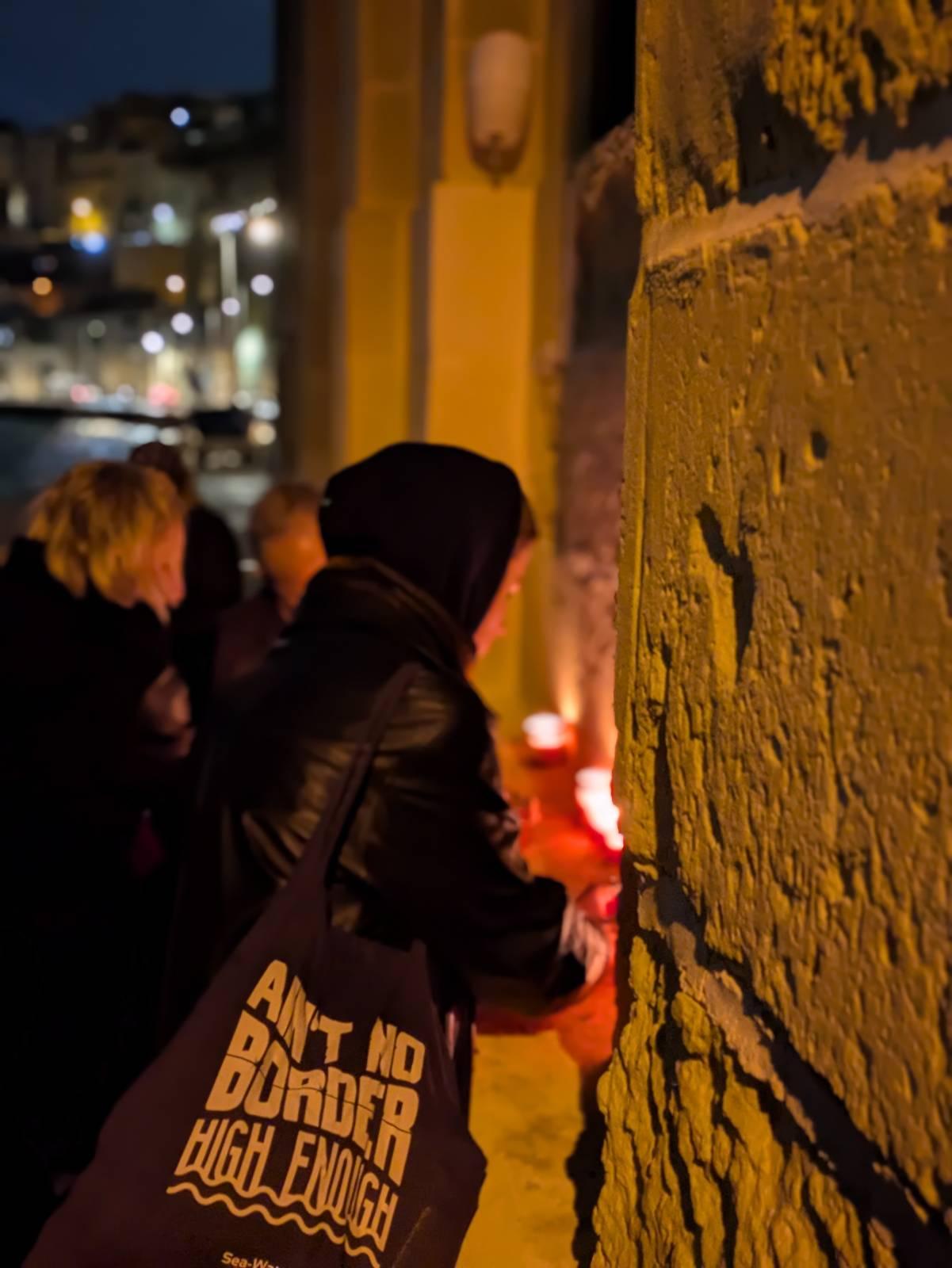
More recently, we have noted increasing involvement in mobility struggles at sea from within Malta. Over the past five years, transversal alliances have emerged and solidified between the civil fleet and Maltese advocates and activists through existing networks, strategic litigation around shipwrecks and pushbacks, and activist initiatives such as the CommemorActions held annually in Malta and around the globe, the El Hiblu 3 campaign and the Malta Migration Archive. These collaborations involve sharing information and raising awareness, allowing Maltese actors to directly confront Malta’s non-assistance at sea. In this way, the feeling of distance to what occurs at sea is changing. Maltese activists move within and stretch existing social and political boundaries, enacting a different sense of islandness, one that is not insular but that creates connections to others elsewhere through forms of solidarity that exceed an exclusionary, territorially-bounded sense of being “Maltese.”
Maurice Stierl received funding by the Deutsche Forschungsgemeinschaft (DFG, German Research Foundation) – SFB 1604 – 501120656.
Ċetta Mainwaring is currently funded by a UKRI Future Leaders Fellowship.
Any comments about this post? Get in touch with us! Send us an email, or find us on LinkedIn and BlueSky.
How to cite this blog post (Harvard style):
Ċ. Mainwaring and M. Stierl. (2025) Migration and Activism on the Maltese Archipelago . Available at:https://blogs.law.ox.ac.uk/border-criminologies-blog/blog-post/2025/09/migration-and-activism-maltese-archipelago. Accessed on: 24/10/2026Share:
With the support of