Looking for Jesús: Transforming Religious Practices and Grief at the U.S-Mexico Border
Posted:
Time to read:
3 Minutes
Guest post by Mónica Ruiz House. Mónica Ruiz House is a 2025 Marshall scholar who studies the militarization of the U.S-Mexico border. Her writings on the borderlands walk the line between academic and creative non-fiction, a nod to the Mexican-American women before her who wrote for the ‘space in-between.’ This blog post is part of Border Criminologies' From the Field series.
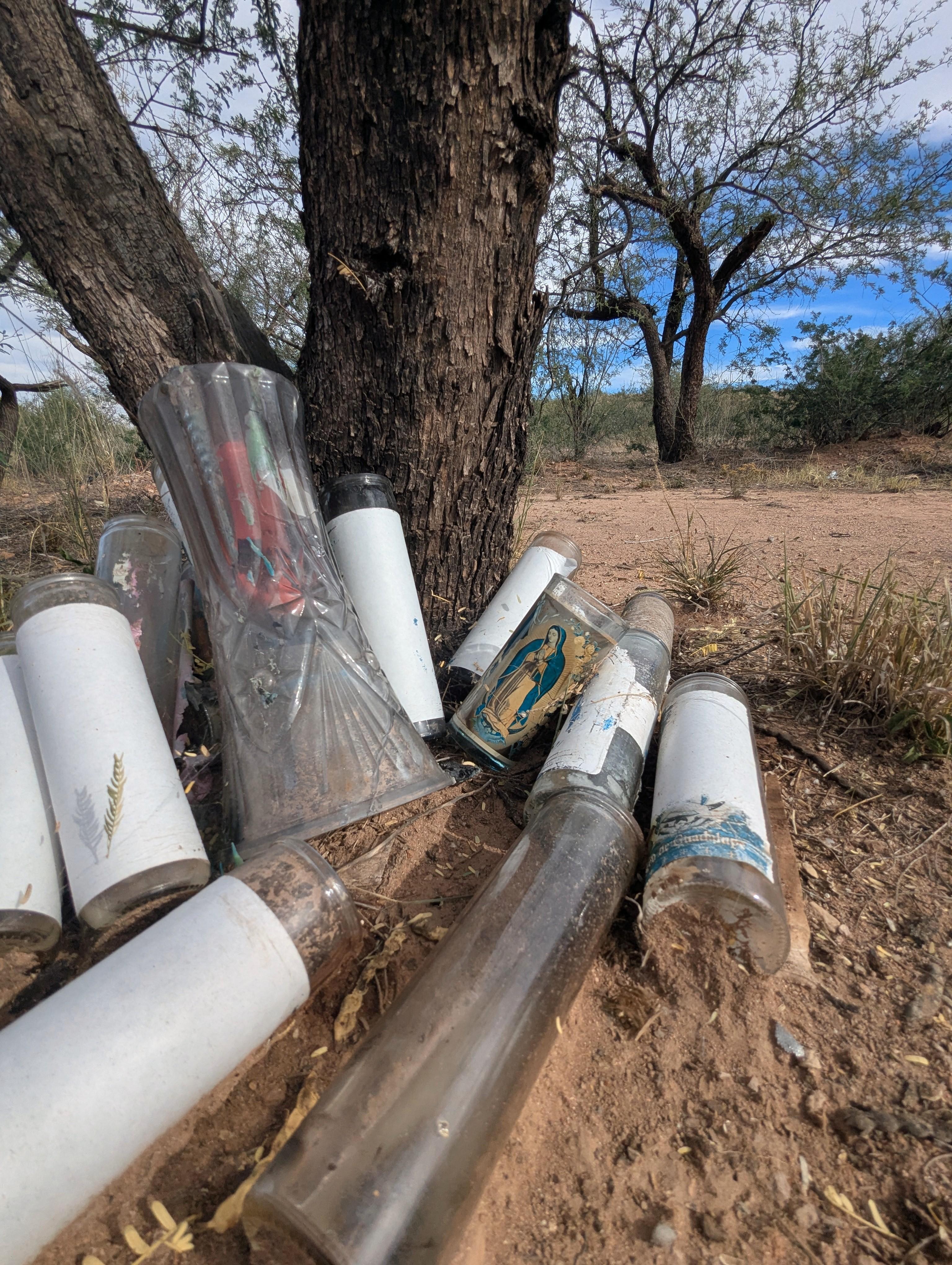
The Tohono O'Odham poet Ofelia Zepeda has long written about the U.S-Mexico borderlands. That this space is beyond the reach of saints – and that their promises are in many ways, “useless” on Indigenous land. For migrants lost here, Hail Marys offer comfort but cannot offer water in the desert.
And maybe Zepeda is right. This is a landscape governed by an entirely different spiritual logic that does not recognise the demands of imported and imposed gods. Since 1998, over 8,000 migrants have died along this route, with many of them surrounded by the Catholic talismans that were meant to protect them.
As a humanitarian who has spent the past three years looking for migrants who have disappeared along the U.S-Mexico border, I echo this logic with bitterness. I find myself asking, “What good is a foreign god here?” This is an inquiry that is equal parts informed by the 150 miles I have walked along this migrant trail; my own faith tradition as a Catholic, Mexican-American woman; and my study of criminology as a masters student at Oxford.
The answer lies not in what religion can or cannot do — but rather, in the meanings it provides. The migrant trail devours both religious bodies and objects. Yet it also gives back, shaping faith and even birthing new practices.
The ethnographer Hirai describes how journeys refashion religious meaning into a “puente mediante,” or analytical bridge. But this ‘bridge’ is as embodied as it is interpretive. Humanitarians build altars out of cactus remains, adopt migrant talismans as their own, and learn to pray in a language that is not their mother tongue. In this way, the transformation of Mexican-Catholicism makes the shared grief of the borderlands intelligible.
With this framework in mind, I invite you to come looking for Jesús with me.
Looking for Jesús
We call it search and rescue.
But in practice, it’s always search and recovery. Together, searchers will sweep the scraggly underbrush of the Sonoran Desert. We look for what little remains of a person who has been missing for several months: a femur bone, a disemboweled torso, a severed hand blackened in the sun. This desert has a way of disappearing the dead, if they are found at all.
But today we are lucky. We find most of Jesús about twelve miles north of the border. My first reaction is relief — that at least now, he can be laid to rest.
My second reaction is to mix Hail Marys with fuck-you-God. I want to howl at the figurine of Our Lady that lays at the foot of his gravesite. But her plastic face is unmoving and seemingly unperturbed by my grief.
Our search leader doesn’t react though. Instead, he quietly picks up bits of greenery that have weathered Arizona’s dry season. Using the skeleton of a porous cactus as a base, Nel assembles a borderlands flower arrangement that will form the base of our altar.
I watch as he opens his canteen, raises it in a solemn toast, and pours water over the parched earth.
Ali, another veteran humanitarian, follows suit. She takes her beloved tobacco leaves and scatters them to the four winds.
My hands shake as I reach to untie the scapular around my neck to add it to the makeshift ofrenda. It bears a familiar inscription, a promise that the Virgin Mary once gave to the friars of Mount Carmel:
WHOSOEVER DIES WEARING THIS SCAPULAR
SHALL NOT SUFFER ETERNAL FIRE
Now, this promise has become favoured along the migrant trail. It gave me this tradition and now I return it to this land.
Once the desert has claimed its offerings, the six searchers embrace. Our hands run sticky with snot and tears. I can feel Ali’s heart through the palms of her hands. I wonder if she can feel my erratic heart too.
I offer an Ave María. And another to San Miguel.
Nel, in his limited Spanish, whispers a prayer of his own as he passes around a photo of Jesús for us to bless: “Que le vaya bien.”
When we finally separate, we split rolls of orange fluorescent tape to mark the grave. These death ribbons come to dot willowy Ocotillo trees.
Later, Nel will call the sheriff and Ali will call Jesús’s family.
We are not our Lady of Mount Carmel. But maybe our work does offer an earthly answer to her promise. Religion does not undo dying, but it provides us a framework for mourning the dead — a framework that, at the very least, allows water to mark Jesús’s final resting place. It promises that no one else who walks the same path he did dies in the desert. And that his body no longer burns in the hot sands of the Sonoran.
In this way, we have adopted the prayers of those who have walked before us.
Any comments about this post? Get in touch with us! Send us an email, or find us on LinkedIn and BlueSky.
How to cite this blog post (Harvard style):
M. Ruiz House. (2025) Looking for Jesús: Transforming Religious Practices and Grief at the U.S-Mexico Border. Available at:https://blogs.law.ox.ac.uk/border-criminologies-blog/blog-post/2025/12/looking-jesus-transforming-religious-practices-and. Accessed on: 24/10/2026Keywords:
From the Field
Share:
With the support of