Unpacking transparency: researching migration and border governance through Freedom of Information Requests
This post is part of a themed series focusing on methodological reflections on studying border policing. This blog series is a product of the Thematic Group on Border Policing & Emotions. Those interested in joining the group or staying updated on events and initiatives are warmly invited to contact Maartje van der Woude via email at m.a.h.vanderwoude@law.leidenuniv.nl.
Posted:
Time to read:
3 Minutes
Amalia Campos-Delgado is Assistant Professor of Law & Society at the Van Vollenhoven Institute for Law, Governance and Society, Leiden University. She holds a PhD in Politics from Queen’s University Belfast and is member of the Mexican National System of Researchers -SNI, Level 1. Her research interests include border securitisation, externalisation of borders, immigration-control bureaucracies, and migrant care work.
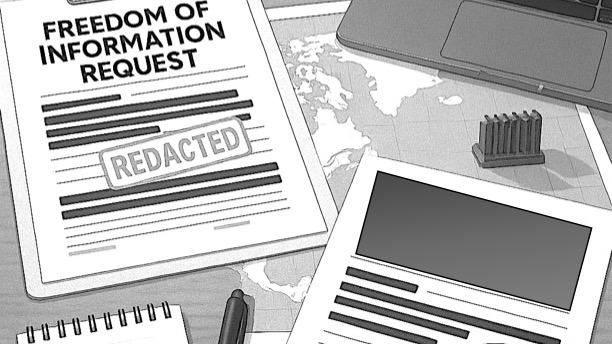
Mexico is often praised for its robust legal framework on the right to information. As of 2023, it ranked second globally for the formal strength of its access to information regime. Constitutionally enshrined and elaborated through detailed legislation, this right was, until December 2024, implemented by an autonomous and decentralised body, the Instituto Nacional de Transparencia, Acceso a la Información y Protección de Datos Personales (INAI), responsible not only for the processing of Freedom of Information (FOI) requests but also for ensuring compliance by federal agencies and providing mechanisms for appeal and review. Yet, as I have learned though long-term engagement with FOI as a research method, the gap between formal guarantees and meaningful access can be wide, often obscured by technical setbacks and politically charged barriers.
Over the past decade, I have worked with FOIs to investigate the often-opaque enforcement of migration control in Mexico. Rather than treating it simply as a tool for retrieving data, I have approached it as a research method in its own right, one that uses the state’s own practices of documentation to problematise how irregularised mobility is governed. This has allowed me to trace governance processes, from the seemingly mundane routines of bureaucratic operations to broader political economies underpinning migration enforcement. Drawing from this experience, in this post I reflect on the potential and challenges of FOI as a method on migration and border control research.
Knowing the Maze
Using FOIs as a method of data inquiry means embracing the epistemic principle that data is constructed in the process of research, and that its production is embedded within specific power-knowledge dynamics. While this involvement in the construction of the data may be less visible when using FOIs, the reality is that the framing of a request shapes the response. Crucially, for this method to be effective, a degree of pre-knowledge is required: what is likely to be available, where it might be located, within what time frame, what might be withheld, and how to phrase queries. In this sense, the researcher does not merely access information but actively participates in constructing the object of inquiry.
Obtaining information through FOI involves navigating a bureaucratic maze where delays, refusal, and incomplete responses are routine. If there is an emotion that characterises the use of FOI in research, it is a combination of frustrated perseverance and tedious obstinacy. As Mike Keen observed, “several hundred pages of information released may yield only one or two useful documents, if that”, a process that can easily lead to exhaustion, frustration, and even despair. Yet, it is precisely this emotional persistence that fuels critical inquiry; the frustration, the obsession with fragments, and the fleeting satisfaction of finding that one crucial page. Without this intellectual and affective investment, the method would falter, succumbing to bureaucratic setbacks, delays and obstructions. For instance, formatting barriers, such as the release of spreadsheets in illegible scans, were a near-constant in the files I received. In the end, these forms of technocratic obfuscation serve to delay, dilute or deflect scrutiny.
Mapping the outcomes of the requests, those fulfilled, technically obstructed, delayed, or denied, allow us to zoom out and see patterns of opacity. In my research, an example of how silences also speak was the response regarding the absence of records on mutinies and acts of organised resistance in Mexican detention facilities, despite these events being referenced by agents and widely documented in the media. This highlights that the absence of records, the refusal to acknowledge certain procedures or events, and the classification of documents are not neutral acts. These silences, too, reveal the state’s strategies for constructing the illusion of accountability and control.
The politics of visibility
While FOI is typically viewed as a means of uncovering what the state seeks to hide, it can also serve to scrutinise what the state deliberately chooses to publicize. Visibility in migration governance is rarely neutral, rather it is often carefully staged to covey particular narratives of legitimacy, efficiency, and control. In this sense, FOI becomes a powerful instrument not only for challenging secrecy but for unpacking the performativity of visibility in statecraft.
An example of this can be seen in the 2019 mass expulsion of 311 Indian nationals from Mexico, which the Mexican state framed as a diplomatic and enforcement triumph. The deportation was accompanied by a media spectacle and official statements emphasising international cooperation and deterrence. For me, the highly orchestrated nature of the event was, in fact, an invitation to unpack the behind-the-scenes dynamics, drawing attention to all the operational and financial manoeuvres behind this expulsion. This example highlights the potential of FOIs to problematise the surface-level narrative constructed by state actors, revealing the crafted visibility and offering glimpses to operational dimensions often hidden from public view.
FOI, then, is not just about accessing information; it is about navigating the tensions between what the state reveals and what it obscures, and understanding the politics behind those decisions. Its promise of transparency is frequently undercut by withholding, formatting obstacles, and strategic ambiguity. The request process itself, along with the shifts around it, such as those currently unfolding in Mexico – the delays, redactions, or outright refusals – are themselves data. They reveal not just the state’s boundaries of accountability but also the image and illusions the state constructs about itself.
Any comments about this post? Get in touch with us! Send us an email, or find us on LinkedIn and BlueSky.
How to cite this blog post (Harvard style):
A. Campos-Delgado. (2025) Unpacking transparency: researching migration and border governance through Freedom of Information Requests . Available at:https://blogs.law.ox.ac.uk/border-criminologies-blog/blog-post/2025/09/unpacking-transparency-researching-migration-and-border. Accessed on: 24/10/2026With the support of