Book Review: Supply Chain Justice: The Logistics of British Border Control
Posted:
Time to read:
4 Minutes
Guest post by Holly Bird. Holly Bird is an ESRC-funded PhD student at the University of Glasgow and a fellow of the Stuart Hall Foundation. She holds an MSc in Criminology and Criminal Justice from the University of Oxford and an LLB from the University of Edinburgh.
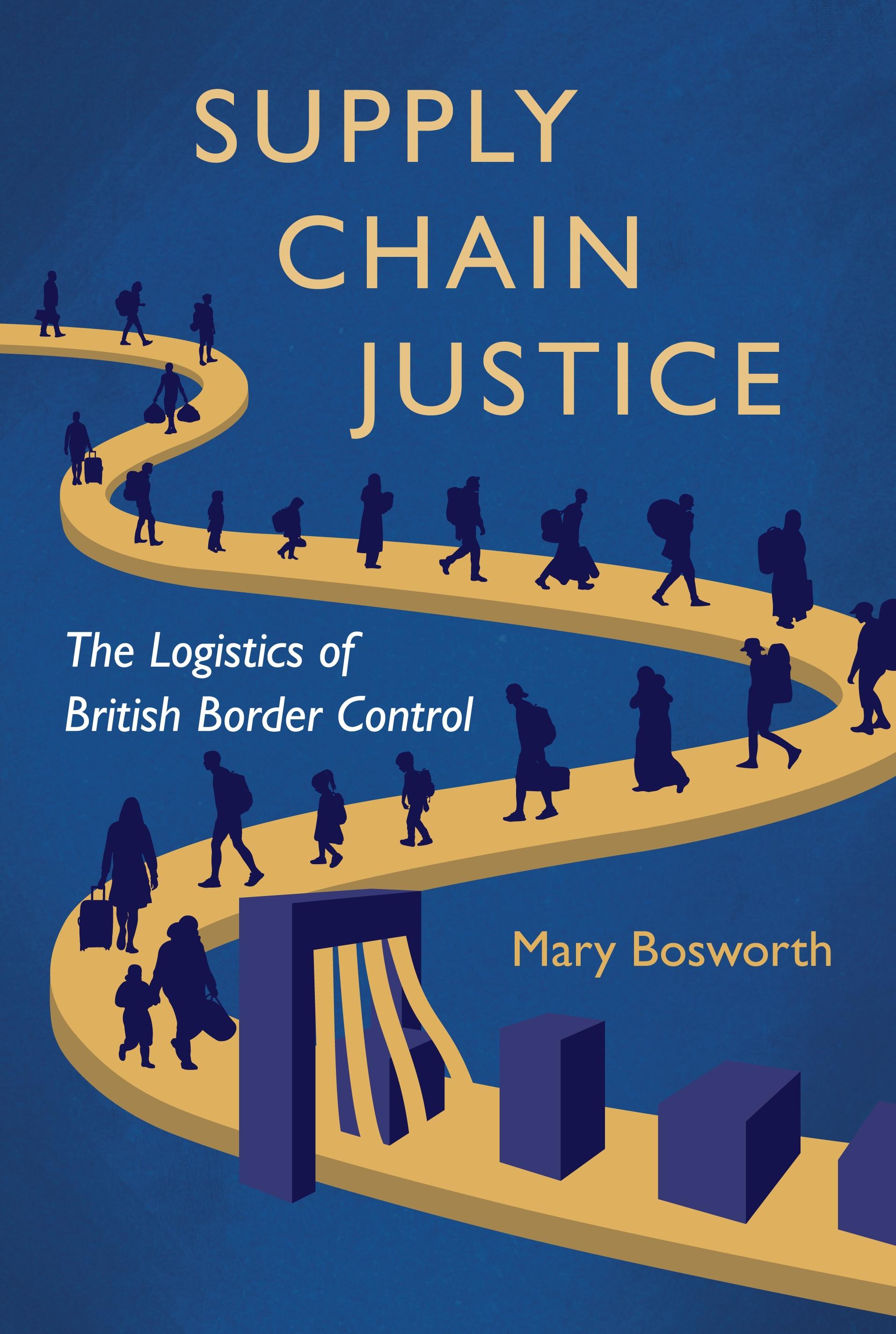
Review of: Supply Chain Justice: The Logistics of British Border Control by Mary Bosworth (Princeton University Press, 2024)
Professor Mary Bosworth’s 2024 book, Supply Chain Justice: The Logistics of British Border Control, offers a vivid and analytically rich account of the UK’s ‘immigration detainee escorting system’, situating extensive empirical research within scholarship drawn from across a number of disciplines in order to understand and illuminate the workings of the border control ‘supply chain’. Outsourced entirely to private sector ‘partners’ by the Home Office and run, in essence, like any other business supply chain, the system Bosworth explores ‘is a joint enterprise; a large-scale infrastructure project that, in redistributing people, shifts public funds into corporate balance sheets’ (p4).
Since the publication of ‘Border Control and the Limits of the Sovereign State’ in 2008, Bosworth has written widely about the UK’s border control and detention system and its connections with criminal justice, punishment, citizenship, race, and gender. In 2013, she founded the Border Criminologies research centre at the University of Oxford (where she is currently co-director)network; the following year, ‘Inside Immigration Detention: Foreigners in a Carceral Age’ (2014), her first full-length book on the subject, was published. Responding to the dearth of empirical work on the logistics of border control in the UK, Supply Chain Justice shifts focus from within immigration detention facilities to the complex systems and public-private relationships that facilitate detention and deportation.
Supply Chain Justice is based on months of observation of the various interconnected components of the border control system, as well as dozens of interviews and conversations with high-level managers and precariously employed staff members in a variety of roles, in-depth staff surveys, and documentary and data analysis from both Home Office and private sector sources. Bosworth attends meetings between the Home Office and its corporate partners, participates in sometimes intensive and physical staff training sessions, accompanies escorting officers on long-distance trips across the country, visits seventeen different short-term holding facilities and holding units, and witnesses detainees become deportees as they are transferred between detention facilities and finally onto a plane. Part of what makes the book so compelling - for academic and non-academic audiences alike - is the way that the emotional, ethical, physical, and practical difficulties faced by the research team remain at the surface of the text. The author’s reflections and insights into the messy and complex ‘behind the scenes’ part of ‘doing’ the research is narratively intertwined with the analysis and discussion of the research data.

The book’s introduction, ‘Manufacturing the Border Control Supply Chain’, is prefaced by a two-page list of abbreviations used by the Home Office and its private sector partners - from ‘ARC’ and ‘C&R’ (Alarm Receiving Centre / Control and Restraint) to ‘UASC’ and ‘WFJ’ (Unaccompanied asylum-seeking child / Western Jet Foil) - which sets the scene for the disturbing combination of bureaucracy and cruelty present throughout the book’s six chapters, underpinning the UK’s border control system at every stage of the ‘supply chain’. One of the key tensions within the system is that it is run, as Bosworth is informed by a senior manager, ‘[as] a logistics business’ (p22) - and yet, as she is told elsewhere ‘people are not packages’ (p22). This contradiction is evident not only from an operational or functional perspective, but is also regularly expressed by staff, whose conflicting and inconsistent feelings towards the work that they do is thoughtfully situated and explored within a local, national, and international economic context.
The book’s first chapter focuses on the ‘technical infrastructure’ of the system - on the work done at OCCs (Operational Control Centres) in Belfast, London, and Manchester, and at the overseas escorting control centre at Gatwick Airport - and the high-tech (and low-tech) ways that the overall system is operationalised, monitored, and monetised through data. In chapters two and three, Bosworth turns towards sites of short-term detention: the ‘short-term holding facilities’ at Manston and Dover; other ‘holding units’ based at airports and asylum and immigration reporting centres; and ‘residential short-term holding facilities’ in Manchester, Belfast, and Swinderby. In chapter four, Bosworth accompanies staff ‘on the road’, moving detainees between holding facilities, prisons, immigration removal centres, police stations, and airports. The final two chapters focus on what is ‘in theory, the end point of the border control supply chain’ (p113) - enforced removals and deportations, carried out via scheduled and charter flights.
Supply Chain Justice exposes and problematises the failures, tensions, and inhumanity built into the UK’s border control system. It is an impressive book that scrutinises ‘the interconnections between capital and border control’ (p61) on multiple levels, bringing a human and quotidian dimension to macro-level themes such as neoliberalism, privatisation, and outsourcing; labour and work; the violence of data, automation, and bureaucracy; the impact of doing emotionally demanding and ethically difficult research; and more. At no point, however, does it feel like the book is trying to do too much - rather, Supply Chain Justice serves as a productive starting point for further scholarship and action. It is a timely and necessary piece of work for those within criminology and its adjacent academic disciplines just as much as it is for journalists, policymakers, third sector workers, lawyers, and activists. As Bosworth shows, the ‘bureaucratic processes [within the system] offer a structure which can yield profit, while also depoliticising and normalising this work [of border control]’ (p158). As she further points out, ‘For those employed to do the work, these same logics and structures keep their pay low, limiting their working conditions and job security’(ibid.). Supply Chain Justice demonstrates the value of making connections between border control and ideas of work and labour academically and intellectually, but also urges us to consider the ways in which these connections open up ‘the possibility of new alliances’ (p154) when it comes to ‘organising, imagining and building alternative approaches’ (p167) and resisting the violence and injustice of border control in the UK and beyond.
Free image on Unsplash: https://unsplash.com/photos/a-warehouse-filled-with-lots-of-boxes-and-pallets-VnMbc9Szs-E
How to cite this blog post (Harvard style):
H. Bird. (2025) Book Review: Supply Chain Justice: The Logistics of British Border Control . Available at:https://blogs.law.ox.ac.uk/border-criminologies-blog/blog-post/2025/11/book-review-supply-chain-justice-logistics-british. Accessed on: 19/10/2026Share:
With the support of