Book review: The ‘invisible man’: Administrative detention in Italy as a vacuum of fundamental rights
Sunjay Gookooluk’s testimony reveals institutional violence in Rome's Ponte Galeria detention centre – demonstrating that closing the facility is a compelling legal and human rights imperative
Posted:
Time to read:
4 Minutes
Guest post by Ludovica Grassi. Ludovica is a trainee lawyer in criminal and immigration law and a master’s student in Forensic Sciences at Sapienza University of Rome. Her research focuses on the interconnection between criminal procedural law and migration.
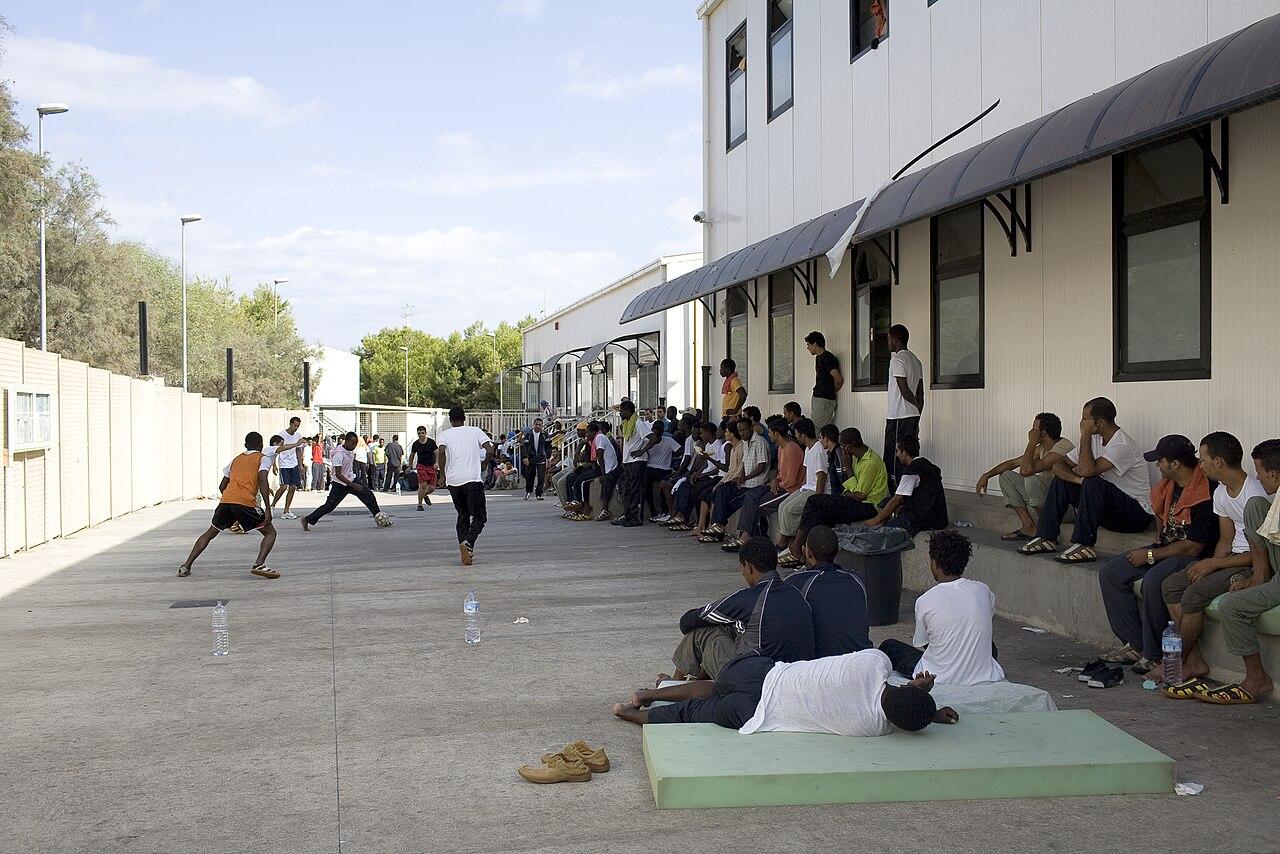
“They came in while it was still dark in the large dormitory and took him while he was asleep. He was a twenty-year-old Tunisian man, a drug user undergoing methadone treatment. They pinned him to his bed and tied his hands. We didn’t see him again, but shortly after, a group of twenty officers – police, Carabinieri, and military – came back in, wearing gloves and carrying batons. They stormed Dormitory 3B, where some people had barricaded themselves inside. They made everyone come out and take off their shirts. They stayed inside for a while. One young man, to avoid being taken away, had wrapped razor blades around his neck. This time they left him there, but they’ll be back for him.”*
This is just one of the daily episodes Sunjay Gookooluk describes in his book “Diario di un invisibile. Nell’inferno di un centro di detenzione amministrativa italiano” (“Diary of an Invisible Man. Inside the Hell of an Italian Administrative Detention Centre”) published in 2026, the first literary testimony from inside the Italian administrative detention system. As a detainee held at the Rome’s Ponte Galeria CPR (the denomination used for Italian administrative detention centres) between 2014 and 2015, he felt like an “uprooted plant” just condemned to survive in “a sort of huge labyrinth made of concrete, iron and large bars”.
Arriving in Italy from Mauritius in 1989, Gookooluk built his life in the country, where he also became the father of two children. Precarious living conditions led him into criminalised activities and to long periods of imprisonment in Rome's Rebibbia prison. While incarcerated, he studied Italian, obtained a diploma, and wrote poetry that received literary recognition.
Upon his release, he was stopped during a routine police check and taken into custody under an expulsion order based on his designation as a "socially dangerous" person, a legal category rooted in the fascist-era Codice Rocco (the Rocco Code, Italy’s current penal code) that allows broad judicial discretion and underpins Italy's dual-track system of penal sanctions and security measures.
He was then transferred to Rome's Ponte Galeria CPR – one of Italy's first and largest administrative detention centres, which he describes as a "modern lager” (a term referring to Nazi concentration camps). Inside, he became number 8703, a profound erasure of personal identity. Writing while confined, despite the practical obstacles and restrictions on possessing writing materials, became an act of resistance for Gookooluk against the institutional invisibility imposed upon detained migrants.
His account offers a detailed reconstruction of everyday life inside the CPR, revealing degradation and institutional violence while analysing how the privatisation of the centres impacted their management. Gookooluk describes detainees being provided with expired or inadequate food, enduring chronic hunger and the cold of winter, paper bed sheets, and reportedly insufficient healthcare, which was frequently reduced to the indiscriminate administration of psychotropic medication as a response to any physical or psychological complaint. Throughout the whole book, time is described as always suspended: people seem to be reduced to shells awaiting the failure of their immigration and life plans.
Acts of resistance – including sewn lips, the ingestion of razor blades and the burning of mattresses inside detention cells – appear as desperate attempts to reclaim one’s own voice within a system designed to strip detainees of individuality and autonomy. The centre itself is described as geographically isolated from the surrounding urban area and physically enclosed by high walls, military vehicles, sophisticated alarm systems, surveillance cameras, iron fences and imposing bars. A reality designed to isolate, control and discipline.
Gookooluk was eventually released from the CPR, due to the expiration of the maximum time limits prescribed by law (the current limit set for administrative detention is 18 months). But he was once again detained in the same facility after being summoned to police headquarters to collect a formal notice. This second period of detention was subsequently confirmed unlawful by the Italian Supreme Court of Cassation.
Revealing structural harms in Italy’s detention centres
Beyond reporting isolated episodes of hardship, this testimony documents structural features of Italy's administrative detention regime. The account questions the democratic legitimacy of a system that imposes severe restrictions on individual liberty without a criminal conviction. It also reveals violations of human dignity through inhuman and degrading treatment, in breach of Articles 2 and 3 of the European Convention on Human Rights, Articles 1 and 4 of the Charter of Fundamental Rights of the European Union and the guarantee of personal liberty enshrined in Article 13 of the Italian Constitution.
Among the most emblematic cases associated with Rome's Ponte Galeria CPR is that of Wissem Ben Abdellatif, a 26-year-old Tunisian man, who suffered a fatal cardiac arrest after being kept under physical restraint and sedation for five consecutive days, first at Grassi Hospital in Ostia and then at San Camillo Hospital in Rome.Even more striking is the death of Ousmane Sylla, the 22-year-old from Guinea who died by suicide while detained in February 2024.
The persistence of these events also reveals a deeper contradiction between the existence of the Rome’s Ponte Galeria CPR and the civic identity of the City of Rome, since it publicly identifies itself with the protection of human dignity and fundamental rights. Indeed, in March 2025 a group of sixteen university professors filed a writ of summons before the Civil Court of Rome, seeking – through an “actio popularis” by stepping into the shoes of the Municipality of Rome – a court order requiring the Ministry of the Interior to close the Rome’s Ponte Galeria CPR and to provide compensation for the damage inflicted on the Capital’s civic identity. They established through serious, precise, and consistent circumstantial evidence that this violation has adversely affected the identity of the Roman community.
This contradiction is no longer merely symbolic, since it raises pressing legal and political questions about whether a system that repeatedly exposes individuals to such risks can be reconciled with the constitutional principles upon which the Italian Republic is founded. Nearly a decade before the death of Ousmane Sylla, Sunjay Gookooluk had already documented an environment in which the body became the object of constant surveillance and control, where despair frequently manifested itself through many forms of self-inflicted harm.
The continuity between what Gookooluk’s lived and the other tragedies which have occurred years after his detention demonstrates that these are not exceptional failures but recurring manifestations of a detention model whose harmful effects have long been foreseeable.
The Rome Guarantor for Persons Deprived of Liberty reportpublished in July 2026 confirms persistent structural deficiencies in Rome’s CPR, including squatting toilets in the women’s section, poor sanitary conditions in the men’s section, lack of natural light, inadequate sleeping facilities, and the absence of lockers for personal belongings.
Through his chilling account, Gookooluk shows us that closing the facility is not merely a political option, but an increasingly compelling legal and human rights imperative.
*Translated by the author.
Any comments about this post? Get in touch with us! Send us an email, or find us on LinkedIn, Bluesky and Instagram.
How to cite this blog post (Harvard style):
L. Grassi. (2026) Book review: The ‘invisible man’: Administrative detention in Italy as a vacuum of fundamental rights. Available at:https://blogs.law.ox.ac.uk/border-criminologies-blog/blog-post/2026/07/book-review-invisible-man-administrative-detention. Accessed on: 17/10/2026Share:
With the support of