Respite and radical alternatives: six days on a rescue ship in the Mediterranean
Between territories and hostile systems, survivors and crew on a rescue boat imagine radical alternatives through care
Posted:
Time to read:
6 Minutes
Post by Melissa Pawson. Melissa is managing editor of the Border Criminologies blog. She also works as a freelance journalist, covering hostile border policies and stories of migration across the UK, Jordan, Syria, Turkey, Greece and Tunisia. She has written for Al Jazeera, The Independent, Middle East Eye, The New Humanitarian and openDemocracy. She holds a master’s degree in Conflict Studies and Human Rights from Utrecht University.
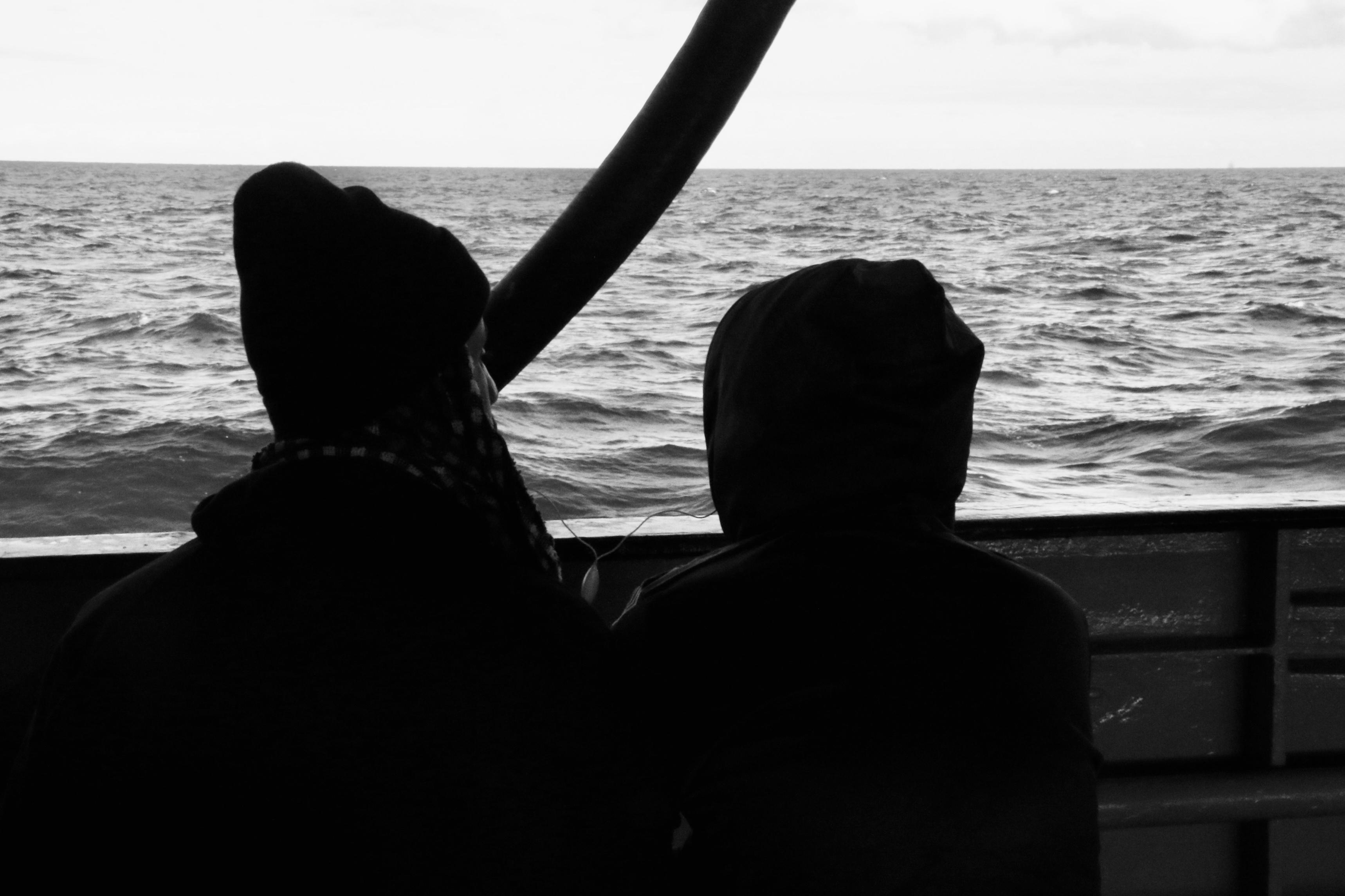
Grey blanket wrapped around his shoulders, Michael looks out to sea. He sits quietly on a bench, for all the world as if he's in a waiting room. Around him, other men huddle in identical blankets. Some are deep in conversation; some play cards or listen to music in worn wire headphones; others sleep. Waves fizz and lap against the boat as we make our steady way north to Italy.
As a journalist, I accompanied Humanity 1, a German-flagged civil search and rescue boat on its trip across the Mediterranean in November 2025. In that time, the crew rescued 160 people from two wooden boats in distress, north of the Libyan coast. On the six-day journey back to Italy, we lived in a liminal space together, neither here nor there, between lands and jurisdictions, between life before and after.
Humanity 1 is part of the ‘civil fleet’ – over a dozen citizen-run boats which patrol the crossing from North Africa to Europe, rescuing people in distress. The organisations fill a vital gap left by European coast guards since Italy ended its search and rescue operation, Mare Nostrum, in 2014.
While on board, we moved through the ‘middle sea’, which Jessica Sciubba describes as “a locus of in-betweenness, as an unstable and multi-directional space of encounter/ clash.” We felt the “encounter/clash” of this “in-betweenness” especially during the rescues, and when a nearby Libyan coast guard (LCG) vessel appeared on the horizon – well known for their violence towards rescue crews and people in distress.
Once these dangers had passed, we settled into the quiet, vast ‘in-between’ of international waters. The survivors on board had left behind horrific experiences in Libya and their home countries. And they had not yet arrived in their unknown futures, which were likely to be characterised by bureaucracy, the burden of telling and re-telling their stories, and dehumanising experiences in Italy's asylum system. In between those temporalities and territories, the care provided by crew allowed for respite and dignity to emerge. In doing so, they enacted radical alternatives to state brutality.
Respite in the in-between
Michael (a pseudonym) was rescued by Humanity 1’s crew along with 84 others on 26 November. The group were spotted in an unseaworthy, overcrowded wooden boat around 90 miles north of Libya, attempting to cross to Italy. They came with no lifejackets and few belongings. The journey is hundreds of miles long and extremely deadly – over 26,000 people have died or gone missing on the route since 2014, and that’s likely an underestimate. More than 1,000 people have died so far this year – many of them caught in a deadly cyclone in January.
I met Michael out on deck. He was so softly spoken, I had to strain to hear him over the wind and waves. He told me he’s 25 and from South Sudan, and that he fled instability and conflict in his home country in 2017, only to encounter a war zone in Sudan, before making his way to Egypt, where he lived for several years before leaving for Libya. He spent two years in Libya, where he was kidnapped twice by militias, and detained once by Libyan authorities, when they caught him trying to cross the sea. Each time, luck and desperation helped him escape imprisonment, avoiding the hefty ransoms usually demanded by militias and authorities alike for release.
After interception by the LCG, conditions in the prisons they were held in were often dire. “We regularly went without food from 10am to 10pm, and were only given water once a day,” said Michael. He and other prisoners were forced to work without pay, cleaning guards’ weapons, an airport and even the officers’ personal mansions. It was while Michael was cleaning one of these ‘villas’, that he saw his chance to make a run for it.
“There is no difference between hell and Libya,” he said. “Freedom is not thinking about Libya.” As we spoke, we continued to move steadily north, his words and the boat taking him further and further away from the site of his experiences.
Ahmed (a pseudonym), from Sudan, also expressed a freedom in ‘forgetting’. During his time on the rescue boat, he expressed relief at being able to “forget” the worst of his experiences at home and in Libya. “It was a really hard journey and I went through very difficult times in Libya, but I never gave up on reaching my dreams,” he added.
Ahmed and Michael described a process reminiscent of Nietzsche’s “active forgetting”, a positive force by which they could leave the horrors of their experiences firmly in the past and “banish trauma”. This banishment was certainly tentative, as much as it was temporary. All around us, hostile systems cast shadows: our journey to port in Italy was so long precisely because of Italy's policy of assigning distant ports to rescue ships. We could’ve reached a closer port in just 13 hours, instead of the six-day trip that we then embarked on.
And soon after, we witnessed an LCG vessel (a boat donated by Italy through an EU-funded scheme) just before it intercepted a boat in distress, most likely funnelling people back into brutal detention centres: carceral spaces that many of the survivors on board with us were grimly familiar with. Three days later, that same LCG patrol boat fired shots in the direction of another rescue boat like ours, the Louise Michel.
Even so, for those six days, these hostile systems touched the inner world of our boat in a distant way, the world of the land still far off, 'out there'. Together, ‘forgetting’ and waiting suspended the passengers in an alternative temporal space: the present moment characterised by the fact that it existed in between others. Michael and Ahmed described this temporal space as “freedom” – but together with the context, which made it short-lasting and fragile, it rather looked something like respite.
Enacting alternatives through care
The respite described does not overwrite the intense frustration that many survivors also experienced. Over those six days, they were unable to speak to their families to assure them they were safe and headed to Europe, and they had no answers about what their fates would be once they reached Italy. Many on board faced the threat of deportation after arrival, due to being from countries designated ‘safe’, and propelled by the recent rushed vote on the European Returns Regulation. It was getting colder every day, and the blankets and heat lamps weren’t enough to cut through the late November nights on deck where they slept.
I felt acutely aware of the importance of the dignity and kindness provided by the crew in this uncertain space – especially when it couldn’t be guaranteed elsewhere, not before or after. Here was something called ‘pirate care’ in action, brought forward in Graziano, Mars and Medak’s 2025 book, which details “the everyday defiance of nurses, cooks, friends, programmers… who join together to practice care dangerously.”
This kind of care is also about imagining and bringing about a different kind of society: “the trajectory of these practices is revolutionary… in addition to refusing artificial borders imposed by Empire, they show that the world does not need to be this way and they prefigure alternatives.”
The ‘pirate care’ I witnessed on board Humanity 1 was characterised by both “everyday defiance” and imagining/ enacting alternatives. Everyday defiance was shown through care and kindness, which afforded survivors dignity and respite that could not be guaranteed elsewhere. And alternatives were enacted through a series of wider organisational actions: conducting rescues despite detentions and obstructions by Italian authorities, refusing orders to coordinate with Libyan coast guard authorities, and calling out state policies of externalisation, abandonment and ‘leaving to die’. Through these actions, civil society step in to enact legal responsibilities of rescue in place of state failures and selective invocation of laws, thereby calling radical alternatives into being at sea.
On 1 December 2025, we finally arrived in port, and I watched as the survivors were met by a dizzying array of agencies – police, the Italian Red Cross, local journalists and health workers in hazmat suits. The next day, Humanity 1 was detained in port. The decision was later suspended by a judge in Chieti, only for the vessel to be detained again two months later.
Humanity 1, and other vessels in the civil fleet, have since set sail again. Together in the middle sea, activists and people on the move continue to carry out radical alternatives to state-sanctioned abandonment and brutality. This starts with giving respite from that violence.
This blog post is adapted from a paper presented at Seas of (im)mobility, solidarity, and resistance at Aston University on 12 February 2026.
Any comments about this post? Get in touch with us! Send us an email, or find us on LinkedIn, Bluesky and Instagram.
How to cite this blog post (Harvard style):
M. Pawson. (2026) Respite and radical alternatives: six days on a rescue ship in the Mediterranean. Available at:https://blogs.law.ox.ac.uk/border-criminologies-blog/blog-post/2026/06/respite-and-radical-alternatives-six-days-rescue-ship. Accessed on: 17/10/2026Share:
With the support of