One body: a decade of deaths in the Central Mediterranean
A woman’s body found at sea is part of a decade of evidence of structural exposure to death, maintained by state policies
Posted:
Time to read:
5 Minutes
Guest post by Dominika Wanczyk and Marta Sánchez Dionis. Dominika is Head of Post-Rescue at SOS MEDITERRANEE, an international maritime and humanitarian search and rescue organisation operating in the Central Mediterranean. She was on board the Ocean Viking in January 2026, when the woman whose story opens this article was recovered from the sea.
Marta is Advocacy Coordinator in the International Advocacy team at SOS MEDITERRANEE. She is a co-author of Into the Storm (2025), SOS MEDITERRANEE's report on ten years of search and rescue operations in the Central Mediterranean.
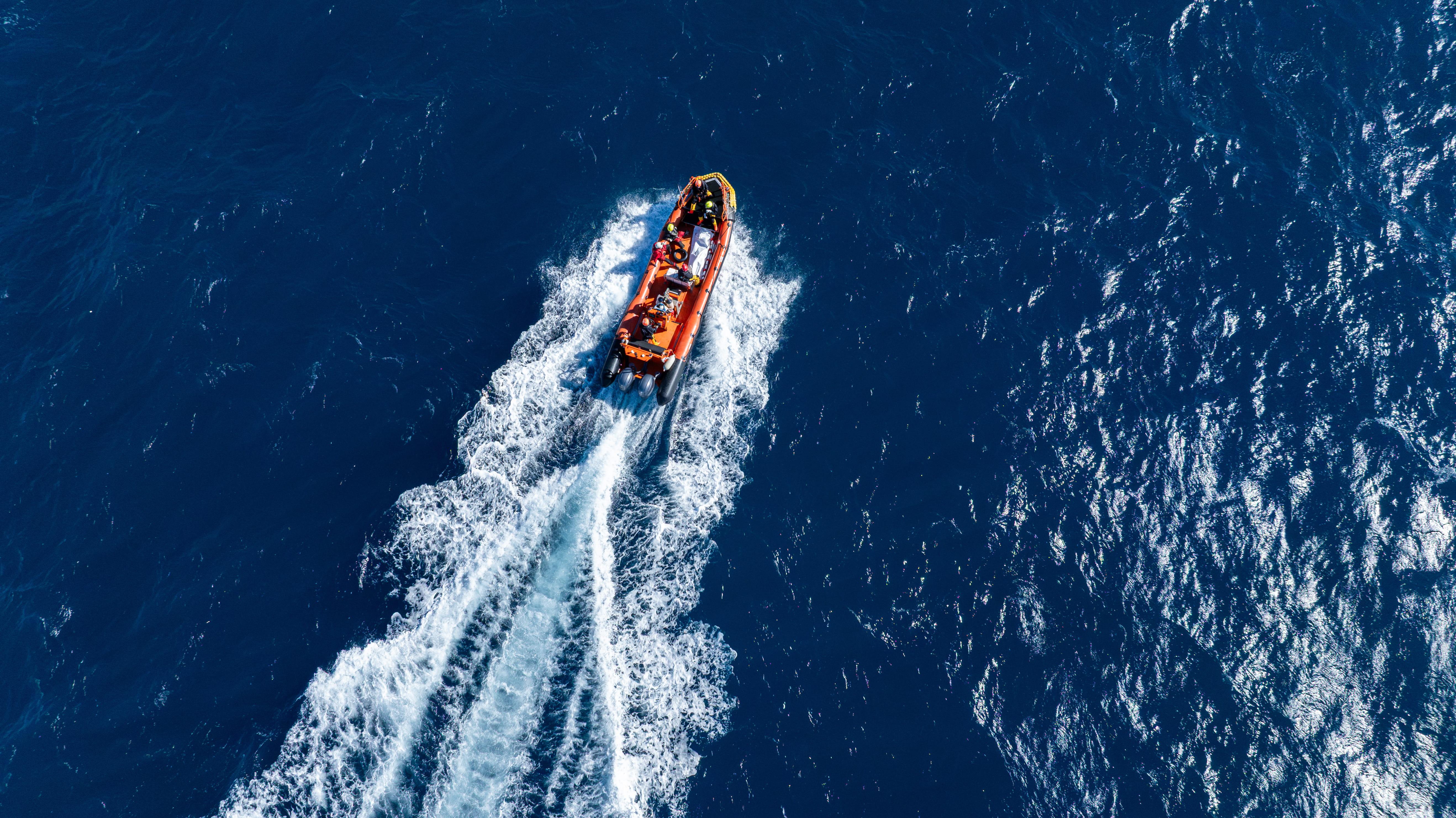
In January 2026, our rescue vessel, the Ocean Viking, was in port in Sicily as a storm moved across the Mediterranean. Winter weather can be unpredictable, and in recent years it has felt increasingly intense. This year was marked by an exceptionally violent storm. Cyclone Harry brought rough seas and damage to coastal areas. The mooring lines – the thick ropes that hold the ship to the dock – had snapped under the strain, simply from the movement of the sea in the harbour. We couldn't sail south to our area of operations. We waited. And while we waited for the storm to pass, reports started coming in. Every day, more people missing. A boat that hadn't arrived. Numbers of people unaccounted for. Families searching. Some estimates suggested that over a thousand people who left before the storm never made the crossing.
When we finally returned to sea towards the end of January, during one of our long scans of the horizon, a crew member spotted the body of a woman. She was found floating alone, face down, held up by a thin black rubber flotation ring. We slowed the ship, launched the rescue boats, and brought her onboard. We searched her pockets carefully, hoping for something that might help identify her. There was only a Tunisian banknote. We noted the small details: the clothes she was wearing, the way her hair was braided – documenting traces of a life that existed before this.
We recovered her body so that she would not disappear completely. So that, if possible, she could be identified. So that her family and loved ones would not be left only with uncertainty.
Her body was brought ashore and disembarked in Syracuse on February 1. When we arrived in port, we carried her off the ship on one of our stretchers intended for medical emergencies, and transferred her gently into the coffin the authorities provided. There was a moment of silence, some paper flowers, a few notes. Small gestures. A few simple words: you are not alone.
She had reached the place of safety she set out for. Just not in the way she had hoped.
These are the deaths we know about
Her death is not an isolated incident. It is part of a broader pattern that SOS MEDITERRANEE has documented since March 2016, when our first rescue vessel, the Aquarius, conducted its first operation off the Libyan coast. Over ten years of search and rescue operations in the Central Mediterranean, our teams have rescued 43,194 people and documented 318 deaths and disappearances at sea. This includes 55 bodies recovered and 263 people reported missing by survivors on board our vessels, or reconstructed from incidents in which our crews arrived at the site of a shipwreck and found no one alive. These figures reflect only what has been seen and recorded during our operations. They represent a partial account of a much larger reality, as many deaths at sea go unwitnessed and unreported.
In a significant proportion of the fatal incidents we have documented, survivors rescued by our crews were immediate family members of those who died or went missing during the same journey. Among those survivors: A man from Nigeria who identified his wife among the 22 women found dead at the bottom of a rubber boat in a mixture of fuel and seawater. A young man from Gambia who lost his brother when their wooden boat capsized in the night. A woman from Syria who was medically evacuated with her 7-year-old daughter, who did not survive. A man from Senegal whose 18-month-old child died in the first day adrift, his wife on the fourth day. A young man from Sudan who watched his 26-year-old cousin fall overboard in the dark, one hour before their boat reached safety. These are the deaths we know about because someone survived to report them.
What our documentation captures is not a series of isolated accidents. It is the product of a system that places people attempting this crossing in a condition of “constant perishability” – a persistent structural exposure to death, produced and maintained through deliberate policy choices that have progressively narrowed the space in which rescue is possible, and expanded the space in which death is the foreseeable outcome. The scale of that outcome is registered, partially, in IOM's Missing Migrants Project: at least 20,439 people have been recorded dead or missing in the Central Mediterranean since 2016.
The widening void: how a rescue gap is created
Over the last decade, our crews have been present as this structural exposure to death was constructed, piece by piece – documented in our recent report on ten years of operations. First, Italy and the EU deliberately scaled back maritime assets and withdrew naval patrols from international waters, calculatedly creating what has been described as a "rescue gap" to deter crossings. When crossings continued, these same actors circumvented their obligations under international law by outsourcing containment: funding and equipping Libyan Coast Guards to intercept people and return them to Libya, under a model designed to maintain plausible deniability for the refoulement that resulted. This approach was subsequently extended to Tunisia. The result has been a deliberate reduction in the availability of rescue – leaving people exposed not only to the immediate dangers of the crossing, but to interception and forced return to contexts where serious harm is well documented.
To secure this architecture, civil search and rescue organisations that stepped in to fill the rescue gap have been systematically targeted through criminalisation and administrative obstruction. Italian authorities have routinely closed ports to NGO ships, assigned distant ports of disembarkation in the north of the country to prolong transit times, impounded vessels, and prosecuted NGO crew members under the narrative that humanitarian rescue acts as a "pull factor" for smuggling, a claim that has been thoroughly and repeatedly debunked. Since 2016, these measures have cost SOS MEDITERRANEE alone 606 operational days: 150 days spent in standoffs awaiting a port assignment, 194 days under administrative detention, and 262 days navigating to and from distant port assignments. All constituting days not spent at sea.
Unwitnessed, unrecorded
The woman recovered on 30 January was found alone at sea. She is one of 796 people recorded dead or missing in the Central Mediterranean in the first four months of 2026 alone – the deadliest start to a year in nearly a decade. She is the visible fraction of a much larger invisible toll – and that toll is growing harder to measure. The issue is not only that deaths go unrecorded: it is that the capacity to record them is being dismantled. NGO vessels and aircraft are often the only actors that document and disclose what happens at sea. By imposing detentions on civilian ships, outlawing consecutive rescues, and enforcing long transits to distant ports, Italian authorities structurally minimise the presence of NGO ships in active patrol areas, effectively removing independent witnesses from the maritime zones where emergencies occur.
The Central Mediterranean is not unobserved – Frontex and coastal state drones and aircraft survey it continuously – but what those assets witness is disclosed selectively and partially, through incident reports that reach the public only fragmentarily, if at all. When NGO presence is reduced or obstructed, deaths go unwitnessed and unreported.
At least 1,500 people were reported missing in unverifiable shipwrecks last year, their deaths impossible to confirm – a consequence of the restriction of humanitarian presence at sea, according to IOM’s Missing Migrants Project. The death of the woman in January is part of a pattern – one that has been documented, repeated, and sustained over time. Not a random tragedy, but the outcome of decisions about how this space is governed, and who is protected within it.
She is one among many. She is not only a number. She is evidence of a reality that too often remains unseen. A life that was here. A life that existed. And a death that was neither inevitable nor acceptable.
Any comments about this post? Get in touch with us! Send us an email, or find us on LinkedIn, Bluesky and Instagram.
How to cite this blog post (Harvard style):
D. Wanczyk and M. Dionis. (2026) One body: a decade of deaths in the Central Mediterranean. Available at:https://blogs.law.ox.ac.uk/border-criminologies-blog/blog-post/2026/06/one-body-decade-deaths-central-mediterranean. Accessed on: 12/10/2026Keywords:
Border deaths
Share:
With the support of