Precarious care and medical neglect in Greek immigration detention
Healthcare workers reported unclear responsibilities, limited supervision, inadequate equipment and frequent police interference, which all shaped the care provided to detained people
Posted:
Time to read:
5 Minutes
Post by Andriani Fili and Stergios Magkriotis. Andriani is a Wellcome Trust Postdoctoral Research Fellow at the Centre for Criminology, University of Oxford, and co-director of Border Criminologies. Stergios is a researcher who focuses on issues of immigration detention, everyday life in displacement and informal support. He holds a PhD in Sociology from the University of Edinbrugh. Andriani and Stergios are collaborating under the project 'Medicalising Immigration Detention'. This post is part of a thematic series on healthcare and detention.
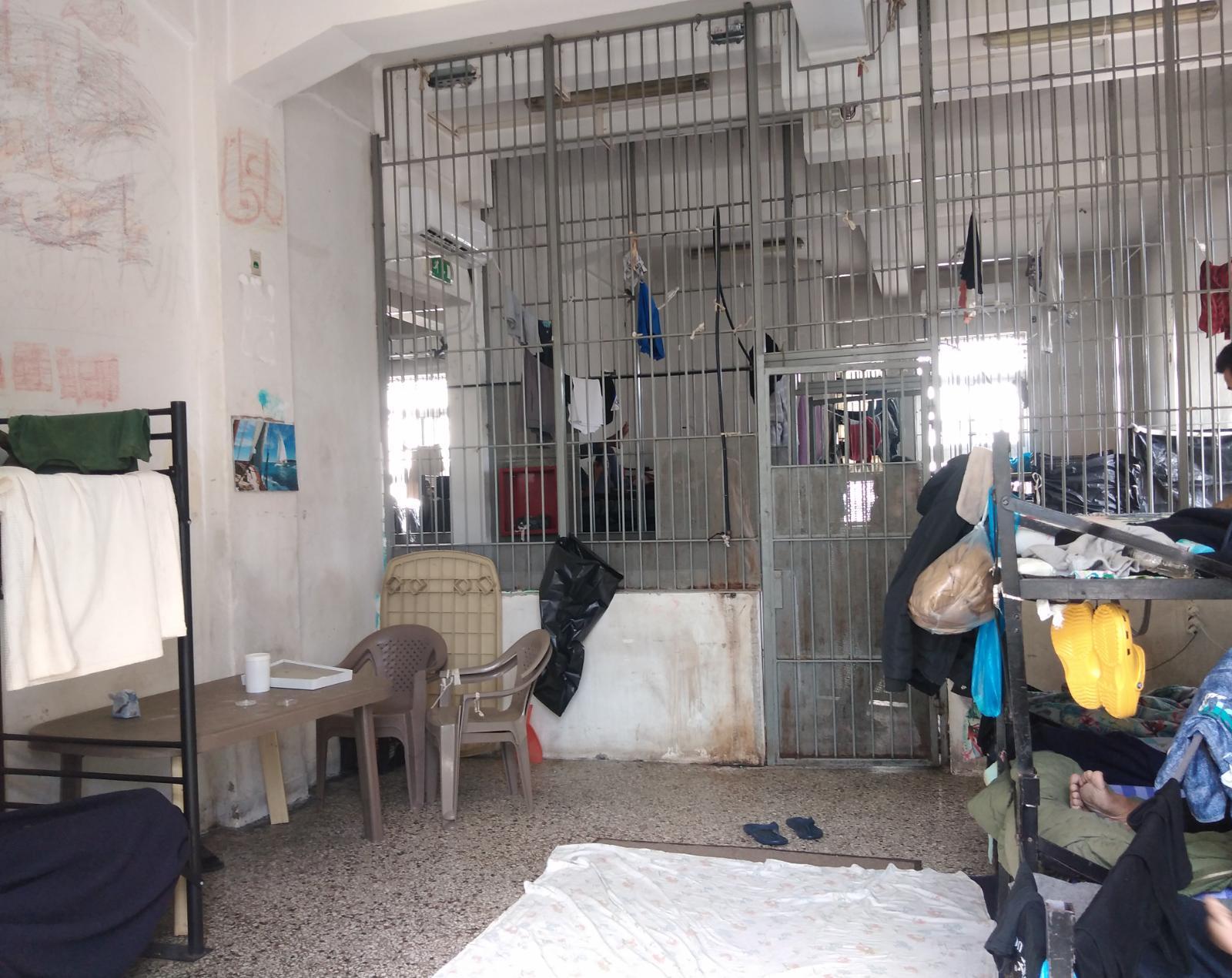
When discussing healthcare in immigration detention, we usually focus on what happens to the people detained. We consider the lack of medical treatment, deteriorating physical and mental health, and, in some cases, preventable deaths. These are important concerns, and ones I have encountered repeatedly in my research on immigration detention in Greece. But understanding how medical neglect persists also requires looking at how healthcare is organised, who provides it, and the institutional conditions under which medical decisions are made.
Having researched immigration detention in Greece since 2011, including through my work as an NGO practitioner providing support to detained people, I have seen how the promise of healthcare often bears little resemblance to what happens in practice. More recently, through interviews with healthcare professionals working in pre-removal detention centres, I have become increasingly interested in how their working conditions shape the care that detained people receive. What emerges is not simply a story of insufficient resources or overworked professionals. Rather, it is a picture of a healthcare system operating within, and often accommodating, an institution whose primary purpose is confinement and removal.
When healthcare becomes part of detention
The relationship between public health and immigration control in Greece is well established. As I have explored previously, migrants have long been portrayed as threats to public health, their bodies associated with disease and contamination. In 2012, for example, political rhetoric about migrants as a "public health bomb" helped justify police operations, compulsory medical examinations and detention. The contradiction is difficult to ignore. While migrants have been presented as threats to the health of the wider population, they are confined in institutions where their own health is systematically undermined.
Overcrowding, inadequate sanitation, limited access to doctors and serious medical neglect are widely documented. The European Committee for the Prevention of Torture has repeatedly raised concerns about healthcare in Greek detention facilities. Its 2024 report described appalling conditions, including an outbreak of tuberculosis in the Corinth pre-removal detention centre. These are not isolated incidents. Through Detention Landscapes, a project documenting human rights violations in Greek detention facilities, we have recorded numerous accounts of people being denied medical assistance. One person described repeatedly asking for medical attention, only to receive paracetamol. Another reported being beaten after asking to be taken to hospital.
These experiences reveal something important: access to healthcare is not simply a question of whether a doctor is available. It is also about who decides whether someone can see that doctor, whether their suffering is believed, and whether their health is considered a priority at all.
The organisation of medical neglect
In Greece, healthcare and psychosocial services in pre-removal detention centres (PRDC) are provided through AEMY, a state-owned company operating under private law rules. On paper, this arrangement ensures the presence of doctors, nurses, psychologists, social workers and interpreters. In practice, however, services have been characterised by chronic understaffing, temporary contracts and fragmented responsibility. At the end of June 2026, only seven doctors and six psychologists were deployed by AEMY in the six mainland PRDCs. In Amygdaleza, where 704 people were detained, only two doctors were deployed, while in Corinth, which holds 385 detainees, there was no doctor or psychologist. These shortages are serious, but they do not fully explain the medical neglect documented in Greek detention facilities.
In interviews conducted with healthcare workers, many described entering detention work almost by accident, often because they needed employment or professional experience. Some had little knowledge of the institutions in which they would be working. Once inside, they encountered unclear responsibilities, limited supervision, inadequate equipment and frequent interference by police. In some cases, police officers effectively determined whether detained people could access medical services. Their descriptions suggest an institutional environment in which medical decisions are frequently shaped by police authority.
One psychologist explained how officers could decide whether someone needed to see a doctor or psychologist, or simply refuse to open a cell. The consequences of these arrangements fall most directly on detained people, whose access to treatment becomes dependent on the discretion of those responsible for their confinement. The problem, then, is not simply that healthcare professionals cannot always do their jobs. It is that medical care is organised through the same structures of power that govern detention.
Healthcare professionals occupy a complicated position within these institutions. Their work can alleviate suffering, but it can also contribute to the normalisation and administration of detention. One psychiatrist interviewed for our research described the expectations placed on staff in particularly stark terms: "The only thing that concerns us [AEMY] is for you to be there from 8 to 4 and for no one to die." This account raises questions about what healthcare is expected to achieve in detention. Is its purpose to respond meaningfully to people's health needs, or to maintain a minimum level of medical provision that allows detention to continue?
Our interviews also revealed differences in how professionals negotiated their roles. Some challenged police decisions, questioned discriminatory treatment and attempted to secure medical assistance for detained people. Others developed close working relationships with police officers or accepted institutional practices that restricted access to care. These differences matter. Healthcare workers are not a homogeneous group, and working within a coercive institution does not necessarily mean that every professional reproduces its violence in the same way.
The key here is how these different practices are shaped by the institutional arrangements governing healthcare. Temporary employment, limited supervision, unclear responsibilities and police interference can restrict professional independence while allowing harmful practices to become routine. In this sense, examining healthcare labour is not about shifting attention away from detained people. It is about understanding the mechanisms through which their suffering is produced and sustained.
Beyond the promise of better healthcare
Medical neglect in Greek detention centres is often discussed as a failure of implementation: insufficient funding, poor management or inadequate staffing. These problems are real, and addressing them can make an immediate difference to detained people's lives. But I think we need to ask a more difficult question: what happens when healthcare is organised within institutions whose primary purpose is not care, but control? In my research, I have argued that medical neglect should not be understood simply as an absence of healthcare. Medical services may formally exist, while access remains restricted, treatment is delayed and the health problems caused by detention itself remain unaddressed.
Healthcare can therefore become part of what sustains detention. Its presence helps present confinement as regulated and humane, even when it does little to prevent the harm produced by confinement. These tensions were also central to discussions at our recent Health, Care, and Control workshop in Bologna, which brought together researchers, practitioners and activists working on immigration detention in Greece and Italy.
One important question remains: if we challenge detention because healthcare is inadequate, do we risk suggesting that detention would become acceptable if healthcare improved? Better staffing, independent medical provision and meaningful accountability are necessary. But they cannot resolve the fundamental contradiction of providing care within institutions that systematically undermine people's health. After more than a decade researching immigration detention in Greece, I find it increasingly difficult to see medical neglect as an exceptional failure of the system. It is deeply connected to how detention operates, alongside the uncertainty, isolation and violence experienced by those confined.
Understanding the organisation of healthcare, including the roles and practices of those who provide it, helps expose these processes. Ultimately, the question is not only how to improve healthcare inside detention, but how to challenge a system that – by its very design – produces ill health in the first place.
Any comments about this post? Get in touch with us! Send us an email, or find us on LinkedIn, Bluesky and Instagram.
How to cite this blog post (Harvard style):
A. Fili and Stergios Magkriotis. (2026) Precarious care and medical neglect in Greek immigration detention. Available at:https://blogs.law.ox.ac.uk/border-criminologies-blog/blog-post/2026/11/precarious-care-and-medical-neglect-greek-immigration. Accessed on: 28/11/2026Keywords:
Healthcare and detention
Share:
With the support of