Medical care as a tool of border control: health-centred struggles against border carcerality in Italy
Rather than protecting people, clinical tools risk being systematically co-opted as structural filters for mass detention and expedited deportation
Posted:
Time to read:
7 Minutes
Guest post by Camilla Ponti, Nicola Cocco, and Francesca Esposito. Camilla Ponti is a developmental psychologist and a relational psychotherapist. She is a member of several decolonial and abolitionist collectives and she is also involved in studying and participating in research that analyzes the care-control nexus within the system of border carcerality.
Nicola Cocco is a Medical Doctor specialised in Infectious and Tropical Diseases. He spent five years in Africa with different NGOs. He has worked at the WHO (Global TB Program), where he tried to focus the objectives of TB research on social and neglected areas. He currently works as an infectious disease specialist in Milan prison implementing research projects also at international level. For the Italian Society of Migration Medicine (SIMM), he is working for research and advocacy projects with a focus for migrant people in detention.
Francesca Esposito is a Researcher at the Department of Psychology “Renzo Canestrari” at the University of Bologna and an Associate Director at Border Criminologies. Her research looks at detention and carceral border violence through an intersectional and abolitionist lens, with a particular focus on the care-control nexus and health-related struggles and mobilisations against border carcerality. This post is part of a thematic series on healthcare and detention.
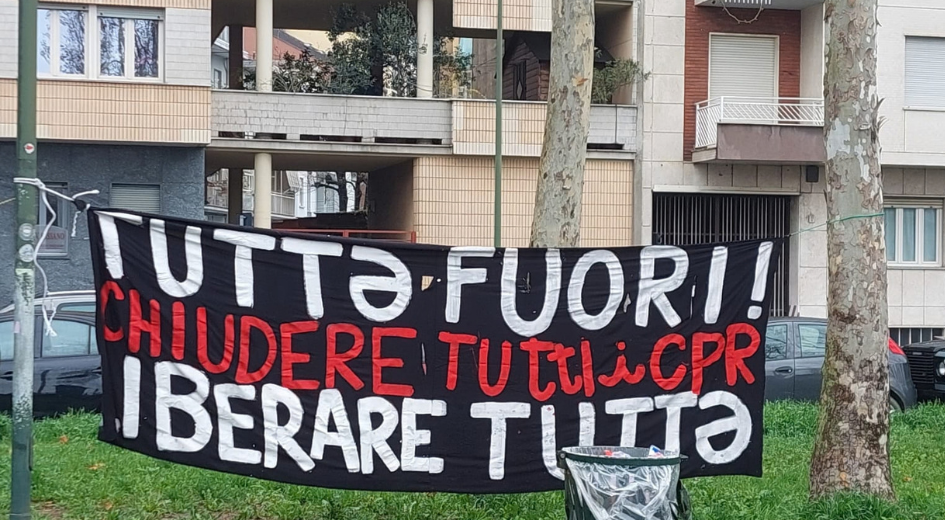
PHOTO 2 – Banner at an anti-detention protest “Everyone out. Close all CPRs. Free them all” (pic by Camilla Ponti)
Opening note: As authors, we stand in full solidarity with the Italian medical doctors currently facing judicial investigation for refusing to reduce their clinical practice to a tool of border enforcement through "fitness for detention" certifications. We reject the criminalisation of health professionals who refuse to be complicit in state-sanctioned border harm, and we reaffirm our shared commitment to challenge border carcerality and uphold the value of universal care.
The relationship between care and coercive control in immigration detention is the subject of intense debate – ethical, deontological, and political. Most recently, those debates have focused on the new EU Pact on Migration and Asylum, which entered into force on 12 June 2026. In the Pact, the language of care is even more closely linked to policies of border control and carcerality.
There is a growing body of national and international evidence documenting the psychopathogenic and potentially lethal effects of immigration detention. Despite this, the role of healthcare personnel in upholding detention regimes remains central and is still insufficiently examined. This blog post seeks to develop a critical reflection on that role, drawing on our militant action-research and involvement in the Italian context of struggles.
Healthcare workers speak out and organise
The participation of healthcare workers in the processes of screening, detention, and deportation of migrants in Italy encompasses several distinct yet interconnected steps and procedures. The public national health service (NHS) itself is involved in the operation of this carceral border system, as NHS medical staff are required to produce an assessment of “fitness for life” in a restricted community in order to validate the confinement of individuals within immigration pre-removal centres (Centri di Permanenza per i Rimpatri, or CPRs).
Following the Lamorgese Regulation of 2022, responsibility for health screenings prior to entry into CPRs was transferred to NHS healthcare workers, predominantly infectious disease specialists. Before 2022, screenings had been conducted by medical staff privately employed by detention managing bodies (in Italy detention management is outsourced to private actors, generating a lucrative business). This shift has prompted some significant developments. No longer caught in the grip of “dual loyalty” or under threat of losing their jobs, many healthcare workers have begun to speak out and organise in opposition to the system. Among those initiatives, the Italian Society of Migration Medicine, the Association for Legal Studies on Immigration, and the Network Mai più Lager—No ai CPR jointly launched an awareness campaign in January 2024, directed at doctors involved in "fitness for detention" assessments.
Detention as inherently harmful to health
We’ve gathered evidence from hours of direct observation, interviews, and collective exchanges over the past years with healthcare workers across Italy. What we found highlights how public health services, particularly emergency departments, have been turned into border enforcement outposts. Under the provisions of the 2022 Minister of the Interior Directive, NHS healthcare workers are routinely under systemic pressure by police forces to deliver rushed, superficial legal-medical clearances. In a recent policy brief, the World Health Organisation describes immigration detention as an inherently pathogenic system that generates physical and psycho-emotional suffering. The policy brief indicates: “Where data are available on the impacts of immigration detention, there is evidence demonstrating negative health outcomes as a result of detention”. This institutional pathogenicity is further documented in a recent Lancet Regional Health Europe publication, as well as by national monitoring reports carried out by independent associations, which highlight how structural confinement fundamentally conditions health outcomes, exacerbates underlying trauma, and accelerates clinical deterioration.
As documented by activist collectives and specifically flagged to the Rete Mai più lager - NO ai CPR helpline, several cases vividly demonstrate this reality. A striking clinical example from a hospital in Milan showcases the reductionist nature of these evaluations: a 55-year-old detained man presenting with severe neurological symptoms was discharged back to the CPR with a superficial diagnosis of “cocaine withdrawal,” completely omitting that his concurrent brain CT scan had revealed a massive, highly suspect pituitary adenoma, a predominantly benign (non-cancerous) tumor originating in the pituitary. He was only operated on weeks later, after being released as unfit from the CPR and supported by activists who accompanied him to the hospital.
Declaring migrants ‘unfit for detention’
Aware of this structural pathogenicity, a growing network of healthcare workers have decided to turn the “fitness screening” on its head. By utilising the Italian Code of Medical Ethics (specifically Article 32, which binds medical doctors to protect “vulnerable individuals” when their living environment compromises their health and dignity) these healthcare workers began issuing formal certifications of “unfitness.” This decision reclaims an active stance and clinical autonomy against immigration detention authorities, directly counteracting the state-enforced erosion of the universal right to care. It represents a collective effort to resist the reduction of migrant subjectivities and bodies to objects of control and confinement and to restore ethical accountability and the political value of care within public health spaces.

To date, the campaign co-launched by SIMM, ASGI, and Rete Mai più Lager No ai CPR has engaged over 1,000 doctors and involved more than 120 certifiers, resulting in roughly 230 to 250 unfitness medical reports signed “in science and conscience.” In this sense, “unfitness” certifications become a tool for resisting border carcerality and its pathogenic dimension and a reaffirmation of the value of life against systems, such as immigration detention, that systematically expose people to premature death. Since 1998, at least 42 deaths in detention have been recorded, and there are likely many more that have gone unrecorded. The healthcare workers’ mobilisation gained historic institutional endorsement in mid-2025 from both the National Council of the Order of Psychologists (CNOP) and the National Federation of Medical Orders (FNOMCeO). But it has also been met with harsh state repression.
The criminalisation of healthcare workers
On 12 February 2026, the Squadra Mobile – the specialised criminal investigation branch of the Italian State Police – raided the Infectious Diseases ward at Santa Maria delle Croci Hospital in Ravenna. Police subsequently placed six doctors under investigation – a number that quickly rose to eight within the same department. The doctors were accused of “ideological falsehood in concert” (falso ideologico continuato in concorso, Art. 479 Italian Penal Code) for issuing medical certificates declaring migrants "unfit for detention" (non idonei) in CPRs. By spring 2026, the Giudice per le Indagini Preliminari (Judge for Preliminary Investigations, GIP), an independent judge who oversees the initial “preliminary investigation” phase of a criminal case, imposed a ten-month suspension from medical practice on three of the physicians. This measure was upheld by the Bologna Tribunale del Riesame, the appellate judicial body with district-wide jurisdiction over the entire Emilia-Romagna region. The remaining five doctors were banned from issuing CPR-related fitness assessments for ten months.
No formal trial has yet begun for the eight Ravenna physicians, but the case demonstrates that state intervention has aggressively expanded. Following February 2026, prosecutors mandated police headquarters across Emilia-Romagna, a region in northern Italy, to seize material from other hospitals. This escalation culminated on 16 September 2026, when over 23 doctors across Italy faced home and workplace searches under allegations identical to the doctors in Ravenna. Some of the accused were also investigated for criminal conspiracy aimed at preventing deportations. Although the FNOMCeO (National Federation of the Orders of Surgeons and Dentists) firmly defended the autonomy of clinical judgment, the inquiry highlights a dangerous precedent: the weaponisation of criminal law to discipline and silence healthcare workers, subvert clinical independence, and enforce the primacy of border carcerality over the dignity and protection of life.
While far-right political forces have instrumentalised and manipulated the case to advance their securitarian and repressive agendas, some left-wing administrators and, above all, professional medical organisations have spoken out in support of healthcare providers. Markedly different, however, was the support shown in the streets and squares. From flash mobs in front of the targeted hospitals, to solidarity gatherings and demonstrations across Italian cities, these mobilisations have shown that the struggle against border carcerality and for the right to universal care is alive, collective, and refusing to be silenced. Solidarity has also been expressed at the international level.
Resisting the cooption of healthcare
We still do not know how the struggle against healthcare providers’ criminalisation will end. What we do know, however, is that it is not simply a local matter. It is, as Nicola Cocco and other colleagues have argued, “the tip of an iceberg”: a vivid and violent illustration of what happens when healthcare is positioned at the intersection of clinical ethics and carceral border enforcement. Writing for Border Criminologies in May, they assert:
“As physicians, we are increasingly being asked to serve as the gatekeepers of a detention system that we know, scientifically and ethically, to be pathogenic.”
This situation is particularly concerning within the framework of the New European Pact on Migration and Asylum. The Pact indeed institutionalises mandatory border security, vulnerability, and health screenings for all those arriving without a visa, effectively scaling up the entanglement between healthcare and carceral border governance to a pan-European level. Rather than protecting people, clinical tools risk being systematically co-opted as structural filters for mass detention and expedited deportation.
In response to these developments, in June 2026, a broad coalition of healthcare organisations and civil society bodies launched a national appeal: Against the Securitization of Care: The Right to Health of Migrants under the New European Pact. This appeal calls for a structural uncoupling of healthcare provision from carceral logic. It urges the medical community to strongly resist the “securitisation of care”, reaffirming that clinical ethics, therapeutic autonomy, and the universal right to health must never be subordinated to border control and immigration enforcement.
The struggle of Italian healthcare workers is no longer a localised one. It is part of a broader, transnational movement to reclaim care as a life-affirming practice, resist the securitisation of health, and defend the value of every human life against the violence of carceral border regimes. This is all the more important considering the turbulent horizons looming over us.
Any comments about this post? Get in touch with us! Send us an email, or find us on LinkedIn, Bluesky and Instagram.
How to cite this blog post (Harvard style):
N. Cocco, C. Ponti and F. Esposito. (2026) Medical care as a tool of border control: health-centred struggles against border carcerality in Italy. Available at:https://blogs.law.ox.ac.uk/border-criminologies-blog/blog-post/2026/10/medical-care-tool-border-control-health-centred. Accessed on: 10/10/2026Keywords:
Detention and Deportation
Share:
With the support of