International law reborn from the sea: From the Flotilla to border resistance in the Mediterranean
From the Global Sumud Flotilla to the acts of resistance against obstruction of sea rescue, the norms of international law are reborn in the face of necropolitics
Posted:
Time to read:
7 Minutes
Guest post by Enrica Rigo and Tatiana Montella. Enrica Rigo teaches Philosophy of Law at Roma Tre University, where she founded the Legal Clinic on Migration and Asylum in 2010. A feminist activist and advocate for migrants’ rights, she is the author of Migration, Asylum and Exploitation: A Feminist Legal Perspective (Bristol University Press, 2026).
Tatiana Montella is a lawyer and feminist activist who collaborates with the Legal Clinic on Migration and Asylum at Roma Tre University. She specialises in criminal and immigration law, as well as gender-based violence, and acts as a legal advisor to two anti-violence centres.
This article was originally published in Italian by Jacobin Italia, and has been reproduced here with permission. It has been edited for length and style.
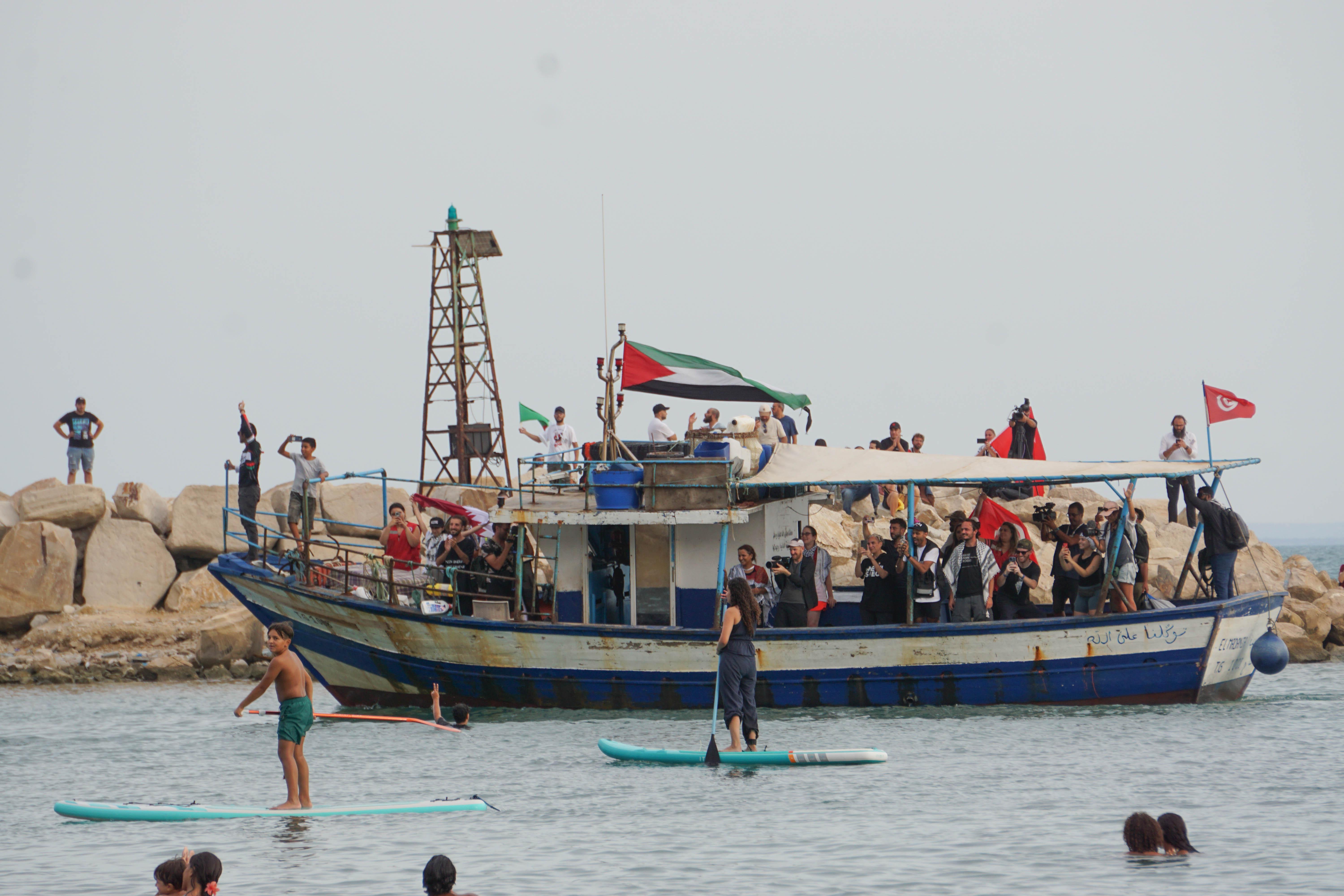
Today, the Mediterranean is crossed by constituent acts that do not simply call upon existing laws, but open up the possibility of a refoundation of international law beyond states. Among these are the actions carried out by dozens of ships sailing as part of the Global Sumud Flotilla in late 2025. These vessels were united not only by the aim of breaking the siege on Gaza and opposing Israel’s genocide, but also by the enactment of a new decolonial internationalism based on solidarity. Constituent acts also take place through the migrants’ crossings of the Mediterranean’s militarised borders, and through the actions of the people who support these struggles, as they challenge who has the power to define law, rights and political community.
In this view, ‘law’ is not only that which is ratified by states to legitimise wars and borders of exclusion. Rather, there exists another kind of law that does not beg for recognition, but rather constitutes it through practice: it is expressed by resisting bodies, invoked by people on the move across borders, and practiced by search and rescue ships that challenge the authority of borders. This law emerges precisely where states fail to protect life, where they betray and kill. It is this law that today takes shape in the Mediterranean, transforming it from a sea of death into a sea of resistance.
Re-inserting Israel into the West’s colonial history
As never before, international law – which remains the law of states and for states -– has shown all its limits and its incapacity to protect people from colonial and racist violence, whether in the violence of war, occupation and apartheid, or that of national borders. It is no coincidence that the activists of the Global Sumud Flotilla have asserted the legality of their action, in opposition to the illegality of the naval blockade of Gaza. In doing so, they also oppose the imposition of apartheid on the Palestinian people and the complicity of states that continue to actively support Israel (by sending weapons, doing business with companies that profit from the occupation, or remaining inert in the face of genocide, and thereby contributing to making it possible).
The resonance gained by Francesca Albanese, the UN Special Rapporteur on Palestine, has not only helped to unveil these complicities: it has played a crucial role in disseminating the interpretive framework of settler colonialism across a wide public. Through this, her reports have connected Israel’s practices of segregation, oppression, and annihilation against the Palestinian population. Although critical historiography has long advanced a colonial reading of Zionism, this approach has struggled to gain traction in international law discourse, particularly within European and Western-centred debates. As Nadera Shalhoub Kevorkian emphasises, taking this framework seriously means recognising that the practices of terror, domination, and control inscribed in colonial violence are not an exception to law. Rather, they are made possible by law itself, which provides the institutional legitimation for what Kevorkian describes as “the occupation of the senses and its inscription of pain onto the bodies and lives of the colonised”. In this context, the slogan “from the river to the sea” means that ending the apartheid imposed on the Palestinian population demands nothing less than the decolonisation of the laws that structure and legitimise it, both in the occupied territories and across all of historical Palestine, as Albanese has repeatedly emphasised in her public interventions.
Re-inserting the Israel–Palestine conflict into the history of colonialism is therefore far more than a lexical matter. It entails calling into question the entire history of the West, without denying the specificity of historical contexts. This approach directly confronts what Anthony Anghie has identified as the colonial matrix of international law. Conversely, the exceptionalism through which the foundation of Israel is interpreted provides a powerful justification for the asymmetry of international law, presented as an alleged moral superiority of the West. This, in turn, functions to discredit international law’s institutions whenever initiatives to comply with their prescriptions are pursued in favour of the oppressed and against hegemonic states.
It is precisely the stifling vision of international law as the law of and for hegemonic states - aimed at preserving the interests and privileges of a narrow circle of beneficiaries - that has been challenged by the visionary power of the Sumud Flotilla, and by the passions and desires it has been able to mobilise.
Wresting the sea from states
In this alternative vision of law – one capable of wresting spaces from states – the sea of the flotilla meets the sea of migrants’ struggles against borders and for freedom of movement. Far from a merely rhetorical move, the recognition of migrants’ crossings and struggles as constituent acts reflects an ongoing process at work across the Mediterranean that has turned the sea into a laboratory of normative challenges for rethinking legal notions such as ‘place of safety’, ‘self-defence’, and ‘state of necessity’. A clear example is the duty to rescue any person in distress at sea, the content of which has been progressively enriched through case law beyond the original scope of international conventions.
While the obligation imposed on rescuing vessels to coordinate with states’ competent authorities and to comply with their instructions remains central, it must be balanced with – and, where necessary, give way to – the absolute prohibition of the refoulement of asylum seekers to countries that do not guarantee protection from persecution, torture, or inhuman or degrading treatment. This prohibition has led to a substantive redefinition of the notion of a ‘place of safety’, which, in the law of the sea, complements the duty to rescue and the obligation to disembark survivors in a safe port. The Vos Thalassa mutiny in July 2018 is paradigmatic in this respect, when some of the people rescued at sea forced the tugboat’s captain to disregard the authorities’ instructions and to reverse course in order to avoid their pushback to Libya. After a lengthy trial, in 2022, Italy’s highest court, the Court of Cassation, recognised that the conduct of the mutineers was covered by the justification of self-defence, reasoning from their right not to be refouled, and thus redefining the notion of a place of safety.
Acts of resistance such as those of the Vos Thalassa thus make clear that Libya is not a ‘place of safety’ for people on the move, nor can a ship or an offshore detention centre be considered one. A ‘place of safety’ can only be a place where life is no longer threatened, where access to food, care, and shelter is guaranteed, and where one can apply for asylum, as required by the 1951 Geneva Convention. Over the last decade, the law governing the Mediterranean border regime has been continually strained and redefined by acts of civil disobedience: from Carola Rackete’s 2019 breach of the blockade of the port of Lampedusa, to the more recent refusal by the rescue NGO Mediterranea to comply with authorities’ instructions to prolong navigation for several days up to the port of Genoa, and thus to extend the suffering of migrants rescued after having been literally thrown into the sea by Libyan militias in August 2025.
Delegitimising the logic
State responses are indeed extremely violent. They target migrants, who are held at sea for days and then confined in hotspots or detention centres in Albania after disembarkation; rescue ships, which are fined and seized for weeks; and crews, activists, and networks of solidarity with migrants, who are criminalised, prosecuted, and imprisoned. Yet when the perspective shifts from the law of border regimes to one that prioritises the safeguarding of life, unlawful practices appear elsewhere: in the blocking of migrants at sea and the denial of disembarkation; in pushbacks to Libya; in torture enabled by state agreements designed to seal borders; and in deaths caused by the state-sanctioned violence of borders.
The international law of states shifts responsibility for state crimes onto the victims. In Gaza, it does so by blaming Palestinians for not collaborating with the occupying power’s plans of annexation, thereby justifying starvation as a weapon of extermination. At Europe’s borders, it does so by criminalising migrants for taking to the sea as an escape route from oppression, environmental devastation, and the violence of war intertwined with voracious and coercive capitalism.
This shifting of responsibilities absolves borders of their lethal responsibilities. The logic that sanctions those who defend human rights rather than war criminals, and the governments that protect them, is the same logic that invokes the law to protect borders instead of the lives of people on the move, prosecuting the captains of boats that traverse the Mediterranean and the NGOs engaged in sea rescue. In this system, impunity for war criminals and border enforcers has become the norm; evident not only in the drone attacks against flotilla activists navigating international waters, but also in the actions of Libyan patrol boats — equipped by Italy and Europe — that have fired on rescue ships at sea, as in the cases of Mediterranea in the spring of 2024 and the Ocean Viking in August 2025.
Any appeal to the moral legitimacy of the West’s legal order collapses in the face of the genocide and systematic destruction in Gaza. In the weaponisation of population displacement; in the engineered differentiation of legal statuses that subjects Palestinians to regimes of permanent exception; in the use of administrative detention as a tool of indiscriminate repression – so starkly reminiscent of detention practices imposed on racialised migrants in Europe – and in the walls and checkpoints that structure the apartheid regime, borders reveal themselves as strategic instruments of occupation and annihilation deployed by Israel. Yet this is also the nature of borders when they claim to protect security or supposed national identities. Borders protect nothing but privilege; they do not generate security, only oppression and exploitation; and they kill. More than 25,000 people have died on the Central Mediterranean route alone over the past ten years. In this context, we should not overlook the symbolic significance of the Sumud Flotilla’s occupation of that same space, carrying its powerful load of solidarity aimed at breaking Gaza’s confinement.
There is no underestimation of the violence enacted by the international order of states, which claims the superiority of an armed West grounded in border sovereignty and war. The acts of drawing borders and killing are constitutive of this logic, just as colonial imperialism is constitutive of the West. With equal resoluteness, however, it must be acknowledged that this order today represents only a minority of the world’s population – albeit an extremely powerful one – and that its logics are increasingly delegitimised. This is the same order embodied by the parallel plans of the United States and Israel for Gaza and the West Bank, rooted in a proprietary supremacy, racist and patriarchal, that expels the majority of humanity from its privileges, as if from a gated resort. It is hardly surprising that this stifling order trembles in the face of a tumultuous humanity that sails, resists, and forges solidarities beyond, and despite, states.
Any comments about this post? Get in touch with us! Send us an email, or find us on LinkedIn and BlueSky.
How to cite this blog post (Harvard style):
E. Rigo and T. Montella. (2026) International law reborn from the sea: From the Flotilla to border resistance in the Mediterranean. Available at:https://blogs.law.ox.ac.uk/border-criminologies-blog/blog-post/2026/01/international-law-reborn-sea-flotilla-border-resistance. Accessed on: 27/10/2026Keywords:
Search and rescue
Share:
With the support of