University entanglement with carceral border institutions: Medical Education, dual loyalty and complicity in Italy-Albania detention centres
Proposals to place medical students inside detention centres makes universities active accomplices in border violence, further legitimising structures of exclusion and containment
Posted:
Time to read:
7 Minutes
Guest post by Nicola Cocco, Kristina Millona, Patrizia Borsellino, Vittorio Agnoletto, Antonello D’Elia, Lara Tavoschi, Francesca Cimino, Fabio Perocco, Francesca Esposito, Chiara Montaldo, and Camilla Ponti.
Nicola is an infectious disease specialist with the Italian Society of Migration Medicine (SIMM) and an activist with Rete Mai più lager No ai CPR. Kristina is an independent researcher and journalist from Albania. Patrizia is a former Professor at the Department of Legal Philosophy and Bioethics at the University of Milano-Bicocca. Vittorio is a physician and representative of Medicina Democratica. Antonello is a psychiatrist, president of the Italian Society of Democratic Psychiatry. Lara is a Professor at the Department of Translational Research and New Technologies in Medicine and Surgery at the University of Pisa. Francesca Cimino is a researcher at the Department of Philosophy and Cultural Heritage at Ca' Foscari University of Venice. Fabio is a Professor at the Department of Philosophy and Cultural Heritage at Ca' Foscari University of Venice. Francesca Esposito is a Researcher at the Department of Psychology 'Renzo Canestrari' at the University of Bologna and a Research Associate at the Centre for Criminology at the University of Oxford. Chiara is Head of Medical Unit with Doctors Without Borders (MSF) Italy. Camilla is a psychologist and activist with Rete Mai più lager No ai CPR.
This post is part of Border Criminologies' thematic series on healthcare and detention. It was previously published in Italian in a slightly revised form on Salute Internazionale.
In contemporary migration scholarship, the concept of border externalisation has expanded significantly beyond traditional maritime interceptions and third-country readmission agreements. Today, it encompasses intricate legal, geopolitical, and structural manoeuvres designed to displace state obligations towards people on the move. Most recently, this has extended to university campuses.
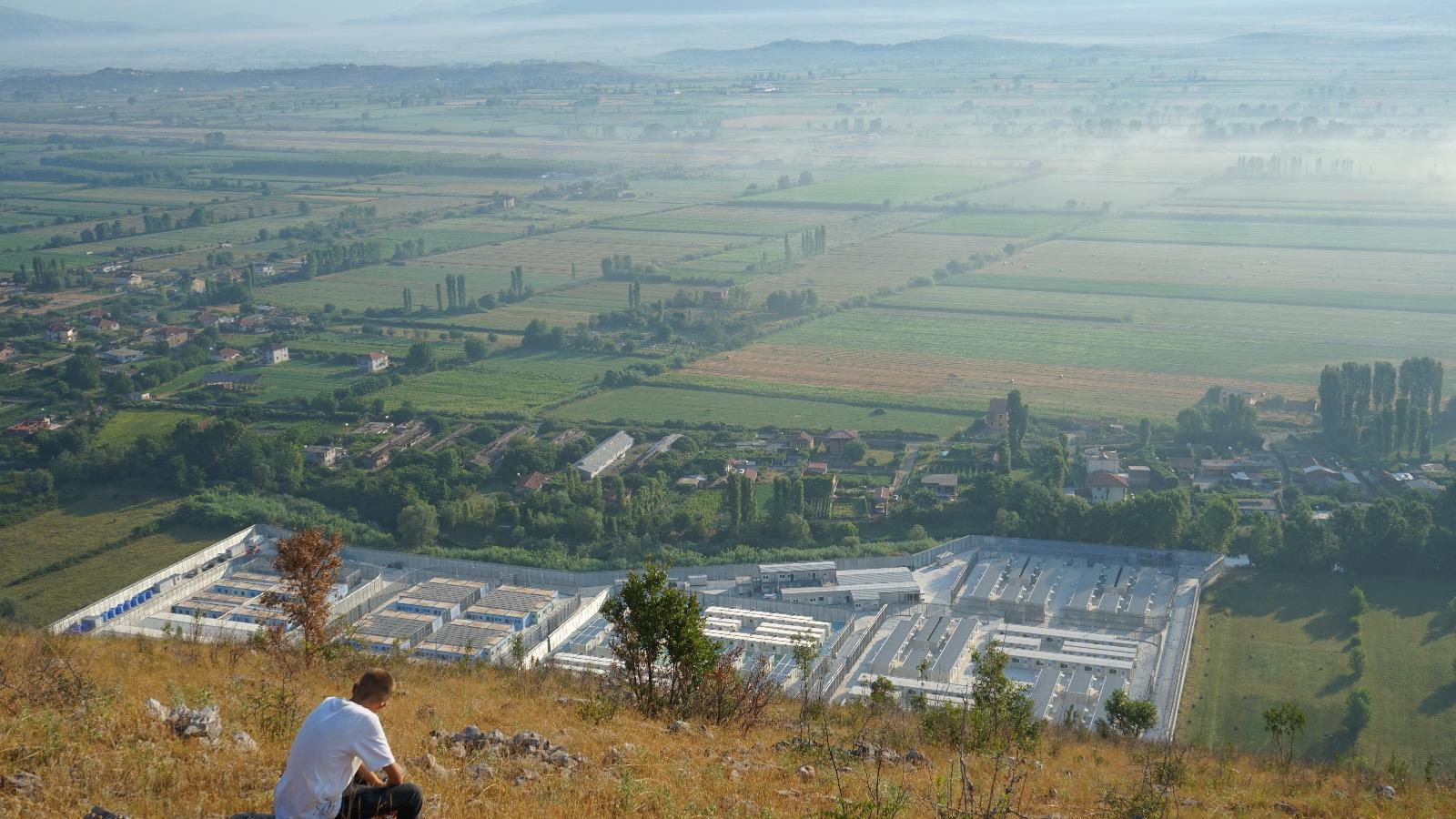
Investigative reporting by independent Italian magazine Altreconomia recently exposed institutional proposals for medical students at an Albanian university to be placed directly within the Gjadër pre-removal detention facility. The facility is one of two centres established under a bilateral protocol signed in November 2023 between the Italian and Albanian governments. The rationale for the placements frames the carceral setting as a "unique didactic opportunity" and a practical laboratory for learning migration medicine and transcultural healthcare under extreme conditions. As healthcare practitioners and academics, we are extremely concerned about this framing, which normalizes an institution of structural violence under the guise of medical education.
The centre in Gjadër, and a similar facility in Shengjin, are critical manifestations of Italy’s externalisation trend in recent years. The 2023 bilateral agreement established the two immigration detention facilities within the Albanian territory, operating under formal Italian legal jurisdiction, but outside Italian territory through physical displacement.
The facility in Gjadër is a carbon copy of Pre-Removal Detention Centres in Italy (Centri di Permanenza per il Rimpatrio, or CPRs). These centres are characterised by prolonged, punitive containment policies designed to expedite deportation procedures. Legal scholars, human rights advocates, and criminologists have vigorously critiqued the Italy-Albania protocol’s violations of European and international asylum law.
Drawing on concepts of structural violence, carceral geography, and medical ethics, we argue that utilising carceral border institutions as educational spaces transform the university into an infrastructural arm of a coercive border regime. This clinical and pedagogic co-optation compromises the foundational ethical mandate of health professionals – the principle of non-maleficence – and ensnares students in structural “dual loyalty” dynamics before they develop the systemic critique necessary for professional resistance. Ultimately, when medical training is embedded within such oppressive institutions, the formation of future healthcare practitioners becomes structurally embedded in the state-sanctioned production of racist border violence.
Total institutions, carceral geographies, and structural violence
To fully understand the dangers of this pedagogical integration, we situate administrative detention centres within Erving Goffman’s sociological framework of the "total institution". Total institutions are characterised by the complete breakdown of barriers that normally separate the spheres of sleep, play, and work. In these spaces, all aspects of life are conducted in the same place and under the same single authority, strictly scheduled and enforced through a system of explicit formal rules and a body of officials. Immigration detention centres – whether located in Turin, Rome, or Gjadër – are paradigmatic total institutions. Despite their administrative, non-penal legal designation, their material reality is defined by high walls, barbed wire, heavy surveillance, restricted mobility, and the systemic stripping of individual autonomy.
Carceral geography and critical detention studies have broadly demonstrated that these spaces are inherently pathogenic. They do not merely contain people’s bodies; they actively generate physical and psychological deterioration; in other words, they expose people to the risk of premature death. The structural violence embedded in the architecture of detention sites manifests through chronic overcrowding, extreme social isolation, poor environmental hygiene, sub-standard nutrition, and pervasive uncertainty regarding one’s legal status and potential imminent deportation. These carceral determinants of health rapidly and systematically erode the biological capital of detained individuals, transforming the "healthy immigrant effect" into an accelerated trajectory of physical exhaustion, acute psychiatric distress, self-harm, and suicidal ideation.
When a university inserts its students into this carceral space, it is not placing them in a neutral clinical environment. It is introducing them into an active apparatus of state-inflicted harm. The pedagogical space merges with the carceral geography, making it impossible to separate clinical practice from the broader punitive mandate of the institution.
The bioethical crisis: co-optation, dual loyalty, and malpractice
The core bioethical dilemma for health professionals working within carceral institutions centres on the phenomenon of “dual loyalty.” Dual loyalty refers to the structural conflict between a clinician’s clinical and ethical duty to provide unrestricted care to their patient and their administrative, contractual, or political obligations to an employing authority – in this case, the state or the private entity managing the detention centre. This conflict often results in systematic pressures to subordinate patient welfare for non-clinical agendas. Within total institutions, the operational demands of security, containment, and behavioural control routinely supersede clinical priorities.
The international literature on carceral healthcare highlights severe compromises in clinical independence. In Italian detention centres, physicians are frequently pressured to perform tasks that serve carceral rather than clinical ends, such as certifying individuals as "fit for detention" or "fit for flight" prior to deportation. These practices directly conflict with the foundational bioethical tenets of beneficence and non-maleficence. Rather than serving as therapeutic agents, health professionals risk being co-opted as technical enablers of administrative violence, validating and legitimising punitive state policies through medical authority.
Introducing undergraduate medical and nursing students into these environments introduces several grave complications:
- Students do not yet possess the professional autonomy, legal protections, or psychological resilience needed to navigate and resist dual loyalty pressures. They enter the clinical space in a subordinate position, bound by academic hierarchies and evaluated by supervisors who may themselves be co-opted by the carceral framework.
- Exposing students to environments where the denial of adequate healthcare, the excessive use of chemical restraint, and the normalisation of trauma are standard operating procedures which desensitise them to the systemic violations of human rights.
- Using carceral spaces as learning environments for students teaches them to accept clinical malpractice as an inevitable condition of institutional reality.
The Gjadër protocol: transnational de-territorialisation and clinical complicity
The specific proposal to utilise the Gjadër CPR in Albania as an educational site amplifies these ethical anomalies through transnational legal de-territorialisation. The Italy-Albania protocol represents a political experiment of border and detention externalisation, separating the execution of domestic sovereignty from domestic territory. Within this externalised space, Italian administrative laws apply, but the geographic isolation completely cuts off standard mechanisms of legal, civil, and humanitarian oversight.
For health professionals, this extreme isolation magnifies professional risks. Independent human rights monitors, journalists, and non-governmental organisations already face severe restrictions when attempting to access the Gjadër facility. The clinical data, patient records, and quality-of-care audits are shielded from public scrutiny. Consequently, the healthcare system inside Gjadër operates within a profound accountability vacuum. In such an isolated environment, the pressure on healthcare personnel to comply with securitarian directives – such as ignoring vulnerability signs during brief border screenings – becomes overwhelming.
By establishing internship programs in this extraterritorial enclave, the university becomes an active accomplice in border externalisation. It supplies a continuous stream of junior clinical labour that validates an unaccountable system. The presence of university-affiliated students provides a false veneer of humanitarian care and academic legitimacy to a structure designed for exclusion and containment.
Pedagogy of the oppressed vs. carceral pedagogy
The field of migration medicine cannot be taught separately from its political and structural context. It is inherently bound to the social, economic, and legal determinants of health. True pedagogical excellence in this discipline requires what Paolo Freire termed a "pedagogy of the oppressed" – an educational model rooted in critical consciousness, structural analysis, and a commitment to social justice and human rights. Academic faculties have a duty to train students to look beyond immediate clinical symptoms, enabling them to identify and dismantle the structural forces that produce disease, precarity, and trauma.
In stark contrast, utilising a CPR as an educational classroom models a ‘carceral pedagogy’. This model strips medicine of its social responsibilities, reducing clinical training to a narrow set of technical skills applied within a setting of institutional violence. It teaches students to accept the suspension of rights as a neutral background condition, and to view marginalised patients through a lens of containment and security. Such training violates the core mission of higher education, replacing critical thought with technical compliance.
A call for academic mobilisation and resistance
The proposed integration of medical education into the Gjadër CPR must not be treated as a routine administrative decision. It represents an urgent bioethical crisis that demands immediate mobilisation across academic, medical, and legal sectors. Universities must remain independent spaces dedicated to promoting life, human dignity, and universal human rights. They cannot serve as training grounds or logistical support for state-sponsored border control.
We call upon academic institutions, medical faculties, and professional associations – in Italy, Albania, and across the globe – to firmly reject any agreements that embed students within immigration detention centres. The clinical training of healthcare professionals must occur in environments where human life is explicitly valued, protected, and cared for. Medical education must teach students to defend human dignity, especially where it is most vulnerable. Detention facilities cannot serve as classrooms; they must remain objects of rigorous critical study, exposed for their structural harms until they are permanently closed.
Any comments about this post? Get in touch with us! Send us an email, or find us on LinkedIn, Bluesky and Instagram.
How to cite this blog post (Harvard style):
N. Cocco, K. Millona, P. Borsellino, V. Agnoletto, A. D'Elia, L. Tavoschi, F. Cimino, F. Perocco, F. Esposito, C. Montaldo and C. Ponti. (2026) University entanglement with carceral border institutions: Medical Education, dual loyalty and complicity in Italy-Albania detention centres . Available at:https://blogs.law.ox.ac.uk/border-criminologies-blog/blog-post/2026/10/university-entanglement-carceral-border-institutions. Accessed on: 16/10/2026Keywords:
Healthcare and detention
Share:
With the support of