Doing harm well: reflections on a recent Derwentside IRC inspection report
A report has commended a detention centre for its ‘good’ outcomes – but no matter how much carceral spaces are ‘improved’ via reform, they still produce harm
Posted:
Time to read:
5 Minutes
Guest post by Renzo Szkwarok (Shk-va-rok). Renzo is a PhD student at Newcastle University researching practices of border control in the UK. Positioned across social, cultural and political geography, his thesis investigates Derwentside Immigration Removal Centre in County Durham. Specifically, he is interested in how local people make meaning of, interact with, and navigate this new detention centre within their community since it opened in 2021. This post is part of 'Doing harm well', an ongoing thematic series on monitoring and oversight in carceral spaces.
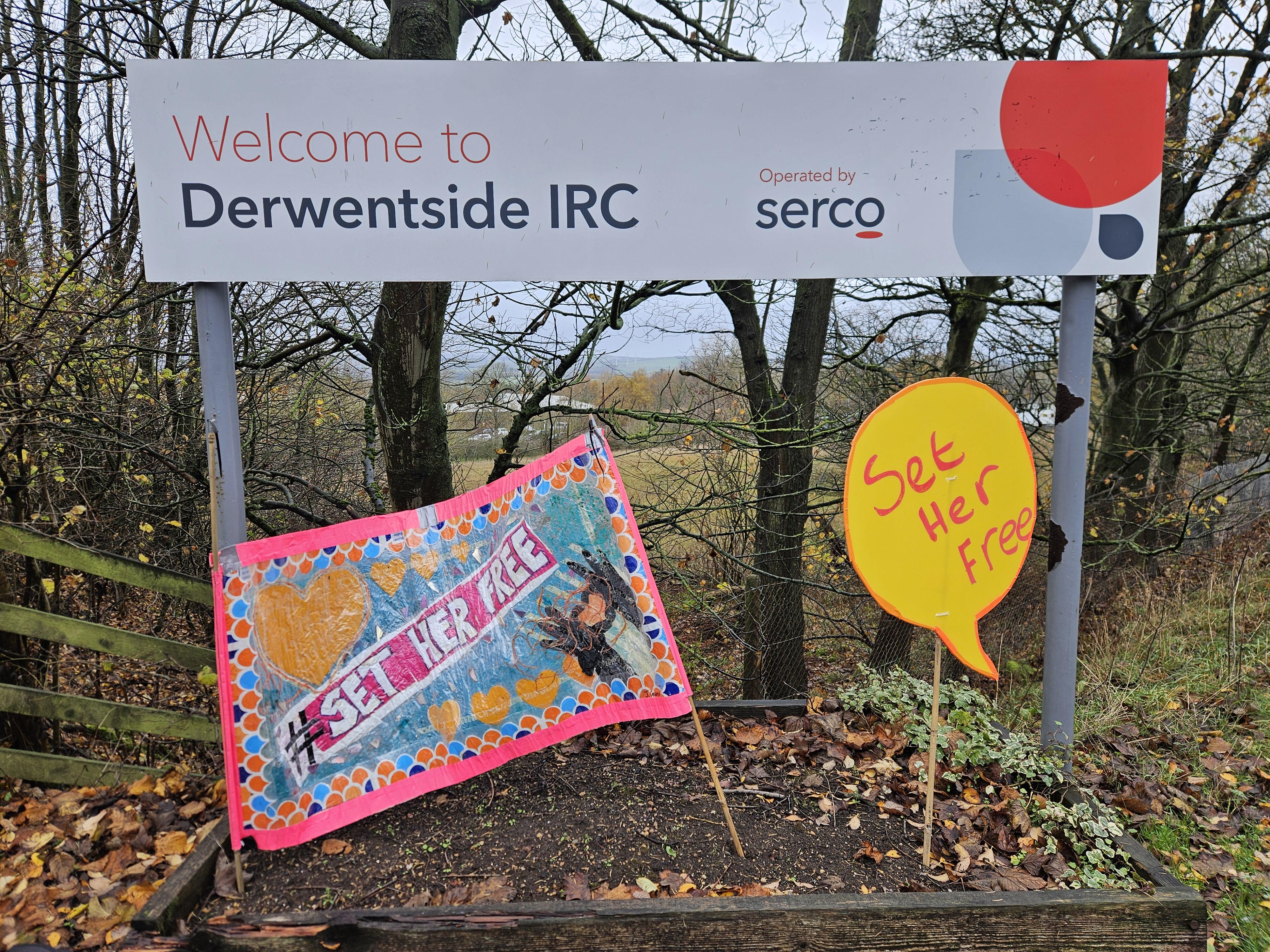
Derwentside is the only Immigration Removal Centre (IRC) for women in the UK. In a 2026 report of the County Durham institution, His Majesty’s Inspectorate of Prisons (HMIP) declared that the centre “stands as an example of what can be achieved through committed leadership, dedicated staff, and a clear focus on the welfare of those in detention". Whilst this sounds positive, this post urges critique of such ‘successes’ in detention contexts. To not do so would risk obscuring gender-specific harms that arise out of the UK’s racialising, criminalising, and punitive system of border enforcement. This post will outline some key findings of the report and then highlight the danger of Derwentside becoming a poster child of ‘best practice’ in the UK’s detention estate.
Doing harm well?
Amongst Derwentside’s ‘successes’, the report notes that HMIP inspectors were impressed with the levels of staff respect and the “positive culture”. Physical and mental health support were also commended for being robust, responsive, and delivered by a skilled team. Additionally, the standard of the living conditions was “very good”. It also noted “good efforts to soften the environment and make it less prison-like”, as well as a “wide range of purposeful activities, including education, work, arts and crafts, and fitness opportunities”. This positive report was even celebrated in a LinkedIn post by a Deputy Director at Serco, the company privately operating Derwentside. Indeed, compared to HMIP’s last visit to Derwentside in 2022, all outcomes for detained women had improved. In this latest visit, inspectors found that “outcomes for detainees were: good for safety; good for respect; good for activities; good for preparation for removal and release”. What is there not to be proud of? The statements reads like a glowing report. Could Derwentside be the poster child of immigration detention ‘best practice’?
The harms
The first pages of the report read well for the Home Office and Serco, but contradictions appear quickly. The successes noted above contrast with serious areas of concern that raise questions over the accuracy and usefulness of the ‘good’ scores awarded by inspectors. On a basic operational level, the inspector’s finding that “59% of women were released and 41% transferred to other centres” (i.e., 100% were not deported directly from Dertwentside) questions the institutional purpose of Derwentside as a ‘removal’ centre. By the government’s own assertion, detention should be used sparingly and only if detainee removal from the UK is likely. With zero removals, Derwentside is clearly failing on this front.
Detention is also isolating, and ‘good’ scores awarded by HMIP obscure the reality of isolation for the detained women. Visitation facilities were reported to be very good, yet only 17% of women had received a visit from family or friends since being brought to Derwentside IRC. This reflects the centre’s location far from the women’s family, community and support network – something the Independent Monitoring Board, anti-detention campaign group ‘No to Hassockfield’, and researchers have long pointed to.
Further to geographical isolation, inspectors noted concern at the lack of staff who are women, a significant number of which had recently left, meaning that overnight bedroom checks (conducted for a variety of reasons) were inappropriately done by men. These involve women’s doors being opened in the night and, although 77% of women felt safe on their first night inspectors found that overnight welfare checks performed whilst women are asleep “were excessive and not based on a reasonable assessment of risks”.
Access to legal support was another concern highlighted in the HMIP report. Although 72% of women who responded to the survey had a lawyer, and 82% said it was easy to contact them, only 40% of respondents said they could understand written English very or quite well. This potentially means that 60% of detained women find it difficult to understand their legal documentation and therefore meaningfully engage with their legal situation. The Home Office does not translate legal documents, so even with good access to legal support, this access is unevenly distributed along lines of language proficiency as well as legal aid, which has faced successive cuts. This finding mirrors national trends reported by Bail for Immigration Detainees.
Inspectors were also concerned about the quality of Rule 35 reports (performed by a medical professional to identify particularly vulnerable people in detention) as they were “worse than [inspectors] usually see”. Indicative of this poor quality, of the 79 Rule 35 reports submitted by staff in the six months prior to inspection, six were about suicide risk. This was both more than inspectors usually see and, as noted in the report, “still did not reflect the number that should have been made,” as some cases went unreported. Reporting on these failings has also been picked up by the BBC. Furthermore, many women – including suicidal and pregnant women – were transferred to Derwentside after long, overnight journeys. Inspectors found “little evidence of consideration of the impact the journey might have on their health and well-being”. Additionally, although onsite healthcare was praised, “all women escorted to hospital in 2025 had been handcuffed, without adequate justification” in line with restrictive Home Office guidance.
Altogether, the use of handcuffs on all hospital visits, and excessive and intrusive room searches that were deemed “more thorough than those practised in almost any other custodial environment” reveal an explicitly carceral institution. Despite a softer and “less prison-like” setting, women are still treated with suspicion as potential criminal subjects to be surveilled and have their mobility curbed. Finally, inspectors also found that six members of staff “had witnessed colleagues behaving inappropriately to detainees” and, although there was no indication of physical mistreatment, eight members of staff had been dismissed for unprofessional conduct in the year leading up to the inspection.
Can detention be ‘good’ at all?
An examination of this report reveals that, beyond the headlines, serious concerns for women’s welfare exist at Derwentside. This is despite HMIP awarding the centre ‘good’ scores across the board. The campaign group No to Hassockfield made this point at their demonstration shortly after the report’s publication. In a statement they said:
“The report confirms what women with lived experience, campaigners and communities have been saying for years: this system causes harm, ignores vulnerability and detains women who should never be here at all.”
As such, questions must be asked over the capabilities of the HMIP to meaningfully address gender-specific harms and make detention ‘better’. As researchers have shown, the intersecting relations between gender, racialisation, class and sexuality that women face in detention mean that there is an increased risk of mental health challenges that are often overlooked or dismissed. In the context of detention related gender-specific harms, it is undoubtedly a good thing that inspectors found that women are treated with respect and that the centre has improved against HMIP metrics since its opening in 2021.
However, we must remain critical of this ‘improvement’ and of Derwentside’s success in this report, as this does not tell the full story. Alongside these gender specific harms, this report must be contextualised within the current climate of heightened, ongoing immigration raids and deportations under this Labour government. As government policies turn ever more draconian on immigration issues, Derwentside IRC acts as one part of a wider border system that criminalises migrants, with the express intended goal of expelling them.
Knowing this, should detention be labelled ‘good’ at all? If, according to HMIP, Derwentside could not deliver better outcomes for women, yet the harms persist across healthcare, legal access, intrusive room searches and staff conduct, then it may show these metrics are not fit for purpose. What the report ultimately shows is that no matter how much carceral spaces are ‘improved’ via reform, they still produce harm. Though there may be instances of good, careful work done by staff as this report opens with, this examination reveals deeper, structural complexities and problems with the present immigration system that unevenly harm detained women. No amount of reform will eradicate harm from this privatised, punitive system of control.
Any comments about this post? Get in touch with us! Send us an email, or find us on LinkedIn, Bluesky and Instagram.
How to cite this blog post (Harvard style):
R. Szkwarok . (2026) Doing harm well: reflections on a recent Derwentside IRC inspection report. Available at:https://blogs.law.ox.ac.uk/border-criminologies-blog/blog-post/2026/06/doing-harm-well-reflections-recent-derwentside-irc. Accessed on: 17/10/2026Keywords:
Doing harm well
Share:
With the support of