Rethinking tech in alternatives to detention: 10 principles rooted in community empowerment and transparency
People’s rights get compromised when systems prioritise cost-saving and efficiency. But co-created tech can help migrants flourish instead
Posted:
Time to read:
5 Minutes
Guest post by Antonella Napolitano. Antonella is an independent expert on technology policies and their impact on society, particularly on migration and welfare. She publishes research on the role of technology in border externalisation policies and identity systems for refugees and migrants. Previously, she was Senior Policy Officer at Privacy International, where she developed the organisation's work on migration and surveillance technologies. She worked on the report, ‘Surveillance to Empowerment’ as Digital Technologies Consultant with the International Detention Coalition. This post is part of a two-part series on the findings of the report.
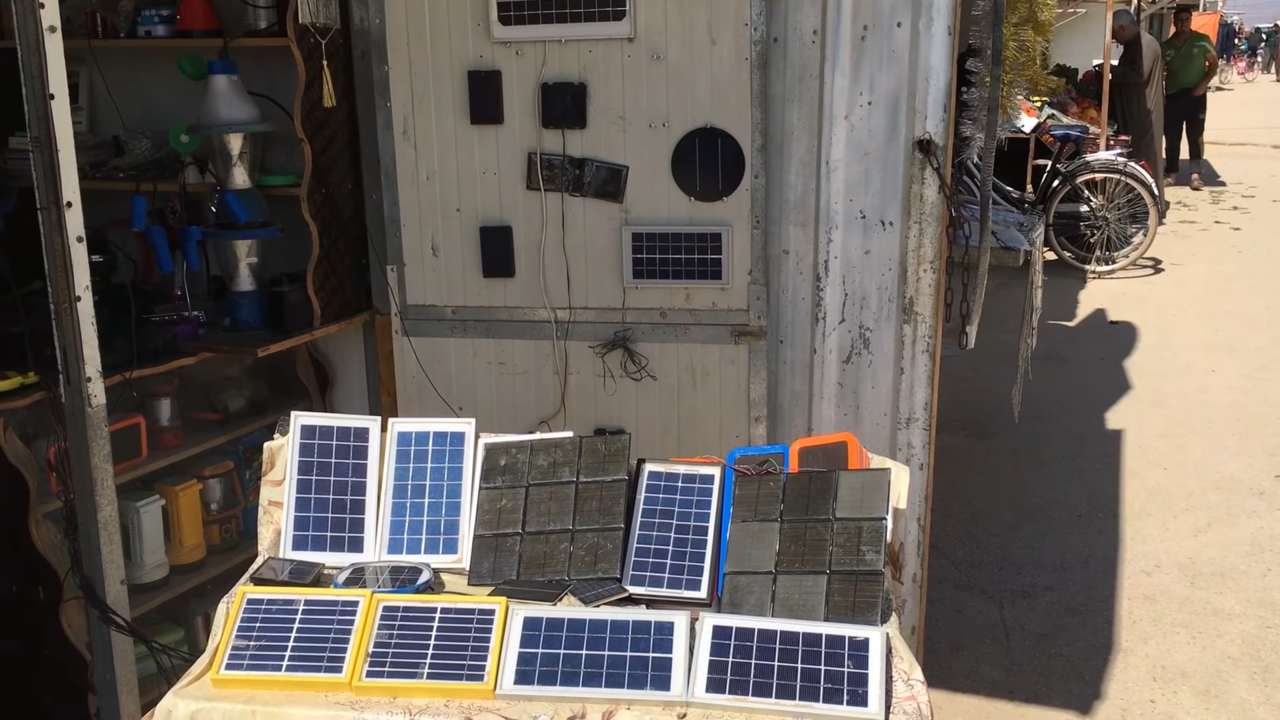
As technology becomes solidly embedded in every aspect of migration and border management, migrants bear the burden of the new systems, with decisions put in the hands of for-profit systems driven by data processing and so-called tech innovation. Digital tools are evaluated on the basis of efficiency, cost savings and compliance rates, without assessing the impact on people’s rights and dignity.
The risks of this were highlighted this week after the personal data of over 600,000 Gazan households were exposed by a cyber-attack on a World Food Programme platform. The system is managed by controversial US military contractor Palantir.
A new report, From Surveillance to Empowerment: Advancing the Responsible Use of Technology in Alternatives to Detention, calls for a reorientation: if used, technology must be embedded in a broader ecosystem of care, underpinned by transparency and community involvement. It should not be bluntly used to enforce compliance. Instead, it should enhance access to legal and other supportive services, to support well-being and improve trust – when possible, within a co-creating process.
The report looks specifically at policies and practices in eight global regions in the context of alternatives to detention (ATD). This is an under-researched area of migration governance, but one that is gaining a central role in the debate around the human impacts of technologies. The report is based on extensive research including consultations in each region with a total of 158 participants – this included people with lived experience, academics, technologists, legal experts, advocates and researchers. It creates a distinction between surveillance technologies, digital reporting tools and digital support services, as each category carries different implications for agency, intrusiveness, and scope of data collection.
Research can be the foundation to craft a way forward: this is why the report details migrant-centred practices and experiments, and sets out 10 guiding principles to ensure technology is used to reduce rather than extend detention, and to promote freedom, dignity, rights, and community integration.
There are alternatives: 10 principles to shift perspective
There are alternatives to immigration detention - and many of them don’t require an intensive use of technology. In Latin America, countries like Uruguay prohibit immigration detention, while Colombia uses a model based on regularisation instead of detention to manage large numbers of people on the move (the country hosts about 2.8 million refugees and migrants from Venzuela.) In Europe, Belgium has an ATD department that based its work on casework management through the Individual Case Management (CASE system). Recently, the country legislated to end child immigration detention and promoted government–civil society partnerships to manage ATD. Some of these models, while not perfect, emphasise relational support over monitoring and treat people on the move as active participants within legal processes, not as subjects to be controlled.
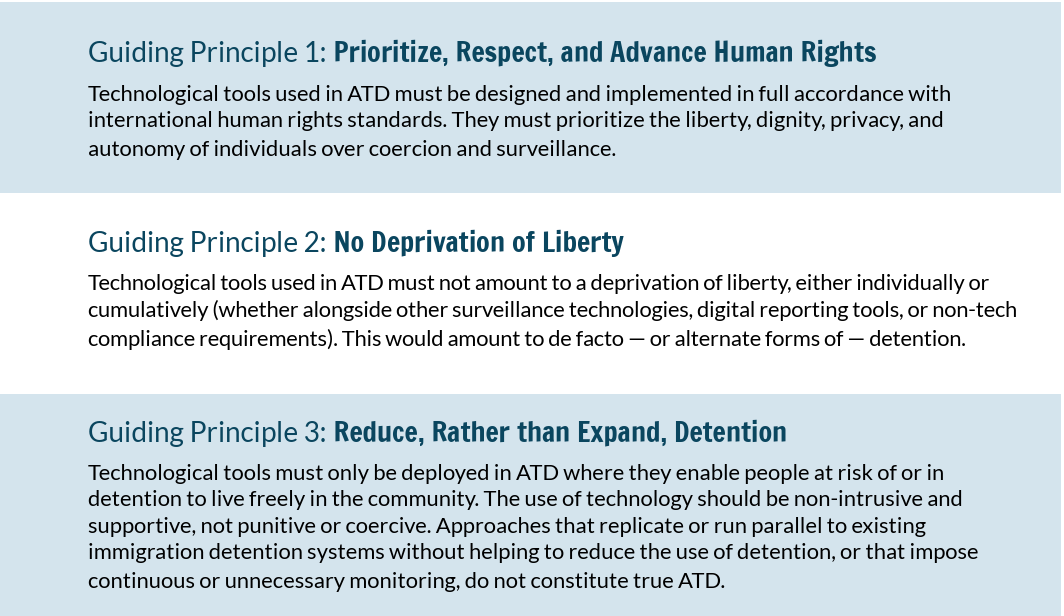
The principles developed in the report provide a framework for deploying technology in ATD programmes in a way that preserves peoples’ rights and dignity. They also aim to facilitate the use of community centred, rights based ATD as a genuine alternative to closed and restrictive detention practices – and as a step towards the end of immigration detention. They address key risks, and should be applied holistically rather than individually, with each reinforcing and complementing one another.
Promising applications include non-biometric reporting tools, digital case management systems, and geolocated support service directories. It is important to note that systems and tools classified as surveillance technologies will generally not meet the requirements of the principles.
Access to legal advice and information
One of the most transformative applications of technology in the context of ATD is its capacity to enable informed and meaningful participation in immigration and asylum processes.
These tools can take the form of ‘legal kiosks’ – secure stations located in shelters like the Border Line Crisis Center, or in transit hubs, that allow users to schedule appointments, upload documents, and receive updates in their preferred language. In Colombia, humanitarian organisations have also piloted legal guidance channels on WhatsApp, and mobile legal clinics with local actors like Voices of Venezuela that deliver pre-recorded ‘know-your-rights’ content to asylum seekers in rural or transit areas.
These locally designed models underscore the importance of designing for low-connectivity environments, visual literacy aids, and voice-guided interfaces – all of which can help to bridge persistent digital divides.
Enhancing case management and access to support services
People on the move – many of whom are navigating unfamiliar legal systems while facing language barriers, limited literacy, and digital exclusion – are particularly vulnerable to missing critical deadlines or misunderstanding their legal obligations.
When digital case management tools are embedded within trauma-informed, person-centred and rights-based models, they become scalable mechanisms for humane migration governance and long-term stability. By facilitating connection between people, caseworkers and service providers, they allow for systems that promote healing, agency, and trust instead of amplifying harm through technological coercion.
Platforms such as RefAid – used by 7,500 NGOs in Europe and the Americas – offer geolocated listings of services while allowing aid organisations to update their offerings and availability in real time. In North America, InReach (formerly known as AsylumConnect) connects LGBTQI+ asylum seekers to legal, housing, health and social services with filters for gender identity, sexual orientation, language, and immigration.
Digital tools in the context of ATD can also play a pivotal role in fostering stability, empowerment, and integration. In Spain, for instance, an app created by the Comisión Española de Ayuda al Refugiado (CEAR) provides asylum seekers with updates on their legal cases, maps of nearby services, and information on language courses and health resources.
Participatory and community-designed technology and evaluation
Participation improves not only usability but also trust and uptake, particularly in communities that have been exposed to coercive or extractive technologies. Tools designed with and for displaced people have proven more responsive to actual needs than generic case management apps. They also tend to be embedded in existing mutual aid networks that many people on the move already rely on, therefore increasing their accessibility.
As emphasised by the work of groups like the Localization Lab, the Engine Room and the De|Center, user-led approaches are critical in humanitarian tech contexts as they promote local partnerships, cultural sensitivity, and iterative testing.
Collaborative design processes — such as partnerships with digital rights organisations — can facilitate independent audits, participatory ethics reviews, and community-centred safeguards from the development phase onward.
Refugee-led initiatives like the Skilled Migrant and Refugee Technician (SMART) project in Indonesia – which upskills refugees in information technology and provides online knowledge sharing – further highlight the need to support initiatives from the ground up.
Importantly, digital tools must never replace human relationships. As the consultation participants repeatedly emphasised, the success of any community-based ATD hinges on trust, casework, cultural competence, individualised screening and assessment, access to services, and continuity of care, elements that technology can support but not replace.
Technology used in alternatives to detention is to be used not to create tools of containment but, rather, platforms for contribution and flourishing, while moving towards the end of immigration detention. These outcomes challenge dominant narratives that portray people on the move as ‘risks’ to be managed and instead position them as agents capable of building meaningful lives and contributing to their communities.
The report From Surveillance to Empowerment: Advancing the Responsible Use of Technology in Alternatives to Detention was published in September 2025. It is co-authored by Daniel Ghezelbash, Kaldor Centre for International Refugee Law, UNSW Sydney, and Petra Molnar, Refugee Law Lab, York University, and the Berkman Klein Center, Harvard University, in collaboration with Carolina Gottardo and Antonella Napolitano, International Detention Coalition (IDC).
Any comments about this post? Get in touch with us! Send us an email, or find us on LinkedIn, Bluesky and Instagram.
How to cite this blog post (Harvard style):
A. Napolitano. (2026) Rethinking tech in alternatives to detention: 10 principles rooted in community empowerment and transparency. Available at:https://blogs.law.ox.ac.uk/border-criminologies-blog/blog-post/2026/06/rethinking-tech-alternatives-detention-10-principles. Accessed on: 10/10/2026Keywords:
Alternatives to Detention
Share:
With the support of