Bibby Boys: the legacy of the Bibby Stockholm barge is more than colonial hostility – it’s also one of community
A photo exhibit highlights the everyday lives of asylum seekers housed on the barge, and the community created through landscape and friendship
Posted:
Time to read:
5 Minutes
Guest post by Georgie Holmes. Georgie is a final year PhD researcher at Aston University. Her research is on boat spaces and materialities of migratory Channel crossings.
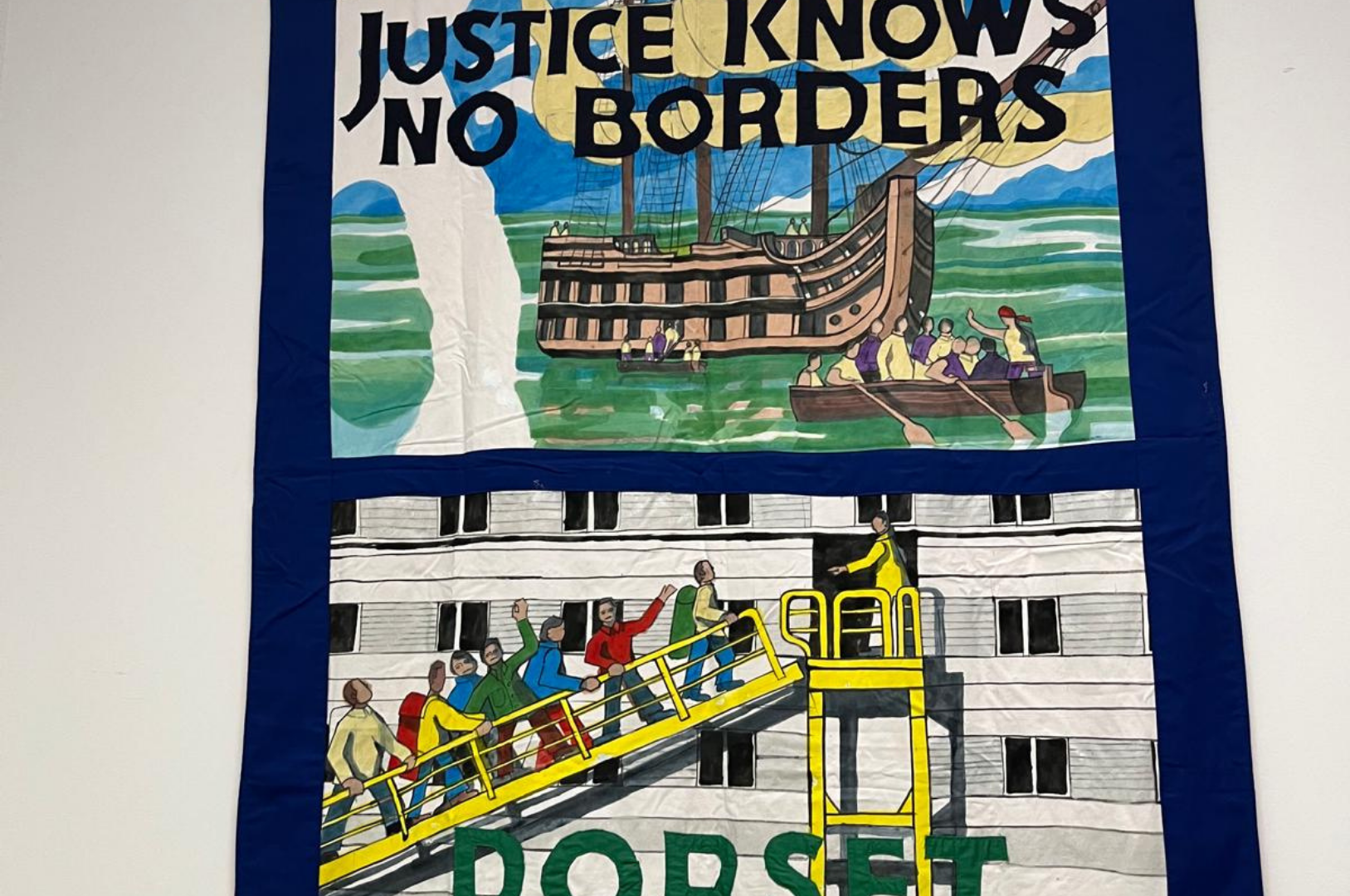
The Bibby Stockholm barge no longer operates as asylum accommodation, but its legacy in the UK government’s hostile borderscape lives on. However, the barge has another legacy – one that has often gone unseen. This is a legacy of solidarity and community, formed in Portland, Dorset, by the people living on the barge and in the surrounding community.
Tucked away from the bustling street markets of Brixton, London, sits Photofusion: a gallery, studio, film processing lab and small exhibition centre. I visited an exhibition in March this year, where photographs from Theo McInnes and Thomas Ralph were displayed.
At the Bibby Boys exhibition, photographs of the people housed within the Bibby Stockholm barge cover the walls of the small white room. They span the course of a year – almost the entirety of the barge’s 18-month docking in Portland. As well as giving us an insight into the men who lived on the Bibby Stockholm barge, Bibby Boys also dives into the landscape and seascape of Portland. Some of the photos show us how this landscape was experienced by those housed on the barge through activities like gardening, walking, and fishing, demonstrating Thom Tyerman’s understanding of “everyday solidarity” as a necessary starting point to combat processes of everyday bordering and hostility in the UK.
Bibby: a feature of the UK hostile environment
The Bibby Stockholm barge arrived in Portland, on the south coast of the UK in 2023, having been specifically refitted to accommodate over 500 asylum seekers. It emerged out of the government’s offshoring plans (where racialised migrants and refugees considered to be “undesirable”, as understood by Collyer and Shahani, are relocated as part of the UK’s extended colonial history). From the outset of the accommodation proposal, the plan was heavily criticised: Sarah Teather at Jesuit Refugee Service labelled it “performative cruelty”, while a group of academics submitting evidence to the government outlined how offshoring asylum accommodation follows “colonial patterns” reliant on “racialised logics of exploitation and control”. It soon made headlines for its health concerns, unsuitable conditions, and its role in a political sphere dominated by migration scares.
The Bibby Stockholm left Portland Port in January 2025: it was discontinued as part of the government’s plan to save £7.7 billion in asylum costs over the next ten years. But its legacy lives on through both the community and landscape of Portland. A key part of that legacy is the Portland Global Friendship Group (PGFG), which was created as a direct response to the Bibby Stockholm’s presence, as a way to make those arriving to the isle feel welcome.
The asylum seekers’ arrival, and the formation of the PGFG, was met with backlash from far-right groups, and Portland became the unexpected face of asylum accommodation at the time. In this sense, the barge became hypervisible, as described by Anne Neylon: a hypervisibility is engineered by the state by maintaining ‘irregular’ arrivals as a “political and legal spectacle”. This is intimately related to processes of invisibility, too, where people are subsequently made invisible by their forced removal into places offshore (e.g. through their removal to Rwanda or, of course, to the Bibby barge).
The ‘everyday’ stories of the barge, behind the headlines
The Bibby Boys exhibition tells a visual story of three sources of community and solidarity – the landscape, fellow asylum seekers, and PGFG members – that formed out of this hostile site of bordering and containment conducted under UK government policy. The photos show a soft, human side away from the volatility and anger the barge garnered amongst far-right groups. They also respond to both the hypervisibility and invisibilisation enacted by the state to portray the everyday experiences of the men.
In an introduction to the exhibition, the photographers cite Portland’s “longstanding insularity” encapsulated by an old Dorset phrase,“Bairn’t narn of we” (“ain’t one of us”). They describe how the phrase was used to refer to men on the barge. The introduction also underpins how the men were acquainted with the PGFG. The photographs emphasise this exclusion/welcome contradiction, as they capture how the men experienced the isle as a home, albeit temporarily.
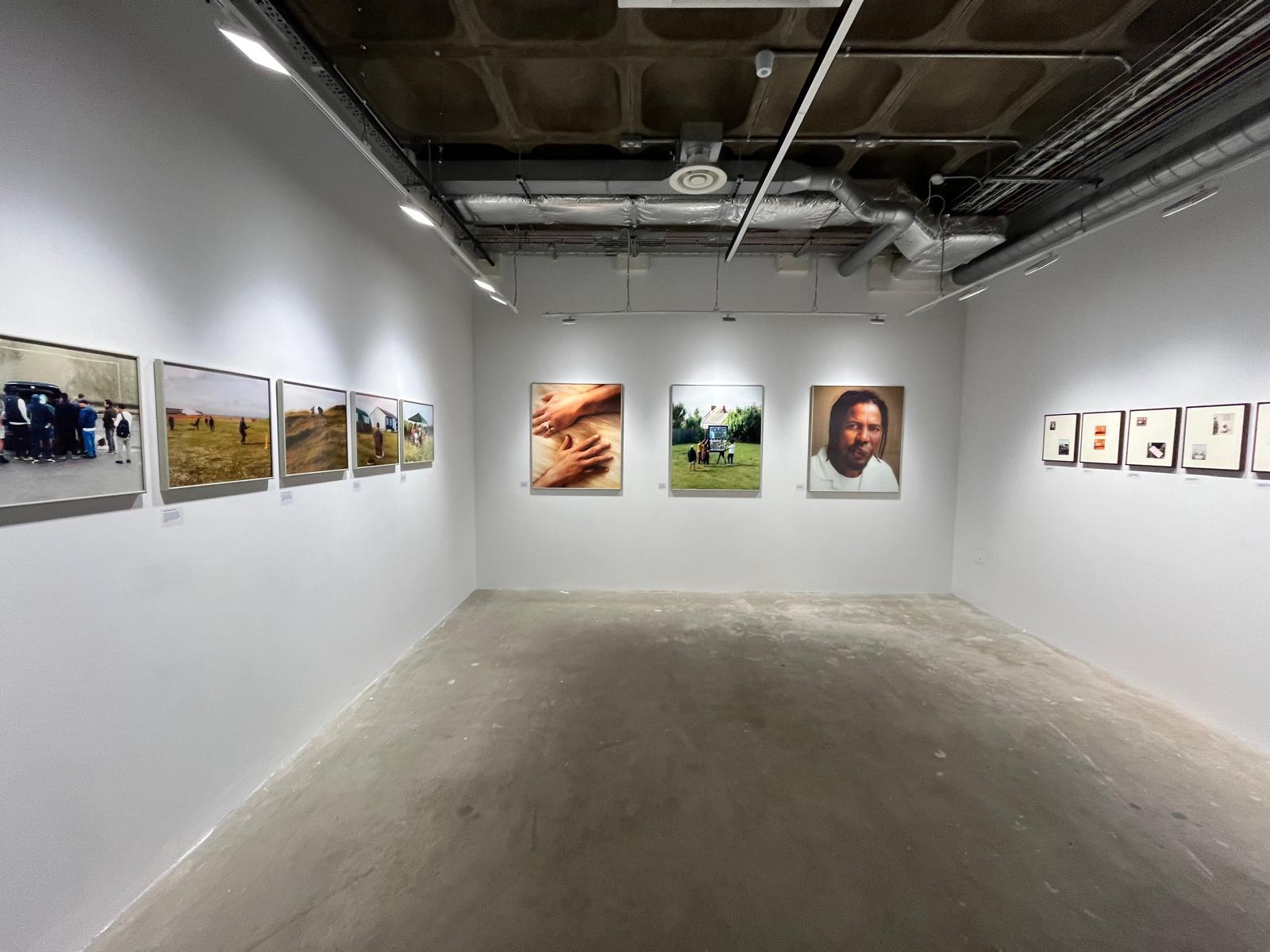
There are, importantly, no photographs of the barge itself. This omission rejects the violent hypervisible spectacle created by the state and re-made by the media, while instead visibilising forms of “everyday solidarity”. Those everyday activities include cooking, swimming, sports, and walking. ‘Rojyar Swimming Off Weymouth Beach’ shows Rojyar floating in the sea off the coast of Dorset, and ‘Cooking on Chesil Beach’ depicts Saeed and a few other men, barbequing on the beach. By showcasing their likes, activities, and friendships throughout their time housed on the Bibby, the photographs tell the quiet side of the story that was not reported on during its placement in Portland.
While absent visually, the Bibby Stockholm is ever-present in the placards that accompany each image. This entanglement is inevitable, being the place where the men were held in poor conditions and reportedly subject to abuse. These photos were taken on days where the men would leave the barge – having to go through a stringent “airport-style security system” (as told by a local authority member during a research interview) to exit and enter.
One photograph stands out in this regard, titled ‘BBQ in Weston’. A group of people sit beneath a gazebo, shaded from the sun, talking and relaxing. On the surface, this photograph shows a group of friends meeting up unspectacularly. But the accompanying placard reminds the viewer of its context, because the meet-up was held as a thank you for the men who had helped do some gardening for a couple from the PGFG. On the same day, violent anti-immigration protests were held in nearby Weymouth and across the country.
The image is a world away from the violent protest, and a glimpse into the quiet, everyday lives of those on the isle whose imprisonment and presence, rather than their personal, human stories, dominated anti-migration headlines. Despite the focus of my PhD research being on migratory Channel crossings to the UK, it was my first time seeing the faces and brief activities of the men housed on the barge, after years of hypervisibility around the asylum accommodation. Notes in the guestbook suggest similar experiences, as visitors expressed their gratitude towards the photographers for spotlighting this side of the Bibby Stockholm story – one grounded in community, solidarity, and compassion.
Rejecting the violence and sensationalism of borders
As Neylon informs us, spectacularised moments and image-based tropes not only shape understandings of migration, but they directly impact the content of the law itself. She uses Sunak’s ‘Stop the Boats’ Bill as example of this, and I suggest this type of encouraged hypervisibility is challenged by the Bibby Boys exhibition. The visual story told is focused on the ordinary and the everyday, rejecting both a violent, sensationalist spectacle and an invisibilisation of those housed onboard.
In this small exhibition room, a glimpse of this community can be found. Formed out of cruelty inside asylum accommodation, Bibby Boys spotlights everything we should be focused on when searching for alternatives to hostile bordering and anti-migration: solidarity, celebration, and compassion. While the Bibby barge is no longer operational, similar carceral practices continue – in particular in the form of military barracks – which have been criticised for their poor conditions and what Jesuit Refugee Service calls “the inhumane reality”. The Bibby Boys exhibition demonstrates how community is formed out of everyday acts of solidarity – an idea we can all take with us in responding to the normalisation of hostile and carceral bordering practices.
Any comments about this post? Get in touch with us! Send us an email, or find us on LinkedIn, Bluesky and Instagram.
How to cite this blog post (Harvard style):
G. Holmes. (2026) Bibby Boys: the legacy of the Bibby Stockholm barge is more than colonial hostility – it’s also one of community. Available at:https://blogs.law.ox.ac.uk/border-criminologies-blog/blog-post/2026/05/bibby-boys-legacy-bibby-stockholm-barge-more-colonial. Accessed on: 17/10/2026Share:
With the support of