Ireland’s hidden border violence: restriction and uncertainty for racialised migrants and asylum seekers
The Ireland-Northern Ireland border is often described as ‘soft’, but it does not operate equally. For many, it is a contemporary site of racialised border violence
Posted:
Time to read:
6 Minutes
Guest post by Dr Lynsey Black and Dr Niamh Keady-Tabbal. Lynsey is an Associate Professor in the School of Law and Criminology, Maynooth University and Maynooth University Social Science Institute. She is Principal Investigator on the Research Ireland funded Starting Laureate project, CONSPACE – ‘Contested Space: Penal Nationalism and the Northern Ireland Border’. Niamh is a postdoctoral researcher in the School of Law and Criminology and the Maynooth University Social Science Institute, Maynooth University. She works on the Research Ireland funded project, CONSPACE – ‘Contested Space: Penal Nationalism and the Northern Ireland Border.’
The concept of border violence has been increasingly deployed to draw attention to the harms produced by border regimes and their role in sustaining racialised global inequality.
This work has expanded understandings of violence beyond ‘spectacular’ acts of physical border enforcement, to the ‘slow’, everyday violence of bureaucracy. Yet much of it remains focused on visibly securitised border zones, at the ‘faultlines’ between the global north and south, where border enforcement is most pronounced.
In Ireland, the term border violence readily evokes the violent history of the land border during the Troubles. The border’s colonial origins have been widely examined. But this border is less commonly understood as a contemporary site of racialised border violence and has been largely overlooked within border criminology. As part of our research on the policing and lived experiences of the border on the island of Ireland, we are conducting focus groups and interviews with asylum seekers and refugees in the north-west, on both sides of the border. To date, we have spoken with 34 participants and the research is ongoing.
The lived experiences of racialised people reveal the border as a site which reinforces a critical understanding of borders not as “inert, fixed, or coherent ‘things’ but as ‘socio-political relations’.” Read in this way, the border on the island of Ireland emerges as a site of particular relevance for border criminology, not despite its apparent invisibility, but because of it.
Ireland’s Hidden Border
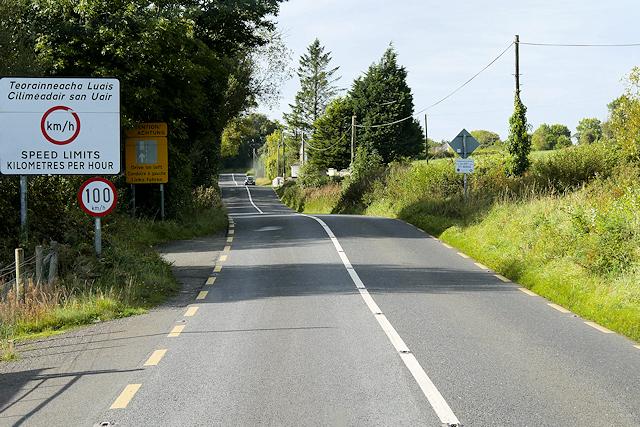
Since 1921, a border has partitioned the island of Ireland into two jurisdictions: 26 counties governed by the Irish State and six by the British, comprising Northern Ireland (we refer to the jurisdictions of ‘Northern Ireland’ and the ‘Republic of Ireland’ as legal-administrative terms, also using 'North of Ireland' to reflect that the naming and status of the counties under UK jurisdiction, and partition itself, are contested). On the ground, this 310-mile border is barely perceptible, signalled only by a change in road markings, license plates and the phone network. While often described as a ‘soft’ border, it does not operate equally for all. For migrants, asylum seekers, and racialised people today, the border continues to function as a site of exclusion and control.
During the period of conflict from the late 1960s to the late 1990s known as the Troubles, the border was heavily militarised through the closure of roads, the establishment of checkpoints and surveillance of cross-border mobility. This was carried out by the British Army operating alongside the Royal Ulster Constabulary, and disproportionately impacted Catholic, Nationalist communities.
Almost 30 years after the Good Friday Agreement, the border is no longer manifested in physical barriers. Instead, it is “performed into being” in everyday encounters shaped by law and racialisation: profiling, surveillance, ID checks, detention and deportation. The UK’s withdrawal from the European Union further intensified these dynamics by rendering the border zone an ‘external border of the EU’. While Northern Ireland remains aligned with certain EU single market provisions, Brexit has nevertheless generated new forms of legal precarity and exclusion.
The legal construction of the Ireland-Northern Ireland border
The Common Travel Area (CTA), first established in 1922 and consolidated through successive administrative arrangements, provides the legal framework by which the border is governed. From its inception, it created what Mary Gilmartin and others describe as ‘hierarchies of mobility’ based on nationality.
Irish and British citizens are entitled to live and work across both jurisdictions and are exempt from general immigration controls. Migrants and asylum seekers located in both jurisdictions remain subject to the ordinary visa, registration, and residence rules of both states, and may be refused entry or deported.
The CTA has always been predicated on the alignment of Irish immigration law with British, explicitly to prevent the ‘open’ border from being used as an alternative route into Britain. Today, Ireland generally imposes visa requirements on the same nationalities as the UK. Restrictive reforms introduced by the British government are paralleled by a tightening in Irish law and policy. Following UK migration reforms extending how long people must wait to gain permanent status, Ireland’s Minister for Justice Jim O’Callaghan stated he was “committed to ensuring that Ireland is not viewed more favourably than the UK” by asylum seekers, before announcing reforms to naturalisation and family reunification rules. O’Callaghan has also said that the CTA “is not for the benefit of citizens of other jurisdictions”.
Border(ed) lives
This framing is detached from the reality of life in (predominantly rural) border regions where work, education, healthcare and family life involves routine cross-border travel. Roads, services and infrastructure are organised around the assumption of routine cross-border movement.
For Irish and British citizens living in border counties, this movement is an unremarkable aspect of everyday life. For those excluded from CTA rights, these same journeys become a source of uncertainty and risk, sustaining what migrant rights groups have criticised as “a hard border for some.”
These effects are most acutely felt by those with precarious migration status living near the border. Asylum seekers have no lawful route to enter the other jurisdiction while awaiting the outcome of their protection claims, a process that can take years.
In a rural Donegal town, just twenty-minutes from the border, an asylum seeker recalled how a drive to Dublin took her through Northern Ireland, following a map on her phone, which, she remarked, “doesn't know that we are stateless.” Asylum seekers there are effectively cut off from Derry, their nearest city which happens to be in Northern Ireland, and its essential services, places of worship, cultural centres, African groceries and halal butchers. Parents spoke of their children being excluded from school-organised swimming lessons in Derry, and of having to explain to their children why they couldn’t attend a birthday party north of the border.
The same constraints apply to employment: asylum seekers are excluded from Northern Ireland’s labour market, where many local residents work. This is particularly significant given the Irish state’s new family reunification rules requiring income thresholds that asylum seekers described as “impossible” to meet.
For those living in Derry, in the North of Ireland, where amenities are more readily available, the restrictions of the border seemed less impactful in daily life, yet it remained associated with uncertainty and fears of being “caught on the wrong side.”
Policing the border
According to the UK Home Office, “there are no routine immigration controls on journeys within the CTA, and there are no immigration checks on the land border.” Yet both states retain powers to conduct “intelligence-led” operations which, in practice, rely on broad discretion and result in racial profiling.
Operation Gull, a joint UK-Ireland operation to target people moving ‘illegally’ between Ireland and Britain, exemplifies this discretionary approach. Civil society organisations have repeatedly highlighted the discriminatory character of these operations, which involve officers boarding buses and patrolling transport hubs, deciding – often on the basis of skin colour, accent, or perceived nationality – who is stopped. Those apprehended in Northern Ireland may be detained in Larne House, where they can be held for up to five days before transfer to mainland Britain and possible onward deportation.
These checks also frequently rely on counter-terrorism powers, including Schedule 7 of the Terrorism Act 2000, which allow police to stop, question, and detain people at ports or within one mile of the border without requiring reasonable suspicion. While use of these powers in Northern Ireland has been extensive, they have rarely, if ever, resulted in a terrorism-related detention.
South of the border, Operation Sonnet has played a parallel role. Gardaí (the national police force in the Republic of Ireland) conduct immigration checks on cross-border roads, which also disproportionately target racialised people. Gardaí may refuse entry or even arrest without warrant a person lawfully present if they suspect that the person intends to cross into Northern Ireland without authorisation, which can result in detention and forced removal.
Racialised hierarchies of mobility
Through the legal architecture of the CTA, the operation of immigration law and the everyday practices of policing, the land border on the island of Ireland is continuously enacted in ways that differentially structure mobility and immobility. For migrants, asylum seekers and racialised people, this otherwise ‘invisible’ border is experienced through restriction, uncertainty and the quiet, yet ever pervasive risk of removal.
Reading the harmful effects of the Ireland-Northern Ireland land border through the lens of border violence makes it clear that the uneven distribution of mobility rights is not incidental, but consistent with migration law’s historical role in producing racialised hierarchies of mobility.
Beyond the most direct expressions of state power at the border, border violence also encompasses forms of harm that unfold gradually, often invisibly, yet nonetheless structure the lives of those subject to the force of immigration control. In this sense, the Irish border is not an exception to broader dynamics of contemporary bordering seen throughout Europe, but a case through which the racialised organisation of human mobility becomes especially clear.
Any comments about this post? Get in touch with us! Send us an email, or find us on LinkedIn and Bluesky.
How to cite this blog post (Harvard style):
N. Keady-Tabbal and L. Black. (2026) Ireland’s hidden border violence: restriction and uncertainty for racialised migrants and asylum seekers . Available at:https://blogs.law.ox.ac.uk/border-criminologies-blog/blog-post/2026/03/irelands-hidden-border-violence-restriction-and. Accessed on: 22/10/2026Keywords:
Racism
Share:
With the support of