Negotiating a ‘fair price’ for migration partnerships: UK-Rwanda dispute in the Hague
Amid the £100m Rwanda-UK dispute, migration management partnerships are emerging as a key site of North/ South diplomacy
Posted:
Time to read:
6 Minutes
Guest post by Nicola Palmer. Nicola is based at the Centre for Criminology, University of Cape Town. She is the thematic co-lead for Border Criminologies’ work on Law and the Courts and the author of the book Courts in Conflict: Interpreting the Layers of Justice in Post-Genocide Rwanda.
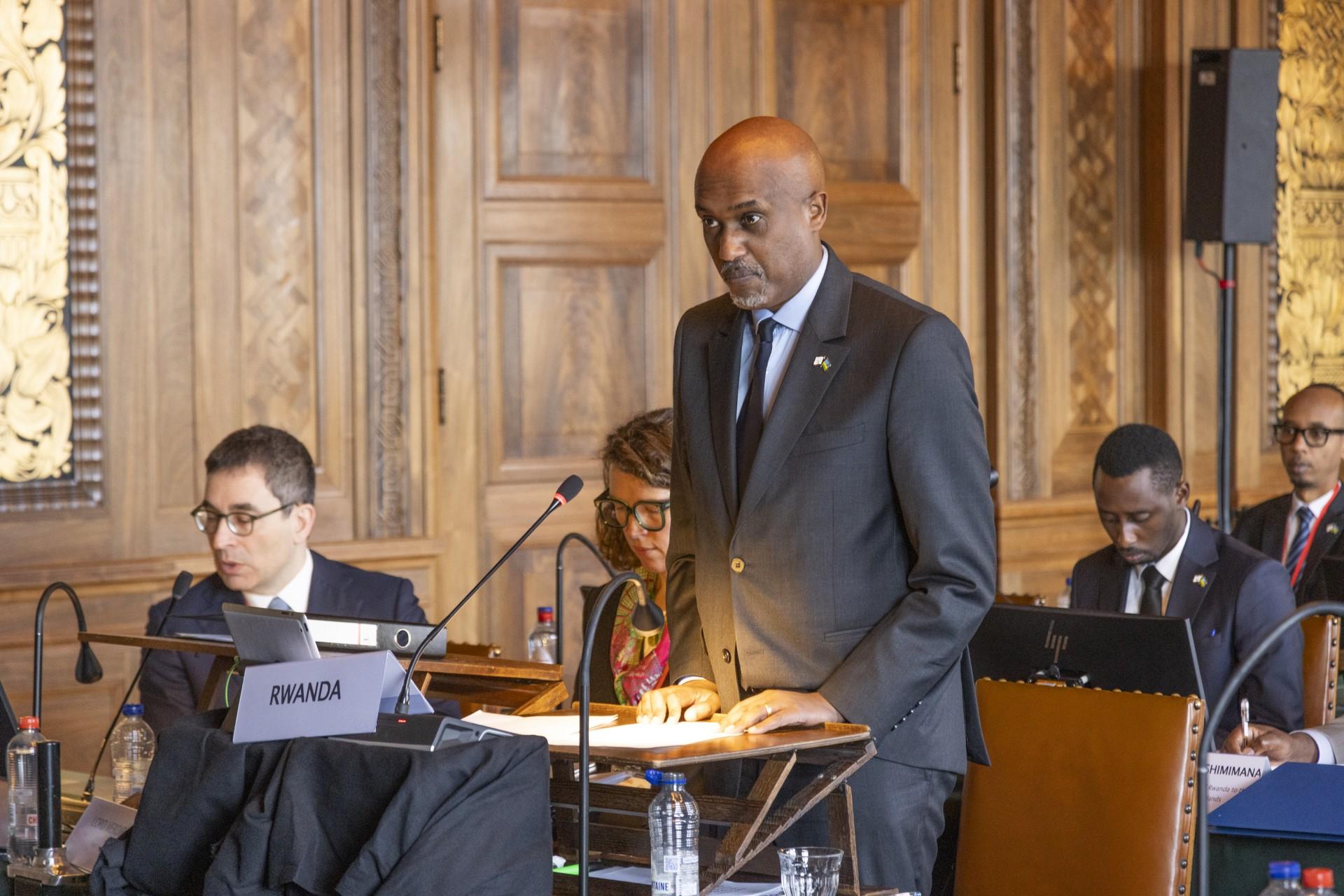
The UK and Rwanda’s Asylum Partnership Agreement is back in the courts. This time it’s the Permanent Court of Arbitration in The Hague. These legal proceedings lay bare how international refugee law is shifting as migration emerges as a key site of Global North/South diplomacy.
For the UK, the Asylum Partnership and the subsequent legal challenges have always been about its own internal immigration policies, as it has moved to limit its international obligations to offer refuge. For Rwanda, the relentless focus on restricting migration in the Global North has offered a key site for strategic diplomacy. Rwanda has negotiated financial payments and pushed other political agendas, notably the domestic prosecution in the UK of Rwandan nationals accused of involvement in the 1994 genocide against the Tutsi.
In this latest round of litigation, Rwanda is in dispute with the UK for its failure to make two payments of £50 million each and to complete arrangements for resettling a proportion of the most vulnerable refugees hosted by Rwanda to the UK, as required by a binding treaty agreement between the two states on 5 December 2023. The dispute forms part of a long political and legal saga that has run since the ‘Migration and Economic Development Partnership’ (MEDP) was signed in April 2022. Under that agreement, individuals whose asylum applications had been deemed automatically inadmissible in the UK would have been forcibly transferred to Rwanda to have their protection claims addressed there.
The MEDP ultimately collapsed after only four people had voluntarily moved to Rwanda. The UK Supreme Court found the partnership to be unlawful, prompting the UK government to enter into a treaty with Rwanda to offer greater procedural assurances. This new legally binding Asylum Partnership Agreement led to a set of financial arrangements laid out in an exchange of Notes Verbales in June 2024. However, after the Labour Party won the 2024 general election, the UK Prime Minister Sir Keir Starmer declared the asylum agreement “dead and buried”. This was the first notification Rwanda received of the UK’s intention to terminate the treaty.
At the Permanent Court of Arbitration: the latest dispute
At the heart of the current legal dispute are two issues. First, do the Notes Verbales signed between the two countries in November 2024 end the binding agreements on payments that the UK would make to Rwanda as part of the Asylum Partnership before any official notification of termination of the Agreement? Second, was a set of diplomatic exchanges between the two countries in March 2025 sufficient to meet the UK’s legal obligations under Article 19 of the Agreement to “make arrangements” to resettle Rwanda’s most vulnerable refugees in the UK?
The court is attempting to determine if the Note Verbales from November 2024 constitute a binding international legal agreement under the 1969 Vienna Convention on the Law of Treaties (VCLT). The legal counsel are arguing over Rwanda’s use of the word “acceptable” and the absence of any detail as to when the Note Verbale would come into effect. The resolution of this issue will determine whether the UK owes Rwanda the final payment of £100 million. Yet in moving down to this level of detail, it is important not to lose sight of what is at stake.
These are fights over determining the legal infrastructure of legitimate exclusion. The UK is fighting for an expansion of the right to exclude people claiming asylum from its territory. Rwanda is fighting for a Global South state’s right to benefit from this exclusionary shift.
From the start, the MEDP, now in the form of the Asylum Partnership Agreement, was driven by the UK’s endeavour to pursue a restrictive reading of its obligation to offer refuge under the 1951 Refugee Convention and the European Convention on Human Rights. In the AAA case in 2023, the UK courts found the MEDP unlawful but adopted a narrow reading of those international legal obligations, focused exclusively on non-refoulement. In this latest litigation, the UK continues to argue for a limited reading of its obligations, this time under that ‘safe-third country’ agreement. Article 19 of the Asylum Partnership Agreement, also included in the initial MEDP, states:
The Parties shall make arrangements for the United Kingdom to resettle a portion of Rwanda’s most vulnerable refugees in the United Kingdom, recognizing both Parties’ commitment towards providing better international protection for refugees.
The UK insists that “making arrangements” should be construed as only requiring an indication that the UK is willing to negotiate on what those arrangements could be, not on actually making them. It contends that the UK has met that obligation through an exchange of e-mails and an online meeting between the parties on 16 April 2025. Rwanda claims that this obligation was to negotiate to reach a specific set of arrangements and the UK refused to participate in these discussions. For Rwanda, it is on these grounds that the breach of an international legal obligation occurred – they are subsequently asking for £6 million compensation and an apology, or alternatively for an order that negotiations must be pursued.
The UK never took this reciprocal aspect of the Asylum Partnership seriously, with the UK government initially emphasising the low number of people who would be eligible. In the evidence presented to the PCA, a statement was cited by MP Tom Pursglove, who went on to serve as Minister of State for Immigration: “what I can say is that we are talking tens here”. Rwanda is arguing that “a portion of Rwanda’s most vulnerable refugees” needs to take account of the fact that it currently hosts approximately 135,000 refugees within its state borders.
Rwanda’s ‘fair price’
From the start of the legal challenges to the MEDP, Rwanda has been framed by the litigants as the major problem with the programme. For months, Rwanda was spoken about rather than to, in the courts and across UK media. Now their vision of global migration and South/North diplomatic relations has been placed front and centre in the PCA legal proceedings. As Lord Verdirame KC, representing Rwanda, emphasised, the UK had only ever been able to engage with the MEDP “through the prisms of its own policy objectives”, failing to recognise that Rwanda had its own reasons for entering into the partnership.
These reasons emerge in fragments through the legal proceedings. Dr. Emmanuel Ugirashebuja, Rwandan Minister of Justice and Attorney General, framed Rwanda’s approach to immigration in terms of many of its citizens’ and current leaders’ direct experiences of refugeehood, and the country’s commitment to a new market-oriented approach to refugee integration.
The image is, however, somewhat more complex on both sides. Diplomatic exchanges laid out in court show that the UK government was anxious to avoid having to push through the repeal of the ‘Safety of Rwanda Act’ before the next payment of £50 million was due on 13 April 2025. The new UK government did not want to appear ‘soft’ on immigration and did not want to repeal the Safety of Rwanda (Asylum and Immigration) Act 2024 until it was offering a wider set of immigration reforms. As the resultant Border Security, Asylum and Immigration Act 2025 demonstrated, these reforms retained the capacity to determine asylum claims as automatically inadmissible and increased the number of criminal offences associated with border crossings. In doing so, the UK government continues its active endeavour to limit its legal obligations to those fleeing persecution. This primary legislation has been built on with still further changes to Immigration Rules, which now require people to apply to renew their refugee status every 30 months.
Rwanda themselves expressed a willingness to negotiate to allow this legislative approach but asked for several diplomatic concessions in return. These requests included the movement of its own people across borders and the prosecution of members of its diaspora in the UK accused of involvement in international crimes. They sought a new diplomatic UK/Rwanda visa agreement, which the UK proposed could take the form of a visa waiver on up to 100 diplomatic passports.
In a later report shown to the PCA detailing a phone call between the UK Home Secretary and the Rwandan Minister of Justice, the Rwandan Minister stated an
interest in doing more and making further progress on broader cooperation… such as transit visas, judicial cooperation, military training, trade and investment. For instance, he reminded her that the UK remains the only country in Europe that has yet to prosecute or extradite genocide fugitives.
Rwanda wants these genocide prosecutions to go forward as part of its decades-long investment in seeking justice for those involved in the genocide. With cases being pursued in 21 different countries, these endeavours have also acted as a key means to control and discipline its diaspora. When the MEDP was first announced, President Kagame directly connected these potential refugee transfers to the need to ‘send back’ five genocide suspects from the UK. In a clip widely shared on social media, he said he hopes the UK will “send to us some people they have accommodated for over fifteen years who committed crimes here [in Rwanda].”
Rwanda’s involvement in this Asylum Partnership has been driven by a complex set of domestic and international drivers. The proceedings at the PCA make these diplomatic efforts publicly visible and judiciable. The UK’s own orientation has remained consistently focused on limiting its own obligations to offer refuge. Rwanda is arguing that shifting these obligations onto ‘third countries’ should come at a fair price.
Any comments about this post? Get in touch with us! Send us an email, or find us on LinkedIn and Bluesky.
How to cite this blog post (Harvard style):
N. Palmer. (2026) Negotiating a ‘fair price’ for migration partnerships: UK-Rwanda dispute in the Hague. Available at:https://blogs.law.ox.ac.uk/border-criminologies-blog/blog-post/2026/03/negotiating-fair-price-migration-partnerships-uk-rwanda. Accessed on: 23/10/2026Keywords:
Law and the Courts
Share:
With the support of