Descriptive statistics from penality on the move. Part 3: Danish Penal Aid
How does penal power travel beyond the nation state? This question has concerned border criminology for some time now, which have helped uncovered various ways in which humanitarianism has been put to work on and for penal power in legitimating its transfer beyond the nation state (see themed series on ‘penal humanitarianism’). In our current research project, we have set out to map the intersections of humanitarian reason and penal governance in detail, focusing on the forms of penality leaving Denmark, Norway, and Sweden through development aid—indeed, as a form of ‘penal aid’ handed over to other states, societies, and citizens and as part of the ‘crime-development’ nexus. In three country-specific blog entries, we present descriptive statistics and visualizations from our datasets on Danish, Norwegian, and Swedish penal aid from 1990 to 2022, focusing on ‘what’ Scandinavian penal aid is, ‘where’ it is delivered, ‘how’ it is categorized and funded, and through ‘who’, meaning, which actors are involved in this form of penal transfer.
Posted:
Time to read:
4 Minutes
Guest post by Andreea Ioana Alecu, Katrine Antonsen, and Kjersti Lohne. Andreea Ioana Alecu is Senior Researcher at Oslo Metropolitan University and Associate Professor at the Department of Criminology and Sociology of Law, University of Oslo. Katrine Antonsen is a doctoral researcher on the JustExports-project at the Department of Criminology and Sociology of Law, University of Oslo. Kjersti Lohne is Professor and Head of Teaching and Learning at the Department of Criminology and Sociology of Law, University of Oslo, and project leader of the research project JustExports—Promoting Justice in a Time of Friction: Scandinavian Penal Exports—funded by the Research Council of Norway. Lohne is also Research Professor at the Peace Research Institute Oslo (PRIO). This is Part 3 of a three-part mini series on Scandinavian Penal Aid.
As a Scandinavian welfare state, Denmark has traditionally been associated with a humane, welfare-oriented approach to criminal justice and punishment, although scholars have recently pointed to an acceleration of a ‘punitive turn – Nordic style’. In particular, border criminologists have pointed to the extended use of penal institutions to manage migration, and how Denmark ‘expands penal power to regulate non-citizens’. While this research has primarily focused on the expansion of penal power within the territorial borders of Denmark, we are interested in mapping how Danish penal power is also spilling over into the country’s international engagements—specifically, its development aid.
As concerns international development, Denmark is a slight ‘outlier’ to the otherwise humanitarian brand of the Scandinavian states. As research have shown, Danish development aid has also shifted throughout the past 30 years from a focus on altruism, humanitarianism, and poverty-reduction towards domestic self-interest, especially—again—with a view to manage migration.
Based on aid statistics from the Danish International Development Agency (Danida), we have compiled a dataset containing 2718 agreements which include elements of penal exports originating from Danmark in the period 1990 to 2022. Penal exports are models, money, personnel, institutions, laws, technologies, and epistemologies related to the complex of crime and justice. The data is more complete after 1998 and contains reliable information about disbursement budgets from 2005 onwards. Despite these limitations, the dataset can be used as a basis for understanding Denmark’s role in the crime-development nexus, and how penality forms part of its foreign aid engagements.
Where do Danish Penal Aid go?
The data encompasses both bilateral agreements and those involving multiple partners or regions. Over the entire period, around 25% of disbursements to penal aid were allocated to multilateral projects, while country-specific agreements accounted for 55.5%. Notably, total amounts to penal aid increased around 2010, alongside significant growth in bilateral agreements—from just five countries in the late 1990s to over 30 by the mid-2010s.
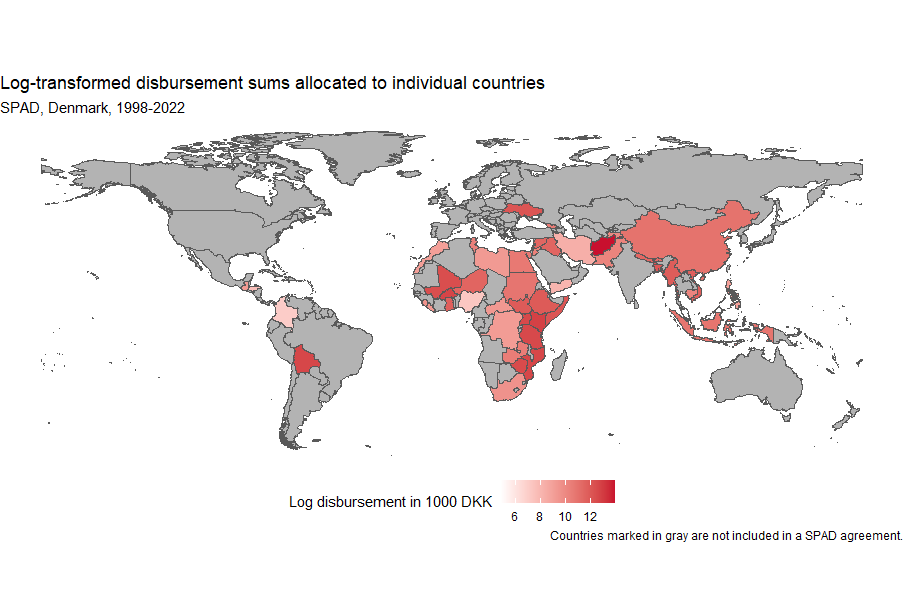
Figure 1 displays the total disbursements allocated to individual countries by Denmark. Throughout the period under review, Denmark maintained agreements with approximately 50 countries, predominantly in Africa and Asia, alongside its multilateral commitments. Notably, the five countries receiving the highest levels of penal aid disbursements were Afghanistan, Kenya, Burkina Faso, Mozambique, and Bolivia. It is worth noting that Figure 1 excludes agreements covering multiple countries or regions, which also represent a significant share of Danish penal aid.
Through which discourses do Danish penal aid travel?
Aid reporting—and statistics—have become incrementally streamlined and internationalized. Danida report according to the IATI data standard, which incorporates the use of OECD-DAC purpose codes (“sector codes”), which provide a systematic framework for classifying the sectors that funding is intended to support. The coding system allows Danida to define and categorize the objectives of its development assistance, while also reflecting the legitimizing discourses that frame and justify how and why aid is allocated.
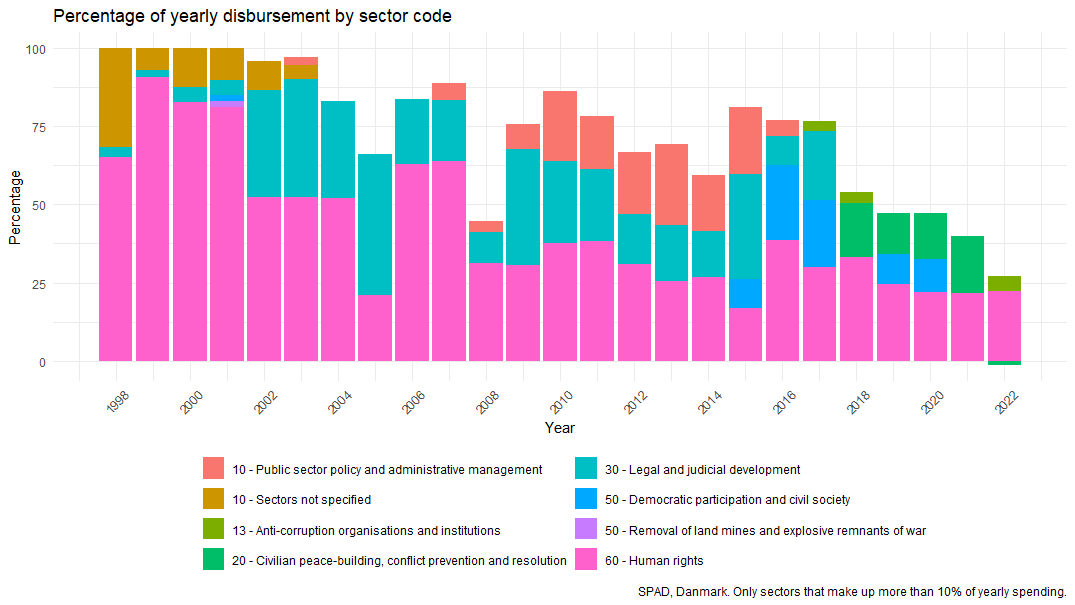
Figure 2 illustrates the annual share of disbursements to penal aid allocated to various sectors by Denmark, focusing exclusively on sectors that account for more than 10% of yearly spending. Up until 2005, over 50% of Denmark's disbursements were classified under "human rights" agreements. However, from 2005 onward, the share of disbursements under human rights agreements declined to approximately 25–30% annually. The second-largest category during the period was "legal and judicial development," consistently accounting for around 25% of yearly disbursements. Starting in 2014, two additional sectors—"democratic participation and civil society” and “civilian peacebuilding, conflict prevention, and resolution”—began to constitute more than 10% of annual disbursements to penal aid.
We additionally note that the number of individual agreements increased substantially in this period. Moreover, over time there has been increased variation in the indicated sector codes resulting in the largest sector codes included in the figure making up a smaller share of the total. This indicates a broadening of focus across various development and humanitarian areas over time.
Who are involved in Danish penal aid?
From 1998 to 2022, approximately 27.5% of Danish disbursements to aid projects including elements of penality were managed by governments, while 46.5% were handled by multilateral partners. NGOs accounted for 21.5% of the disbursements, with national NGOs playing a dominant role by overseeing around 16.6% of the total disbursements. Academic, training, and research institutions represented about 2% of the total disbursements, while public-private partnerships accounted for approximately 1.1%.
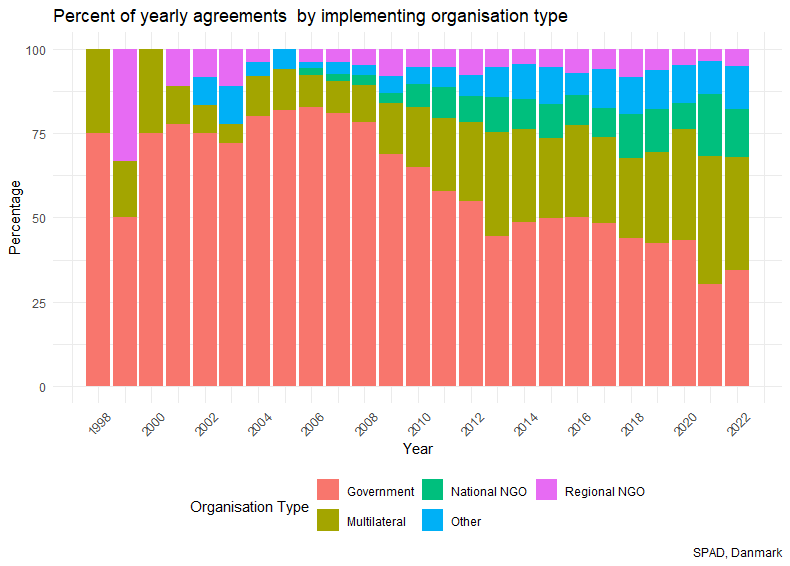
At the beginning of the period, governments were the primary implementing partners of penal aid, managing nearly 70% of the disbursements. However, by the 2020s, this share had declined significantly, with governments responsible for implementing only about 25% of the disbursements. In contrast, multilateral agreements saw a steady increase over the years, particularly from the early 2010s onward, eventually accounting for approximately 33% of the disbursements. The share of disbursements allocated to regional NGOs remained relatively stable throughout the period, whereas the share directed to national NGOs showed consistent growth, particularly from 2008 onward. By late 2020s national NGOs were responsible for implementing around 12% of disbursements involving penal aid.
Conclusion
These brief visualizations indicate the type of data and analytic insights that can be garnered from more engagement with the Scandinavian Penal Aid Dataset (SPAD), which we hope to make available open access soon. Overall, the dataset seeks to map and disclose the field of Scandinavian penal aid by establishing how penal exports are institutionally legitimated, and how these discourses vary across time and space. At a time of seismic geopolitical shifts and drastic budget cuts to international development aid, our dataset provides a yardstick for examining global crime governance under the past three decades, and for examining more systematically a type of penality travelling across borders—couched as aid to distant others.
Any comments about this post? Get in touch with us! Send us an email, or find us on LinkedIn and BlueSky.
How to cite this blog post (Harvard style):
A. I. Alecu, K. Antonsen and K. Lohne. (2025) Descriptive statistics from penality on the move. Part 3: Danish Penal Aid . Available at:https://blogs.law.ox.ac.uk/border-criminologies-blog/blog-post/2025/11/descriptive-statistics-penality-move-part-3-danish. Accessed on: 02/04/2026Share:
With the support of