The bodily remainder: Chicago organisers after the immigration ‘blitz’
Amidst ICE's brutal crackdown in the US, immigration enforcement in Chicago has slowed. But in the aftermath of 'Operation Midway Blitz', community organisers describe the new, more subtle pains that have emerged
Posted:
Time to read:
3 Minutes
Guest post by Monica Ruiz House. Mónica is a 2025 Marshall scholar who studies the metastasisation of the US-Mexico border. Her writings on the borderlands walk the line between academic and creative non-fiction, a nod to the Mexican-American women before her who wrote for the ‘space in-between.’ She currently organises with anti-deportation networks in Chicago and borderlands solidarity groups in Arizona (O’odham land).
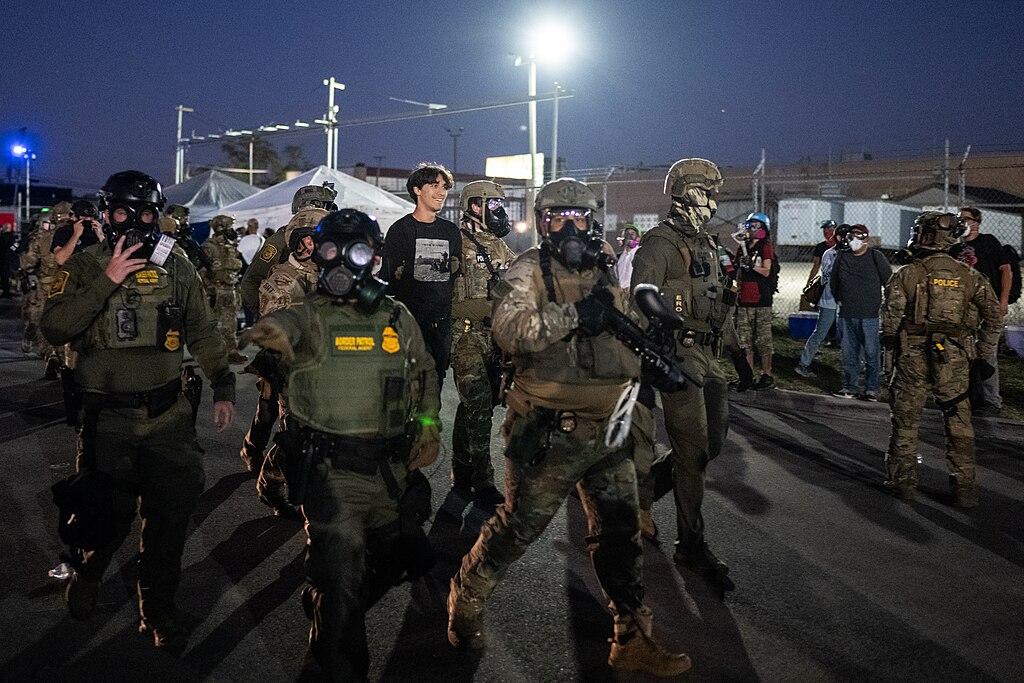
In early September, the US Department of Homeland Security (DHS) launched ‘Operation Midway Blitz.’ This immigration crackdown promised to target "criminal illegal aliens" who were “roaming free” because of Chicago’s sanctuary policies.
The subsequent operation did not make Chicago’s streets safer. Reportedly 4,500 people — of whom nearly 70% had no criminal record — were detained through what can only be described as siege tactics. These included roving patrols of unmarked vehicles, regular use of chokeholds and violent force in arrests, and racial profiling.
Heavy-headed tactics also spilled into crowd control. In clashes with protesters, federal agents deployed tear gas, smoke grenades, and rubber bullets 49 times over the span of two months. One protester was shot after federal agents claimed she sought to use her vehicle as a “deadly weapon.”
This brutality is not limited to Chicago. Most recently, an immigration crackdown in Minneapolis resulted in the killing of two legal observers and the detainment of over 3,000 people — one as young as five years old. One man who was detained in the crackdown has since died in immigration detention.
But while the Blitz has slowed as other cities fall into the crosshairs of the federal government, the physical toll of the siege on Chicago is not over. It has merely dispersed and taken on less spectacular forms. In particular, the forceful — and often unlawful — actions by immigration authorities have left behind thousands of witnesses to state violence: families and loved ones of the people detained, unlucky bystanders, and organisers who seek to prevent more deportations.
By focusing on the last category of organisers as an analytical site, we come to see how pain persists even after state oppression becomes less visible. From muscular tension to dysregulated nervous systems, the Blitz has settled into our bodies. This is the bodily remainder: where we continue to hurt in the after.
The Bodily Remainder
Marco literally cannot sit still. At work, he fidgets incessantly, bouncing between Excel spreadsheets and Signal messages. He is checking for alerts from his neighbourhood’s ICE-watch team, where he volunteers to investigate potential sightings. Constantly monitoring these channels has left him feeling “on a knife’s edge.”
Yet in the eerie and tenuous quiet following the Blitz, Marco’s physical tension hasn’t receded. If anything, it has shifted away from surface-level pain to something deeper. “We’re trying to fathom how things can get worse after experiencing so much,” he reflects. “It sometimes feels like a shot in the gut.” For Marco, the aftermath of the Blitz and the lingering question of immigration enforcement due to return is felt as an object lodged within him — a persistent wound underneath layers of muscle and bone.
Nearby on the west side of Chicago, another organiser named Kai is visibly shaken. Along with hundreds of other people, he’s protesting the killing of 37-year-old Renee Good that happened just days before. Good was shot to death by federal agents while observing an immigration raid in Minneapolis. For Kai, who also records detainments as a legal observer, Good’s killing means that his work has become riskier — and is registered in his body as continual tension.
Coping with this reality sometimes requires a physical outlet. As the crowd begins their march, Kai pauses. “I just need a quick shot for my nerves.” He disappears into a nearby bar for his choice of liquid courage and then rejoins the protesters. When I make light of this action, I am told, “it’s almost like soldiers sharing a cigarette in a fox-hole.” This comment, once again, roots the stress of organising in embodied terms. The buzz of a cigarette or the numbing effect of alcohol offers small, necessary comforts. But any relief is fleeting and cannot negate the inherent violence of ‘soldiering’ that has increasingly come to foreground resistance.
I admittedly don’t cope much better than other organisers. As the raids slow, my sleep suffers and strange apparitions begin to stalk my dreams. My estranged Mexican father appears to my younger self. He holds out his expired green card and tells me que no debo preocuparme [that I should not worry]. Soon, mija, these papers will be fixed. I am a child again, shuffling through the mail to find hidden know-your-rights cards that my American mother has printed out.
I am a child again. I do not have the words to rend this tightness from my chest. So instead, I hug my dad tight to stop my arms from shaking. But he too dissolves into the abyss of uncertainty.
For the fifth night in a row, I wake up in a cold sweat. Sheets have pooled on the floor and comforters have been kicked to the edge of the bed. Fatigue writes itself as unfamiliar lines on my face: dark circles under my eyes, furrows at the corners of my mouth. These are old pains, indexed by the current political moment. But there is also strange newness to them. Nightmares speak to an anticipatory anxiety that has yet to be realised for me or my family.
The bodily remainder, therefore, is not simply trauma that is left over. Nor is it even gratuitous or ‘surplus’ violence. The remainder speaks to the generative aftermath of harm. Indeed, these new aches are shaped — and made legible — by the shadow of spectacle.
Any comments about this post? Get in touch with us! Send us an email, or find us on LinkedIn and Bluesky.
How to cite this blog post (Harvard style):
M. Ruiz House. (2026) The bodily remainder: Chicago organisers after the immigration ‘blitz’ . Available at:https://blogs.law.ox.ac.uk/border-criminologies-blog/blog-post/2026/01/bodily-remainder-chicago-organisers-after-immigration. Accessed on: 19/10/2026Keywords:
From the Field
Share:
With the support of