
When many hands write a law, something odd can happen to its vocabulary. Civil-society groups, industry lobbyists, technical experts, and legislators share a drafting table for years and eventually sign off on a text they all believe they understand. Yet the agreement often rests on the quiet trick that parties have converged on a word without converging on its meaning. The hard conversation about what ‘deployer’ or ‘genetic information’ presupposes, and what using them legally entails, has been postponed. We argue that it is an overlooked pathology of multi-stakeholder lawmaking. Carl Schmitt saw a constitutional version in 1928; Weimar compromises that satisfied opposing camps by leaving the real decision open.
As many years of literature on this aspect show, vagueness can be a feature of law, and legislators routinely hand specification to courts and agencies on purpose. The trouble starts when nobody notices that specification has been deferred. Parties walk away believing they share a common meaning, and reconciling their divergent assumptions falls to downstream actors, eg, implementing agencies, litigants, and regulated firms, who were never part of the inclusive process and lack its breadth of knowledge. Multi-stakeholder drafting, whose entire justification is the integration of dispersed expertise, defeats itself the moment it seems to succeed.
Take the fundamental rights impact assessment (FRIA) in Article 27 of the EU AI Act - one of the two examples we use to illustrate our proposal. The Act was built on a product-safety grammar: AI as something to certify, with provider duties, conformity assessment, and CE marking. The FRIA, however, imported a different grammar from public law, in which what matters is who uses the system, on whom, in what institutional setting, and under what asymmetry of power. The two registers can certainly coexist in abstract, yet the Act never says what happens when they disagree. A CE-marked system is presumed compliant, while a deployer’s own assessment may surface risks the provider could never have seen. Must the deployer then refrain, modify, or file a note with the market-surveillance authority? The text is silent, so hospitals, insurers, and welfare agencies end up doing something close to fundamental-rights adjudication without a methodology, a template, or any of the procedural guarantees that discipline courts.
The AI Act is instructive because it didn't ‘fail’ for the usual reasons. In fact, both processes were long, deliberative, iterative, and evidence rich. Deliberation, iteration, and evidence simply never reached the layer where a statute’s new categories are constituted and prepared for codification. And existing experimental tools miss that layer too. That is why we thought regulatory sandboxes, the obvious source of our conceptual borrowing, could offer a useful template — a bounded environment where mistakes are recoverable, and alternatives can be compared side by side. However, regulatory sandboxes test practices against rules already in force, as their feedback arrives after the concepts those rules embed have hardened.
Hence, the proposal is to keep the sandbox and move it earlier. As a result, a conceptual sandbox is a controlled, pre-codification environment where lawmakers and stakeholders prototype, stress-test, and compare candidate concepts alongside the norms that apply. The method marries two disciplines, (1) conceptual engineering in philosophy, which provides ways to assess and improve concepts as cognitive tools, and (2) requirements engineering in computer science, which has long treated competing stakeholder viewpoints and tolerated inconsistency as design problems amenable to tractable methods. On this view, legal concepts are load-bearing interfaces, inferential nodes linking preconditions to consequences and actors to duties (a point already widely addressed in legal scholarship). If you under-specify the interface, downstream users will build incompatible workarounds, the legal equivalent of technical debt.
On these methodological premises, we build a protocol that runs from diagnosis to audit. The protocol has six phases (Figure 1). The first is mapping: identifying which concepts in a draft do the real work, so that changing them would change who owes what to whom, and asking what stakeholders are actually disagreeing about. Sometimes they disagree about facts or values; sometimes, less visibly, about what a shared word should mean. In Article 27, the concept doing the work is the deployer cast as an appraiser of fundamental rights.
The second phase predicts what will happen if that concept is enacted as drafted. For the FRIA, the prediction is that deployers will be asked to assess rights impacts without the expertise to do so and will produce something else that passes for the task.
The third phase seeks to disprove the prediction by constructing cases that could break it, much as software engineers hunt for bugs through fuzz testing and red teaming. Here the cases confirm it from opposite ends: a public hospital deploying AI triage lacks the capacity for individualized appraisal and falls back on a population-level proxy, while a multinational insurer has all the capacity it needs and produces a flawless document that changes nothing.
Predictions that survive enter the fourth phase—evaluation—where the drafted concept is compared with real alternatives. For the FRIA, these are the Commission’s original idea of the deployer as a mere product user, the Parliament’s far more demanding idea of the deployer as a quasi-public actor, and a middle option in which obligations are tiered by the deployer’s institutional role and its power over the people affected. The enacted text fares worst: it takes the heavy duties of the Parliament’s model and the Commission's thin operational support. The tiered option would most likely have won.
The fifth phase acts on that verdict, repairing the concept or, where repair is hopeless, replacing it. Here repair means splitting ‘deployer’ into public-function, high-asymmetry, and low-asymmetry deployers, the kind of decomposition conceptual engineers recommend when one category must cover too many different actors.
The sixth phase comes after enactment: an audit checks whether the predictions held, and a dossier records which trade-offs were tested, which alternatives were rejected, and which risks were knowingly left for later.
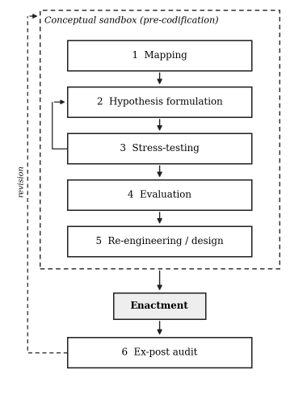
Figure 1. The conceptual sandbox protocol
Making conceptual choices explicit carries political costs, since strategic ambiguity is sometimes what gets a deal done. And institutionalized conceptual engineering raises legitimacy worries, which is why the sandbox is framed as participatory and reason-giving, a way of improving the quality of disagreement. The claim that remains is modest and pointed: in domains reshaped by fast-moving technology, experimental lawmaking only becomes learning when the concepts themselves are tested before they are fixed. Otherwise, as the 2026 Digital Omnibus rewrite of Article 27 suggests, the hard conversation is merely postponed to a more expensive venue.
The authors’ complete article can be accessed here.
Claudio Novelli is an Associate Research Scientist and Research Fellow Lead at the Yale Digital Ethics Center.
Luciano Floridi is the John K. Castle Professor in the Practice of Cognitive Science and the Founding Director of the Yale Digital Ethics Center.
Sofia Ranchordás is Professor of Administrative Law at Tilburg Law School.
Antonino Rotolo is Professor of Legal Theory, AI & Law, and Philosophy of Law at the University of Bologna.
Leendert Van der Torre is Professor of Computer Science at the University of Luxembourg.
Liuwen Yu is a Postdoctoral Researcher at the Luxembourg Institute of Science and Technology.
OBLB categories:
Commercial Law
OBLB types:
Research
OBLB keywords:
Artificial Intelligence Act
Jurisdiction:
European Union
Share:
With the support of
