
Tokenisation enables a fundamental shift in the financial markets as we know them today. Faciliated by Distributed Ledger Technology (DLT), smart contracts and adjacent advances in cryptography (particularly blockchain approaches), cloud infrastructure and Application Programming Interfaces (APIs), tokenisation is no longer a ‘digital wrapper’ which improves efficiency in traditional markets or an extreme alternative to traditional finance. Instead it makes possible a foundational shift in the infrastructure that underpins issuance, trading, custody and settlement across asset classes in the financial system today, as well as in the way users interact with money and finance, particularly in emerging market and developing economies (EMDEs).
After over 15 years of experimentation in cryptoassets and Decentralised Finance (DeFi), the long-term realisable value of tokenisation is shifting towards a combination of monetary and payment frameworks and instruments along with a focus on Real-World Assets (RWAs).
Much of the public debate on tokenisation has been shaped by priorities in advanced economcies (AEs), from modernising wholesale market infrastructure to improving efficiency of back-office operations, and enabling new forms of institutional liquidity. While these themes are important for all markets, aspects such as the development and depth of domestic capital markets, large informal sectors and higher costs of cross-border movement of capital and remittances are more relevant in EMDEs. Market development in EMDEs also differs – digital financial services have already scaled rapidly via mobile money, agent networks and fintech-led innovations in many of these markets.
Against this backdrop, in a new study at the University of Cambridge, we (i) identify promising use cases for RWA tokenisation in EMDEs, including which asset classes are being tokenised; (ii) investigate legal, regulatory, policy and infrastructure pathways that can enable responsible scaling, including the role of public-sector initiatives (such as policy strategies, regulatory responses, and tokenised money projects); and (iii) draw lessons from first movers and representative jurisdictions on how financial innovation can be harnessed for inclusive growth and deepening of capital markets.
Classification of assets and tokenisation approaches
Tokenised assets exist along a spectrum of design choices. These choices relate to ledger architecture, issuance pathway, custody arrangements, as well as the extent to which lifecycle functions move on chain, the openness of the underlying network and the distribution channels through which instruments are accessed. Classification of tokenised assets requires an assessment of all these dimensions.
While there are different ways in which tokenised arrangements can be structured, four main tokenisation approaches currently dominate markets: native issuance, custodial, collateralised and synthetic structures.
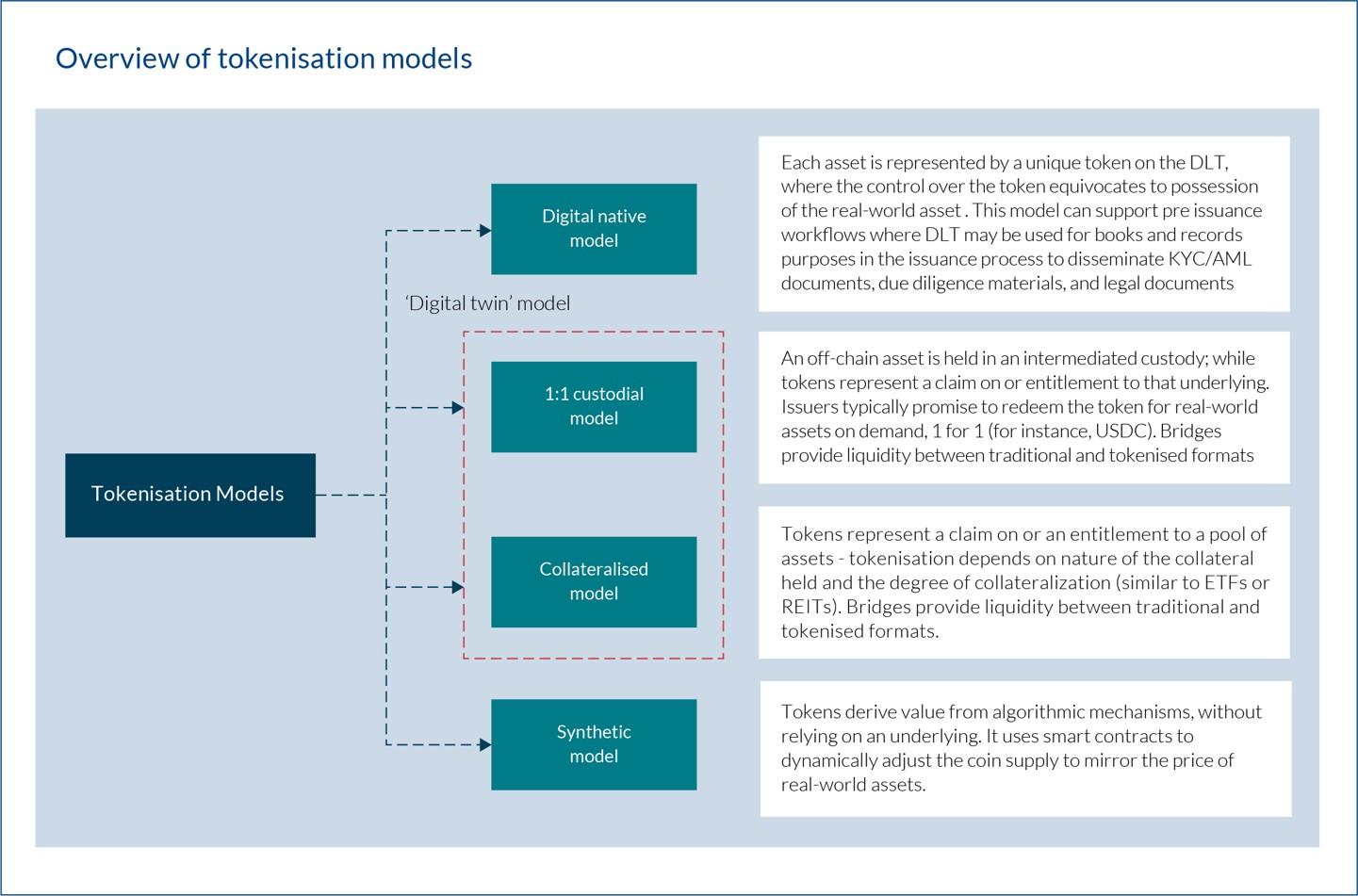
Opportunities and value proposition
The value proposition of tokenisation derives less from fractionalisation, a key enabler in Advanced Economies (AEs), than from its potential to reduce the administrative costs of small denomination offerings, automate compliance and servicing, improve post-trade processes, support more continuous secondary-market activity and enable composability across platforms.
A pronounced perception gap exists between industry and regulators: market participants report high levels of strategic priority (4.5/5) and organisational readiness (4.4/5) for tokenisation. However, regulators assess market activity as significantly lower (2.1/5), despite assigning it a relatively high strategic importance (3.9/5).
Broadening of access to capital is a primary adoption driver for EMDE market participants. Regulators view tokenisation through a financial sovereignty lens, seeking to retain domestic capital from offshore platforms and foreign-denominated instruments. Bringing these together provides an important opportunity.
Challenges and risks
Many of the risks present in products and activities in conventional markets persist in tokenised form but often manifest differently. For instance, fragmentation across competing, non-interoperable DLT networks and the prevalence of custom-built smart-contract standards risk splitting liquidity. Growing interlinkages between tokenised instruments and the broader cryptoasset ecosystem also create new transmission channels for financial stability shocks. Existing supervisory tools may not capture these risks.
Secondary-market activity for tokenised instruments in EMDEs remains limited, reflecting a self-reinforcing dynamic in which low liquidity discourages participation and weak participation further suppresses liquidity. This challenge is compounded by a lack of on-chain settlement instruments.
Regulatory and legal frameworks designed for assets in certificate or book-entry form do not always translate clearly to tokenised representations, particularly in EMDEs. The variety of structuring options tokenisation unlocks can also create ambiguity over investor rights and recovery prospects.
Operational and cybersecurity risks can manifest at the network level (ie node-management vulnerabilities, forking, etc), the smart-contract level (ie coding errors, bugs, etc) or the token level (theft/loss of private keys, custodial failures etc). Programmability can amplify these risks and windows of vulnerability that conventional business-continuity arrangements may not address.
While fractional ownership models can broaden retail access, many EMDEs face low financial literacy and limited investor protection safeguards. More complex tokenised products, combined with inadequate disclosure standards and weak governance, can heighten consumer exposure to fraud, misselling and operational failure.
Tokenisation can reconfigure instead of eliminating components of issuance, trading and post trading processes. An instance of this is ‘re-intermediation’—a lending protocol, for example, could separate liquidity provision, collateral management, and interest rate determination across distinct entities or smart contracts. This introduces questions around infrastructure governance, accountability, risk management, and consumer protection that existing regulatory frameworks may not fully address.
Policy, regulatory and infrastructure enablers
Regulatory approaches relating to RWAs can be grouped in three broad categories: the extension of existing securities frameworks, bespoke virtual or cryptoasset service providers regimes, and anti-money laundering registration frameworks focused on intermediaries and transactional flows. Applied in isolation, none of these approaches captures the full lifecycle of a tokenised asset.
In the majority of jurisdictions we have analysed for this study, regulators have yet to set out and clarify what, when and how regulation applies to tokenised instruments. Where the rules do exist, they focus on primary market issuance. Rules on custody, transfer and post-trade activities remain under-specified.
The most effective regulatory responses combine experimentation with institutional coordination. Sandbox-based approaches remain the preferred mechanism for testing tokenisation use cases.
Legal uncertainty persists over the property rights attached to tokens, the enforceability of smart contracts, the status of private keys, and the reconciliation of operational and legal settlement finality.
Interoperability across Digital Public Infrastructure (DPI) layers (including payments, digital identity, registries and data systems) is the defining feature of a viable tokenised market development.
A minimum viable ecosystem for scaled adoption comprises appropriate regulatory frameworks, credible settlement infrastructure, mature digital infrastructure enablers, the availability of industry functions across the tokenisation lifecycle (ie. issuers, tokenisation platforms, distribution platforms and secondary markets, financial market infrastructure, custodians, transfer agents, as well as infrastructure and data service providers), and secondary-market and redemption arrangements.
Conclusions
Tokenisation's potential to reshape financial markets is both evolutionary and revolutionary. In our study, we have explored the asset classes and lifecycle activities already being brought on-chain and examined how tokenisation can expand access to capital, strengthen financial inclusion, and generate measurable benefits across the financial product lifecycle in both public and private markets. We have also reviewed the legal, regulatory, and policy frameworks emerging, including the role of public sector initiatives such as regulatory sandboxes in supporting adoption and interoperability.
As in other phases of technological change in finance, the evolution from tokenised finance will be shaped as much by policy, legal, regulatory and institutional design and market structures as by technology and market dynamics.
The authors’ complete study is available here.
Hatim Hussain is a Research Affiliate at the University of Cambridge Centre for Alternative Finance and a DPhil candidate in Law at the University of Oxford.
OBLB types:
Research
OBLB keywords:
Tokenisation
Digital assets
Distributed ledger technology
Emerging markets
Market infrastructure
Jurisdiction:
International
Share:
With the support of
