Increase in ICE Detainer Requests Follows Georgia's HB 1105, Deepening Impact on Latin American and African Residents
Posted:
Time to read:
11 Minutes
Guest post by Austin Kocher. Austin is a geographer and a research fellow at the Immigration Lab at American University, and President of Relevant Research. His research examines the ideas, laws, and practices behind the U.S. immigration enforcement system, from border enforcement and ICE arrest and detention to the immigration courts. He relies on public records, Freedom of Information Act requests, and large-scale data analysis to untangle that system, and he writes about immigration enforcement data at austinkocher.substack.com.

Although the federal government is formally responsible for immigration enforcement, the routine practices of state and local law enforcement play an instrumental role in who is arrested and jailed, and subsequently subject to immigration enforcement actions regardless of the individuals’ actual legal status in the country. These routine practices are significantly shaped by state legislation. In recent years, many U.S. states have passed laws intended to increase flows into this arrest-to-detention pipeline, laws that risk exacerbating civil rights violations for foreign-born populations and racial/ethnic minorities who face heightened scrutiny irrespective of immigration status. Local law enforcement agencies do not control ICE’s immigration enforcement policies, priorities, or practices. Yet local agencies do play a powerful—and often invisible—role in shaping who is stopped, arrested, and booked into local jails, where they then become targets for immigration enforcement.
To assess the impact of state-level arrest-to-detention pipeline laws, this report focuses on the measurable effects of HB 1105, the Georgia Criminal Alien Track and Report Act of 2024, signed into law by Governor Brian Kemp on May 1, 2024. As a prime example of arrest-to-detention pipeline laws, this law requires local law enforcement agencies to use imputed citizenship as a factor in arrest and booking decisions, effectively transforming routine police encounters into a pipeline for immigration screening that disproportionately targets foreign-born residents and racial and ethnic minorities.
The data reveals three key findings:
- Detainer requests increased after HB 1105 and surged further under the Trump administration.
- Latin American residents are disproportionately targeted by ICE detainer requests relative to their share of Georgia’s foreign-born population, and detainer requests for both Latin American and African residents increased significantly after HB 1105.
- Georgia is a national outlier in per capita detainer request rates among states with significant foreign-born populations.
Stated plainly: detainer requests to Georgia’s jails increased after HB 1105 went into effect, and they increased specifically for residents from Latin America and Africa, and this appeared to lay the groundwork for an even more substantial increase in detainer requests during the second Trump administration. Statistical testing shows that none of these increases can be explained by chance. The remainder of this report first explains why ICE detainer requests can be used as a measure of local law enforcement activity, then discusses each of the three findings in detail.
Detainer Requests as a Measure of Local Enforcement Activity
ICE’s immigration enforcement activity is most often associated with visible actions such as worksite investigations and raids; community sweeps that involve high numbers of street arrests over a short period of time; and residential home arrests that typically involve the execution of an administrative (non-judicial) warrant and often result in collateral arrests beyond the intended target. But ICE’s most visible enforcement actions typically make up a minority of its total number of arrests. Normally, around 60 to 70 percent of ICE arrests come from custodial arrests: i.e., arrests where another agency (typically a state or local agency) originally booked someone into jail and ICE simply takes custody of the person in jail or as they are leaving jail. For example, from January to October 2025, a period of highly publicized growth in ICE street arrests, half of all immigration arrests still came, according to Deportation Data Project data, from the transfer of non-citizens from other federal, state, and local facilities into ICE custody. In practice, what this means is that even in one of the most aggressive periods of immigration enforcement in recent memory, at least half of all ICE “arrests” are actually the result of arrest and book-in decisions initially made by local officers, not ICE officers.
The main mechanism for turning local arrests and book-ins into federal immigration enforcement targets is what is known as a detainer request. A detainer request, also called simply a “detainer,” is a request from ICE to the local jail asking the jail to hold a person so that an ICE officer can take that person into custody or asking the jail to inform ICE when the person will be released so that ICE can execute a federal arrest immediately upon release from local custody. Detainer requests are typically triggered by information sharing and fingerprinting that occurs at the point of book-in. The Department of Homeland Security receives information about local book-ins, and, if ICE suspects that someone has an immigration violation, they may send a detainer request to the jail—usually very quickly—to take further enforcement action. Although some jurisdictions have a 287(g) Memorandum of Agreement (MOA), which allows them to officially take on certain delegated immigration enforcement authorities, a 287(g) is not a prerequisite for a detainer request; ICE can send a detainer request to any jail facility. Thus, every book-in to a county jail functions as a type of digital immigration checkpoint with significant legal, social, and economic consequences for people who are transferred to ICE custody—regardless of whether they are in the country lawfully or whether they are ultimately deported.
ICE’s reliance on captive populations in county jails as a source for immigration enforcement actions is not a secret, not to law enforcement officers and certainly not to state legislatures. Under normal circumstances, ICE detainer requests might be described as targeting people encountered by local officers during the routine execution of their independent duties. But this is not the case in states where a perverse political incentive to target minority populations has prompted legislation that encourages—or even requires—law enforcement officers to increase book-ins for the purpose of exposing residents to punitive immigration consequences. In this way, state legislation like HB 1105 creates a feedback loop that changes policing practices by forcing them to act as proxy immigration officers because they are required to book a wide spectrum of the public into jail, where they will face a virtual immigration screening. What makes this feedback loop uniquely pernicious is that it creates a thin veneer of plausible deniability for local law enforcement and ICE: ICE can claim that it is not involved in the initial arrest and book-in process and thus only acting on people who are in local jails, and local law enforcement agencies can claim that they are simply enforcing the laws of their jurisdiction rather than usurping federal immigration enforcement authority.
In the absence of comprehensive state-wide data in Georgia, detainer requests are a useful indicator of local enforcement activity. The issuance of a detainer request typically involves some level of subjective decision-making by ICE officers—but the agency submits far more detainer requests than it is ever able to act upon. In recent years, the percentage of detainer requests that result in ICE effectively taking custody has declined from 36 percent to about 13 percent per fiscal year according to TRAC’s detainer data, a trend which TRAC reported in April 2025 continued into the early weeks of the second Trump administration. Thus, detainer requests are not a reliable proxy for ICE arrests. However, detainer requests are a useful metric for evaluating local law enforcement activity that has potential immigration consequences. For example, changes in local law enforcement actions that affect the foreign-born population and other minorities can be expected to impact the total number of people whose biometric information is sent to ICE and, therefore, the total captive population that ICE culls for possible detainer requests (regardless of whether ICE effectuates an arrest).
HB 1105 in Georgia is an example of legislation that attempts to leverage the influential role of local law enforcement officers within the larger immigration enforcement system to increase the exposure of the foreign-born population and other racial/ethnic minorities to the digital immigration checkpoint at local jails. HB 1105 attempts to accomplish this by implementing a subtle yet crucial shift in how law enforcement officers are required to act. Previously, law enforcement officers had the discretion to investigate immigration status if someone did not have identity documents on them; HB 1105 removes officer discretion and requires them to take individuals to the local jail to run them through the digital immigration checkpoint that occurs during the book-in process. In practice, this requirement transforms routine traffic stops and other law enforcement interactions into the first step in an inexorable pipeline of arrest, book-in, and immigration check—resulting in the issuance of a detainer request—that disproportionately affects foreign-born and other minority populations regardless of actual immigration status and citizenship.
The Deportation Data Project’s data on ICE detainer requests, including total detainer requests issued and the composition of foreign-born populations in the data, reveal three significant findings.
Finding 1. Detainer Requests Increase After HB 1105, Further Amplified by Trump Administration
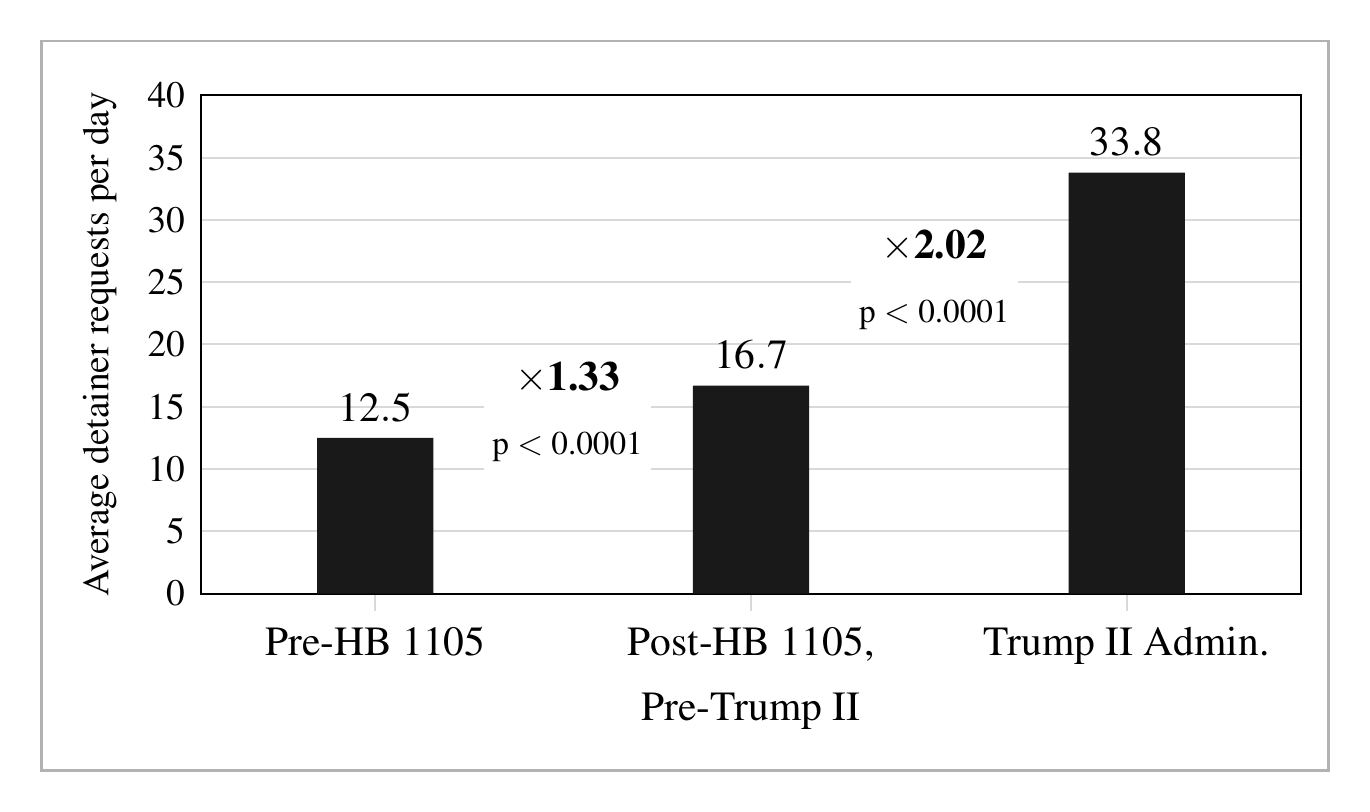
Available data on ICE detainer requests shows that the signing of HB 1105 coincides with an increase in detainer requests to Georgia’s jails. Between September 1, 2023, and the signing of HB 1105 on May 1, 2024 (Period 1), local law enforcement activity prompted ICE to issue an average of 12.5 detainer requests per day. After HB 1105 went into effect, but before the start of the second Trump administration (Period 2), this increased to 16.7 on average. Statistical analysis confirms that this 1.33 increase is not due to chance. After the start of the second Trump administration (Period 3), the number increased further to 33.8 detainer requests per day sent to Georgia, a 2.02 increase over Period 2, also not explainable by chance. The dramatic increase in ICE detainer requests sent to Georgia at the start of the second Trump administration risks overshadowing the prior increase in detainer requests that occurred after the implementation of HB 1105 and minimizing the effects of HB 1105. But the data shows that HB 1105 did coincide with an observable, non-random increase in detainer requests, consistent with the new legal requirement to book people into jails for an immigration check as a part of routine policing.
Finding 2. Disproportionate Targeting of Latin American Residents, Significant Increases for African Residents
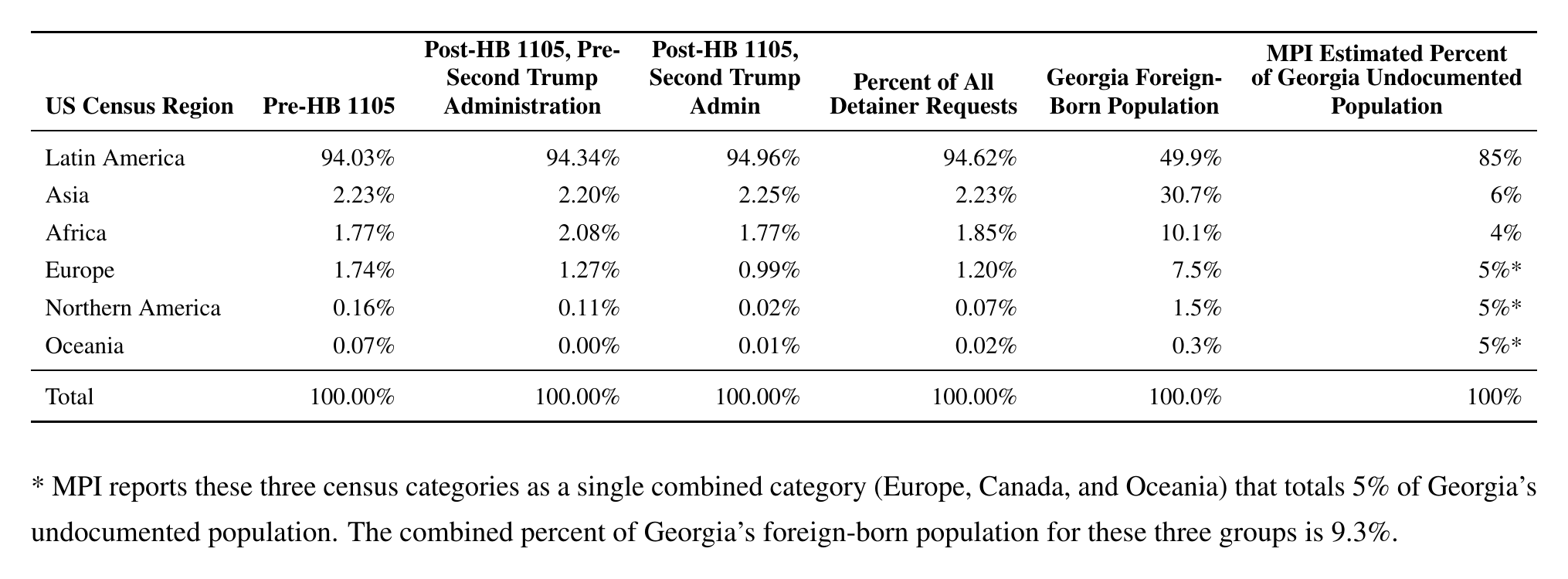
According to U.S. Census data, Georgia’s foreign-born population totals 1.3 million people. People from Latin America make up 49.9 percent of the foreign-born population, Asians make up 30.7 percent, Africa 10.1 percent, and Europe 7.5 percent. (See Table 1.) Yet the total number of detainer requests issued differs markedly from these numbers. About 95 percent (94.6) of all ICE detainer requests issued as a result of local law enforcement book-ins were for people from Latin American countries. People from Asian countries account for 2.2 percent, Africa 1.9 percent, and people from Europe, Northern America, and Oceania account for 1.2, 0.07 and 0.02 percent respectively.
The heavy focus on Latin American residents in Georgia cannot be explained using estimates of Georgia’s undocumented population: although 85 percent of the state’s undocumented population is estimated to be from Latin America, this is still significantly below the rate of detainer requests for Latin Americans; meanwhile, people from Asia, who compose 6 percent of the state’s undocumented population, Africa, who compose 4 percent, and Europe, Canada, and Oceania, who together compose 5 percent, are all significantly underrepresented in the detainer request data.
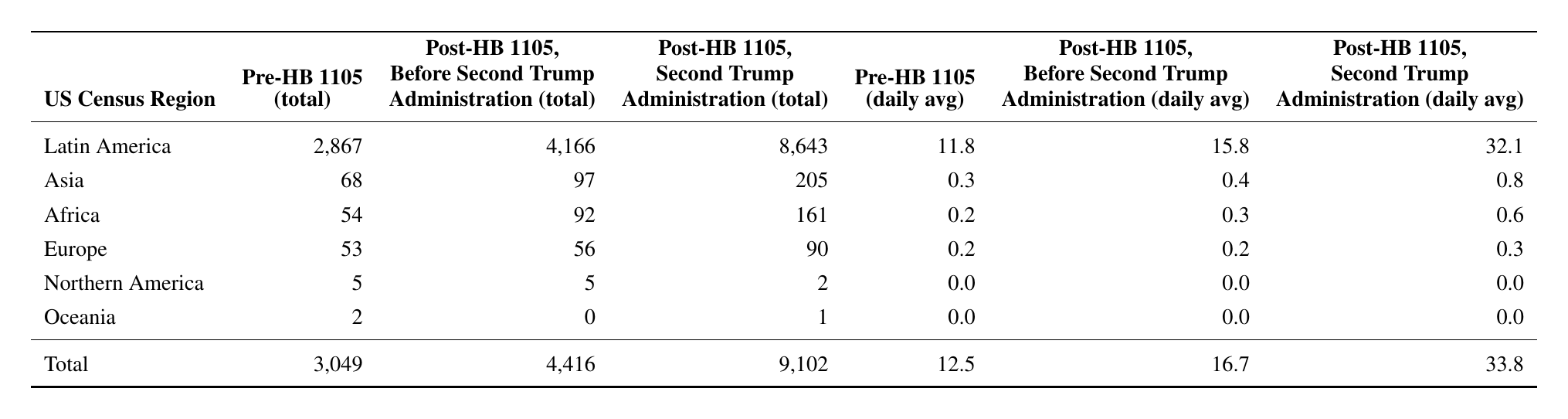
In addition to Latin Americans making up a larger-than-expected fraction of detainer requests, statistical analysis finds that the increases in the average daily number of detainer requests in Georgia for both Latin Americans and Africans are not due to randomness. The average daily detainer requests issued for Latin Americans increased by a factor of 1.34 after the official implementation of HB 1105. (See Table 2 and footnotes.) The likelihood that this was due to randomness is less than 1 in 10,000 (p0.0001), a strong indicator that this change reflects a real shift in enforcement rather than chance. Detainer requests involving people from African countries also increased significantly during the same period, by a factor of 1.57, with a likelihood of less than 1 in 100 that the change was due to randomness (p0.008). Changes for Asian and European nationals were not statistically significant, meaning the available data cannot rule out that those changes were due to chance.
The shift from Period 2 to Period 3 marks an even more significant increase in detainer request rates across regional groupings. The average daily detainer requests for Latin Americans more than doubled, increasing by a factor of 2.04; the likelihood that this change was due to randomness is again less than 1 in 10,000 (p0.0001). Unlike the period in 2024, the period beginning January 2025 under the Trump Administration is associated with statistically significant increases across nearly every regional grouping with sufficient counts, including people from Asian, African, and European countries. Thus, the data shows that while the implementation of HB 1105 coincided with a selective, disproportionate increase in detainer requests, with statistically significant increases concentrated among Latin American and African nationals, the increase in detainer requests under the current Trump administration was actually less selective by region of origin.
Finding 3. Georgia Is a Hot-Spot for ICE Detainer Requests After HB 1105
Based on population demographics of the state, jail facilities in Georgia generated a disproportionately high number of detainer requests relative to its foreign-born population for the entire span of the data, from September 1, 2023, to October 15, 2025. Georgia received the fourth largest number of detainer requests of any state in the country (16,674)—trailing only California (79,567), Texas (74,063), and Florida (31,738)—despite having the eighth largest foreign-born population in the country. Georgia’s foreign-born population (1.3 million people) is much smaller compared to California (10.9 million), Texas (5.8 million), Florida (5.4 million), and New York (4.6 million), according to U.S. Census data.
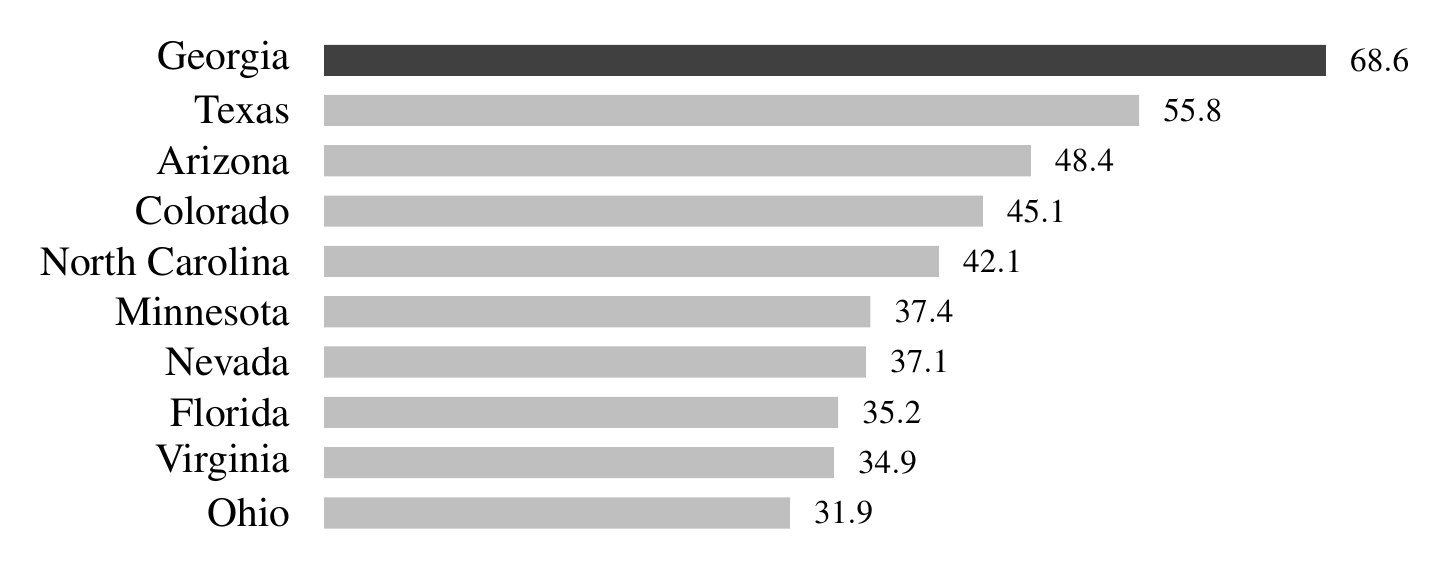
Georgia’s uniquely large number of detainer requests resulting from local law enforcement activity grew even more during the Trump administration. Among the 20 states with at least 500,000 foreign-born residents, Georgia ranked third in detainer requests per 10,000 foreign-born residents both before and after the implementation of HB 1105. Under the second Trump administration, Georgia now has the highest concentration of ICE detainer requests of any of these states at 68.6 per 10,000 foreign-born residents, corresponding to the expected and intended consequences of the changes in local law enforcement practices brought about by HB 1105.
Footnotes
- ^ Of the 225,757 ICE administrative arrests conducted from January 1, 2025, to October 15, 2025, 112,950 (50.0%) came through custodial arrests (i.e., arrests where a non-immigration agency took custody initially, then transferred custody of the individual to ICE).
- ^ Detainer requests typically enable a non-federal agency to hold someone for up to 48 hours (72 hours over the weekend). However, in practice, questions remain about whether these 48 (or 72) hours are lawful in themselves, while many cases exist of individuals being held far beyond this limited timeframe.
- ^ County jails typically have some degree of latitude as to whether to comply with the detainer request, although state and local law may require or, conversely, prohibit complying with the detainer request.
- ^ A detainer request alone is not a determination of immigration status. ICE’s own data shows that detainer requests have been issued for U.S. citizens. Immigrants who do not have legal status and may be subject to a detainer request include non-citizens who entered the country lawfully in order to seek asylum or other humanitarian protections.
- ^ Comparing daily detainer request rates across periods using a Poisson rate test: the overall rate increased by a factor of 1.33 from the pre-HB 1105 period to the post-HB 1105 period (p 0.0001), and by a factor of 2.02 from the post-HB 1105 period to the second Trump administration period (p 0.0001). Tests use the 16,567 classifiable detainer requests and period lengths of 243, 264, and 269 days.
- ^ Following US Census classification of world regions.
- ^ Migration Policy Institute (MPI), “Unauthorized Immigrant Population Profile: Georgia” (2023 estimates), https://www.migrationpolicy.org/data-tool/unauthorized-immigrants/ga. MPI estimates Georgia’s undocumented population at 479,000. The Latin America figure combines MPI’s Mexico and Central America (339,000), Caribbean (15,000), and South America (54,000) categories, totaling 408,000, or 85 percent. MPI reports Europe, Canada, and Oceania as a single combined category.
- ^ This analysis includes the 16,567 detainer requests (99.4 percent of the 16,674 in the data) issued for people whose recorded nationality falls within a U.S. Census world region. The remaining 107 requests are excluded from region-based calculations: 103 with no nationality recorded in the data, 3 issued for people recorded as U.S. citizens, and 1 with a nationality outside the listed regions.
- ^ Pre-HB 1105 includes detainer request data from September 1, 2023, to April 30, 2024. Post-HB 1105 includes data from May 1, 2024, to January 19, 2025. The Trump administration includes data from January 20, 2025, to October 15, 2025.
- ^ A p-value of 0.0001 means that the likelihood that the observed change is due to mere randomness is less than 1 in 10,000. In similarly-situated research, a p-value of at least 0.05 is typically required for peer-reviewed publication; p0.01 is typically considered a strong indicator of non-randomness. The p-value of 0.0001 in this study far exceeds typical scholarly standards for non-randomness.
- ^ From the pre-HB 1105 period to the post-HB 1105 period, average daily detainer requests for Asian nationals increased by a factor of 1.31 (p0.084), and the rate for European nationals was essentially unchanged (a factor of 0.97, p0.88). Neither result reaches the conventional p0.05 threshold for statistical significance.
- ^ Average daily detainer requests increased by a factor of 2.04 for Latin Americans (p0.0001), 2.07 for Asian nationals (p0.0001), 1.72 for African nationals (p0.0001), and 1.58 for European nationals (p0.007) from the post-HB 1105 period to the second Trump Administration.
- ^ States limited to significant immigrant-receiving states with foreign-born populations of at least 500,000 residents (U.S. Census Bureau, American Community Survey 2024 1-Year Estimates). Twenty states qualify; the figure shows the ten with the highest rates. The ten omitted states all rank below Ohio, from California (29.6 detainer requests per 10,000 foreign-born residents) down to Washington (6.1). Detainer counts for this figure come from the combined fiscal-year 2023–2026 data release; the state totals cited in the text come from an earlier release of the same records, and the two differ by less than half a percent.
How to cite this blog post (Harvard style):
A. Kocher. (2026) Increase in ICE Detainer Requests Follows Georgia's HB 1105, Deepening Impact on Latin American and African Residents. Available at:https://blogs.law.ox.ac.uk/border-criminologies-blog/blog-post/2026/11/increase-ice-detainer-requests-follows-georgias-hb-1105. Accessed on: 12/11/2026With the support of