'If we can’t dance, it’s not our regularisation!' The migrant women behind Spain’s landmark legislation
Spain’s regularisation was made possible by the joyful and creative mobilisation of migrant women. By foregrounding care, they helped secure legal status for the most vulnerable
Posted:
Time to read:
5 Minutes
Guest post by Lauren Beyhaut Couraut. Lauren is élève-normalienne in the Ecole normale supérieure Paris-Saclay, and is a PhD candidate and has conducted research on the mobilisation of Spanish migrants during the 2026 regularisation process.
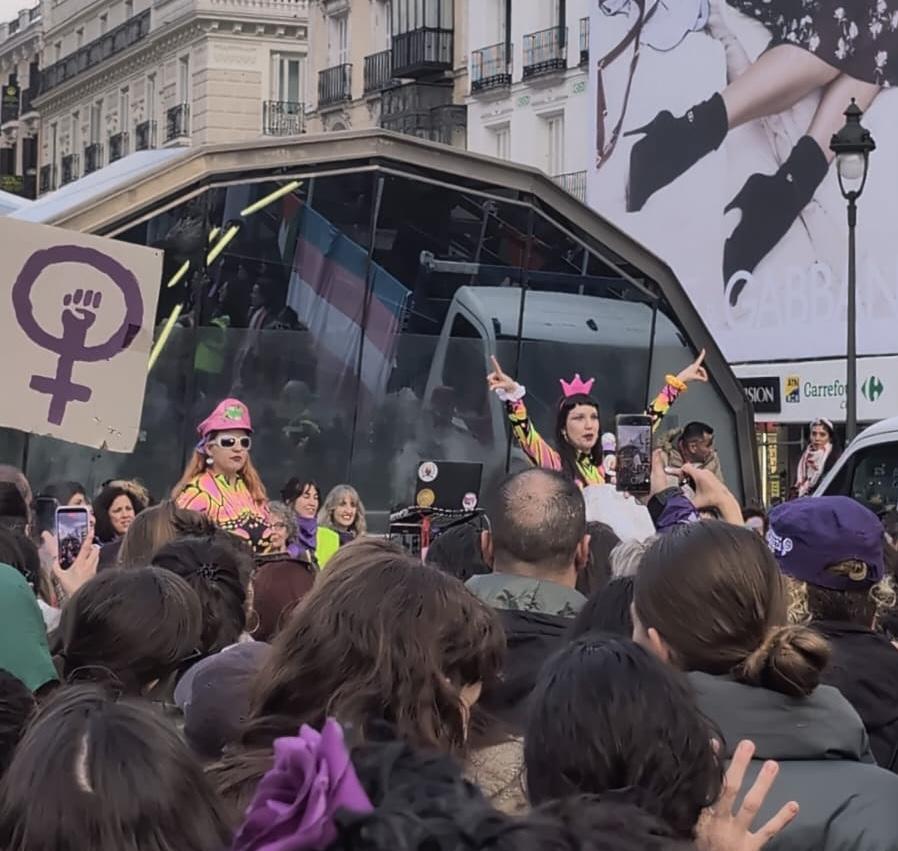
In a European context increasingly hostile towards migration, the nearly one million applications for legalisation submitted in Spain have been deemed “extraordinary”. The historical expansion of the regularisation process – by which undocumented migrants can apply for legal residency and a work permit of up to one year – has mostly been made possible by the mobilisation of the migrants themselves, and particularly migrant women.
Emerging from mutual support and care groups among migrants facing the hardships of the 2020 lockdown, the pro-regularisation movement was first structured around the self-organised migrant and anti-racist movement Regularización YA!, before being joined by a larger number of collectives over time, including migrant groups, business bodies and local associations. Whether occupying the streets or making use of institutional mechanisms, this movement has established itself as a significant political force in the country, capable of giving a voice to those who had been marginalised.
Care, art and joyful resistance
In early February, following the announcement of an upcoming regularisation decree, a general meeting was organised by migrant activists in the heart of Madrid, calling for the creation of a broader political network to support the making of the regularisation. When I joined them, I was surprised to see almost exclusively women, even though migration to Spain is equally split between men and women – an imbalance that one of the activists attributed to traditional gender norms:
Men are still involved in [what] they consider to be more institutional, more important, more serious [activities]. I think it happens with white people too. [...] I think what happens is that men are drawn to things they consider safe.
These women have developed tactics that contrast with the ‘seriousness’ of traditional politics, most of their events being dancing parties, concerts and carnivals. Internally, creating spaces for care and artistic expression likely plays an important role in the pro-regularisation movement’s long-term survival as a horizontal and informal organisation, despite a fluctuating participation. With more than 1,000 activists enrolled on the main Telegram channel of the Madrid Antiracist Assembly for Regularisation (comprising around 60 collectives including feminist and antiracist networks, social centres, worker’s unions, cooperatives, neighbourhood groups and NGOs) the meetings usually bring together around 30 to 40 regular members, mostly women.
Female activists also turned to unconventional forms of advocacy to influence public opinion and make their claims visible. The domestic workers’ collective Territorio Doméstico, for instance, is famous for its original performances. In March, they paraded as models in their own fashion show on the touristy Plaza Callao (Madrid) to draw attention to their lived experience. As one of the models stepped onto the catwalk wearing a pink wig and an apron, the host’s narration jarred with the performance in front of us:
Here is our sixth model, ‘the horror of [detention centres]’! She arrived in Bajaras airport from Colombia hoping to be reunited with her whole family and loved ones, a whole host of plans in her suitcase [...]. But her dreams were immediately shattered, when that afternoon, on the metro, the police arrested her and took her to the centre. She couldn’t believe it: “I have done nothing wrong! Why have they put me in this place, which is even worse than a prison?”
Refusing to ask for pity, the women in these collectives emphasise their ability to resist through art, as the speaker said in Callao: “here, fashion is not an escape but a battleground”. The women also resist by dancing to catchy music they have composed to denounce their irregular status, as in ‘Todas somos Adelita’, whose title aligns them with female figures of the Mexican Revolution. This is not unique to this group: at the regularisation fundraising party held by the pro-regularisation network in February, activism was celebrated as a joyful act, with the main speaker, a migrant woman, shouting: “if we can’t dance, it’s not our revolution, nor our regularisation.”
Irregularity: a feminist concern?
In Spain, irregular migration is a gendered issue: in 2022, the think tank Por Causa reported that women accounted for 60% of the country’s undocumented migrants, working largely in the informal sector and therefore having no means of obtaining legal status. Rising demand for care and domestic workers could push that figure higher. And although ‘women’s rights’ are officially a priority for the Spanish government, migrant women – particularly those without a legal status – remain highly vulnerable to abuse and exploitation, and continue to be over-represented among the victims of femicide and sexual violence.
Thus, in opposition to the rising nationalist-feminist tendencies analysed by Sara Farris, female migrant grassroots collectives engage in Spain’s political debates around gender-based violence, questioning institutional policies. At the International Women’s Day demonstration in March, on Madrid’s Puerta del Sol stage, it was migrant women who delivered the speeches, insisting that irregularity is a feminist issue. A migrant woman activist spoke to the crowd:
We are those on the margins, those whom the system needs to uphold its privileges, yet here our rights are denied.
She was joined by a migrant domestic worker:
And now we are all committed to regularisation; we are the ones most directly affected because most of us are migrants, we have crossed the border, not all of us have arrived, and not all of us are here.
By making regularisation a feminist claim, these women publicly challenged the utilitarian narratives which say that legal status is reserved for those with a labour contract. Doing so, they strengthened the call to regularise all those made ‘vulnerable’ – a demand that was, indeed, included in the final Real decreto 316/2026. With care for one another as their starting point, they highlighted the vulnerability caused by irregular status, finally framing a much broader amnesty than what had been expected when they first started organising. They did not expect to far exceed the figures from previous procedures, let alone double the number of regularisations, and had even doubted whether they would be able to persuade the government to implement it.
Structural and exclusionary limitations
Through joyful and careful activism, the movement survived for six years despite repeated rejections in parliament and a long political blockage. Their creative advocacy tactics were essential in breaking historical records, with a proposal for the decree garnering over 600,000 citizen signatures.
Nevertheless, the campaign’s focus on regularisation was not celebrated by everyone. A former participant of the main organisation of sex workers in Madrid told me after the decree was announced: “we will benefit in no way from the regularisation.” Indeed, the process is only accessible with a clean criminal record, but many municipalities deliver fines for ‘street prostitution’ that prevent accessing any legalisation process. This is just one of the numerous mechanisms that shut large sections of the migrant population out.
Although the “extraordinary” regularisation was ultimately adopted, most of the other demands made by migrant collectives– such as the release of people from detention centres, the favourable resolution of all asylum and regularisation applications that have been pending for months or years, or the provision of support on the mainland for people stranded at the borders of Ceuta and Melilla – appear unacceptable to the Spanish state, at least for now. Far from being discouraged, migrant female activists keep dancing in the capital’s streets, resisting.
Any comments about this post? Get in touch with us! Send us an email, or find us on LinkedIn, Bluesky and Instagram.
How to cite this blog post (Harvard style):
L. B. Couraut. (2026) 'If we can’t dance, it’s not our regularisation!' The migrant women behind Spain’s landmark legislation . Available at:https://blogs.law.ox.ac.uk/border-criminologies-blog/blog-post/2026/07/if-we-cant-dance-its-not-our-regularisation-migrant. Accessed on: 01/09/2026Keywords:
Irregular migration
Share:
With the support of