
Book Review: Unsettled Families: Refugees, Humanitarianism and the Politics of Kinship
Posted:
Time to read:
4 Minutes
Guest post by Roza Sarakatsanou. Roza is a PhD researcher in the Humanitarian and Conflict Response Institute at the University of Manchester. Her thesis focuses on entanglements between humanitarianism, solidarity and migration in Greece. She is completing her fieldwork in the island of Lesvos, studying the evolution of the humanitarian space established over the last decade and memories of the “migration crisis” that peaked in the island. She can be found on BlueSky: @rozasarakatsanou.bsky.social and X: @RSarakatsanou.
Review of: Unsettled Families: Refugees, Humanitarianism and the Politics of Kinship by Sophia Balakian (Stanford University Press, 2025)
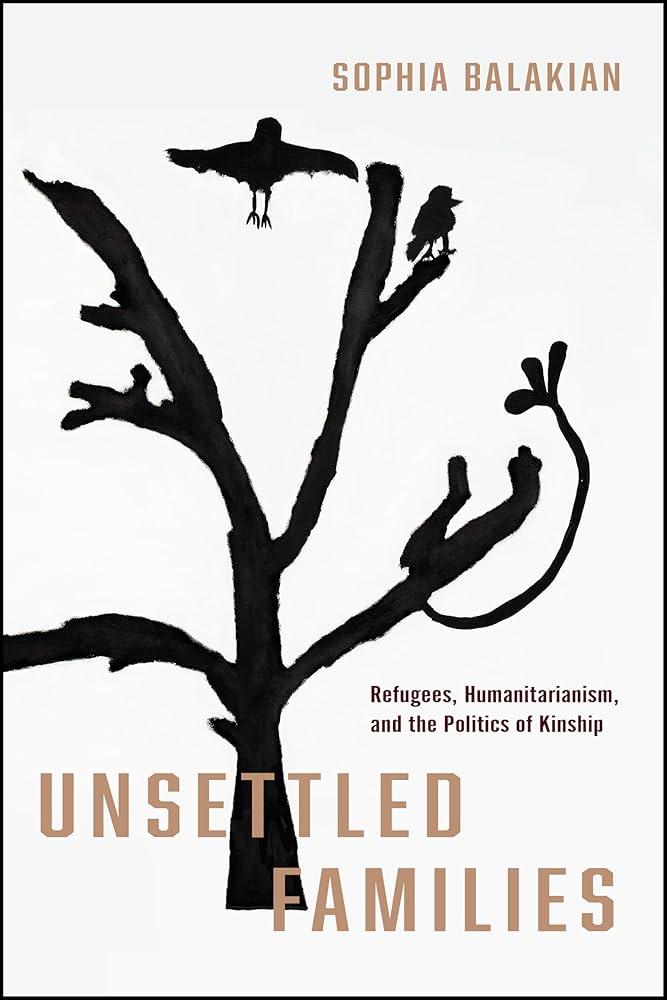
In her book, Unsettled Families: Refugees, Humanitarianism and the Politics of Kinship, Sophia Balakian explores how “fraudulent” figures and categories of kinship are imposed in the mutual efforts of border controls and humanitarian operations to distinguish the “most vulnerable” refugees from “the not deserving” ones. Her intervention concerns those queries, which hold sway not only in the fields of humanitarianism and migration studies, but also in asylum systems. The book follows the stories of people who live in Kenya as refugees, while also focusing on the humanitarian hub of Nairobi (p.7), vignettes from Somalia, the Democratic Republic of Congo, Rwanda and other places to illustrate the complexity of routes of mobility and kinship networks. Finally, Balakian includes conversations with professionals working in different agencies both in Nairobi and Ohio. Thereby, she scrutinises how bureaucratic procedures and international systems fail to grasp the heterogeneity of mobility and the networks of kinship created through the lives of families on the move. This failure often results in categorising individuals and families as “fraudulent”, depriving them of asylum or resettlement options.
Balakian demonstrates that fraud and family are not self-evident categories, as they typically appear in humanitarian programs that facilitate refugee resettlement. Such categories, she argues, blur boundaries and frequently make it impossible to balance exceptional vulnerability and truth in people’s stories. This challenges the expectations of agencies and professionals operating within contemporary refugee governance systems. Placing fraud and family at the center of the analysis, the rich ethnographic interactions reveal that people living as refugees hold different and multiple understandings of kinship and moral rights to resettlement. These understandings often fail to satisfy overly specific, policy-oriented criteria which frame resettlement as a privilege (p.42).
The key contribution of Unsettled Families is bringing kinship studies into current scholarly discussions on humanitarianism and locating "the family" as a crucial category in processes of producing, policing, and contesting nation-state boundaries in the 21st century. Balakian’s analysis pinpoints a crucial systemic paradox. Even though UNHCR advertises an open and culturally sensitive approach to family, in practice resettlement cases are decided based on Western representations of the “nuclear family” and governmental policies among the UN and NGOs. As Balakian argues poignantly, the family unit exists simultaneously as a focus of humanitarian compassion and as securitised suspicion. Refugee resettlement can work to separate families, rather than unite them, through the imposition of biogenetic conceptions of the nuclear family, underpinned by DNA technology.
The analysis heaves from anthropological studies, which focus on the construction of refugees’ subjectivities within systems of humanitarian aid, asylum and resettlement. The book draws extensively on Heath Cabot (2014), Kristin Sandvik (2011) and Liisa Malkki (1996). It also probes fragments of coloniality in African societies, as problematised by Mahmood Mamdani (2001), Achille Mbembe (2018) and Constance Smith (2019). At the same time, Balakian recontextualises “rightful families” within immigration policies and shows how kinship itself is moulded by the specific modes of family construction imposed by powerful states in North America, Europe, Australia, and elsewhere.
Methodological contributions and rigorous ethnographic craftsmanship merit praise. The book exemplifies how individual testimonies, when carefully contextualised within historical and political frameworks, can illuminate structural patterns without reducing people to case studies. Balakian underscores the moral claims of people living as refugees and aims at incorporating their active agency rather than reducing their subjectivities to mere “victims” or “criminals” and “frauds” (p.92).
Balakian structures Unsettled Families as a methodical examination that moves from conceptual foundations through lived experiences to institutional mechanisms and state power. The first chapter sets the scene, discussing how discourses of fraud operate within refugee resettlement programs and how they help construct the image of the “fraudulent refugee”. Chapter 2 places at its center the voices of those attempting to navigate these systems and their critiques of resettlement processes. The third chapter overviews the complex entanglements between humanitarian moral claims and kinship practices, exploring how kinship creates migration opportunities through detailed analysis of Somali families. Balakian then investigates the technological dimension of family verification through DNA testing and its effects on refugee families (chapter 4). Returning back to the United States and concluding her story in Ohio, she disentangles the ways national security regimes shape and constrain resettlement possibilities (chapter 5).
Most importantly, this book showcases remarkable analytical dexterity in moving between personal narratives and broader structural forces. Individual stories of family separation, reunion, and both “success” and rejection in their resettlement cases are consistently situated within shifting local and international political contexts and historical continuities of displacement. The book successfully moves from micro-level of analysis to macro-level of analysis. This multiscale approach allows readers to understand how policy changes reverberate through lived experience and how personal and family strategies respond to and sometimes reshape institutional practices.
The ethnographic portraits, so carefully crafted by Balakian, pay astute attention to details and links of personal and family networks while maintaining clarity in the narrative. Her descriptions of moments with her fellow conversants move beyond mere data collection to create vivid, respectful representations which honour the complexity of individual experiences. The prose seamlessly transitions between different locations, from the bustling refugee processing centres of Nairobi to the resettlement communities of Columbus, Ohio, treating all sites with equal ethnographic precision.
Unsettled Families is intended for students and researchers in refugee and border studies as well as practitioners working in the field of migration and asylum-seeking. This book can be of interest to anyone who seeks to understand the human complexities behind resettlement policies and programs.
Any comments about this post? Get in touch with us! Send us an email, or find us on LinkedIn and BlueSky.
How to cite this blog post (Harvard style):
R. Sarakatsanou. (2025) Book Review: Unsettled Families: Refugees, Humanitarianism and the Politics of Kinship. Available at:https://blogs.law.ox.ac.uk/border-criminologies-blog/blog-post/2025/12/book-review-unsettled-families-refugees-humanitarianism. Accessed on: 15/12/2025Share:
With the support of


