
A Stake in the Hold: Reflections on Partnership during Fieldwork at Operation Sophia’s Stakeholder Meeting
This post is part of a themed series focusing on methodological reflections on studying border policing. This blog series is a product of the Thematic Group on Border Policing & Emotions. Those interested in joining the group or staying updated on events and initiatives are warmly invited to contact Maartje van der Woude via email at m.a.h.vanderwoude@law.leidenuniv.nl.
Posted:
Time to read:
4 Minutes
Guest post by Eva A. van Gemert, Department of Organizational Sciences, Vrije Universiteit Amsterdam e.a.van.gemert@vu.nl. Dr. Eva van Gemert is a postdoctoral researcher and lecturer at the department of Organization Sciences, Vrije Universiteit Amsterdam, the Netherlands. Her research focuses on the performativity of an imaginary of ‘Europeanness’ through the intersection of race, migration, and affect. The fieldwork presented in this blog was done as part of her PhD research at the Erasmus University Rotterdam. She defended her dissertation Rescuing Europe. Articulating European Humanity through ‘Migration Crisis’ on October 25th, 2024.
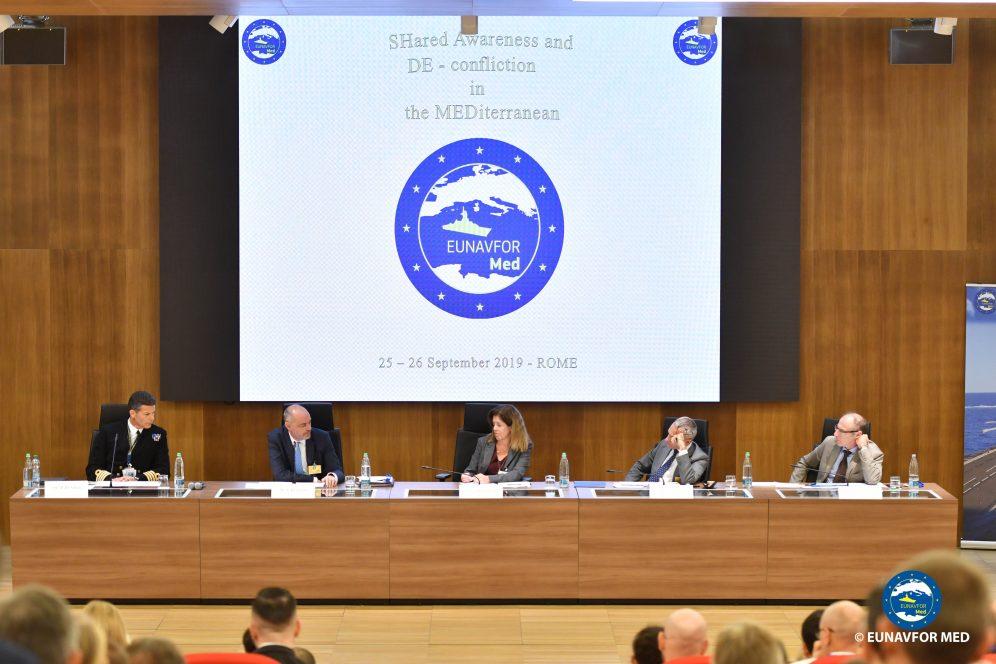
What does it mean to be recognized as a ‘stakeholder’ in a politics of death? Clearly, the question of how to live with the violence that is border control is most urgent for the black and brown bodies at stake in the Mediterranean Sea. However, it became particularly relevant to me in the Spring of 2017, when I intended to do research into EUNAVOR MED Operation Sophia, the EU’s military anti-smuggling mission that was active in the central Mediterranean Sea between 2015 and 2020.
Focusing primarily on the arrest of human smugglers and the destruction of their vessels, Operation Sophia’s establishment formed an important pillar of the EU’s ‘ten-point action plan on migration’. Next to these activities, Operation Sophia organized several so-called ‘stakeholder meetings’, called SHADE MED. These meetings were organized biannually between the Operation’s establishment in 2015, and its formal end in 2020, and took place at its headquarters in Rome, each lasting two days.
Compared to Operation Sophia’s violent practices of border control, the practice of bringing together ‘stakeholders’ while talking about their interests may sound innocent. However, there is nothing innocent about the status of ‘stakeholder’. In her book In the Wake: On Blackness and Being, Christina Sharpe devotes an entire chapter to ‘the hold’, the place where a ship carries its cargo. During the transatlantic slave trade, the enslaved were the stake. Being held captive there, they lived and died in the hold, and survived it. Being in the hold thus constitutes a way of being in the wake, that is, “to occupy and to be occupied by the continuous and changing present of slavery’s as yet unresolved unfolding.”
Hence, I asked myself, when the hold is what is at stake, what does it mean to have a stake in the hold?
When researchers become partners
Getting access to the SHADE MED was remarkably easy. A short, two-line email to the organizing committee introducing myself as an academic researcher with an interest in migration in the Mediterranean Sea was sufficient to put me on the mailing list and to receive an invitation for every following meeting of the SHADE MED. However, this welcoming attitude towards researchers and others should not be understood as mere generosity. Operation Sophia’s apparent openness towards its stakeholders at the SHADE MED also constitutes a way for Operation Sophia to maintain exclusion outside of it. Over the course of my fieldwork, it turned out to be very difficult to get access to representatives of Operation Sophia. When speaking to one of them, I was told that
“we have no official authorization to organize any kind of workshop besides our official floor. As generally understood, we are military personnel with certain rules and a certain mandate and the official floor to discuss it, is the SHADE MED Conference.”
As a result, I ended up conducting ethnographic fieldwork at what turned out to be the last three of eight SHADE MED meetings. I am not the only researcher present here. Likely having come across similar access issues, I meet multiple colleagues from the Netherlands and Italy, who produce critical work on Europe’s borders. What made it so apparently easy for us to be present there at the SHADE MED?
On a fact sheet distributed among the participants, it becomes clear how the SHADE MED is oriented towards the establishment so-called partnership:
“Partnership has been the key word: partner countries, partner organizations, NGOs, international agencies are working together and sharing their experiences”
The list of Operation Sophia’s partners is long, and includes security organizations such as EUROPOL and NATO, associations for commercial trade in the Mediterranean, such as the International Chamber of Shipping (ICS), and non-governmental or inter-governmental organizations, among which are the International Organization for Migration, and the UN Refugee Council, as well as activist search-and-rescue organizations.
Yet, while being celebrated as partners at the SHADE MED, hostilities continue between Operation Sophia and some of its partners. In 2017, multiple incidents occurred between NGO rescue vessels and the Libyan coast guard, trained by Operation Sophia. NGOs have reported that vessels from the Libyan coast guard sailed dangerously close to their ships, while pointing machine guns and threatening to shoot them if they continued their rescue activities, and firing gun shots in the air. In this context, their presence as partners at the SHADE MED is a major accomplishment.
Through their presence at the SHADE MED, these organizations are made part of Operation Sophia’s border violence. This goes for myself as well: while looking for a way to gather data for my research, I now have gained a stake in Operation Sophia, whose violence is not only performed at sea, but also during plenary meetings and workgroup discussions.
Performing whiteness through partnership
Despite this context of border violence, being present at the SHADE MED is often incredibly boring. Listening to the many plenary presentations in the conference room, I notice that my thoughts drift away. Around me, I see other participants sitting in a slouched position, looking at their watches, or whispering to their neighbours. At first glance, the working groups that are organized following the plenary meetings appear more interesting. Emotions that have been building up during the plenary sessions, or even during the developments that have taken place in the Mediterranean Sea in the months before the conference, now come to the fore. I can sense anger and frustration as the most vocal participants speak about their experiences from opposing perspectives. But here, too, is boredom. Some participants are on their phones. This is what it also means to hold stakes: to be able to detach yourself from a conversation about death and drowning, because the bodies at stake are not the stakes of the meeting.
Through their presence, participants in the SHADE MED are made stakeholders in EUrope’s border management, not in the lives of migrants. In doing so, the white stakeholders’ bodies are racialized as well, as their whiteness comes to be understood as the embodiment of both ‘Europeanness’ and ‘humaneness’. The SHADE MED’s setup as a stakeholder meeting can thus be considered a contemporary incarnation of the historical transnational coalescence of colonizers. In the transnational encounter of the SHADE MED, participants experience themselves, despite their differences, as European.
Any comments about this post? Get in touch with us! Send us an email, or find us on LinkedIn and BlueSky.
How to cite this blog post (Harvard style):
E. van Gemert. (2025) A Stake in the Hold: Reflections on Partnership during Fieldwork at Operation Sophia’s Stakeholder Meeting . Available at:https://blogs.law.ox.ac.uk/border-criminologies-blog/blog-post/2025/09/stake-hold-reflections-partnership-during-fieldwork. Accessed on: 23/12/2025With the support of


