Supporting Survival: Developing a toolkit for supporting refugee survivors of torture and torturous violence
A new toolkit blends research and practice to support survivors, students and practitioners. It’s a crucial antidote to the stigma and silencing of torture
Posted:
Time to read:
4 Minutes
Guest post by Victoria Canning. Victoria is Professor of Criminology at Lancaster University and has researched and campaigned around refugee survivor rights for two decades. She has developed the Supporting Survival Toolkit with the Danish Institute Against Torture, co-created the Right to Remain Asylum Navigation Board (with Lisa Matthews).
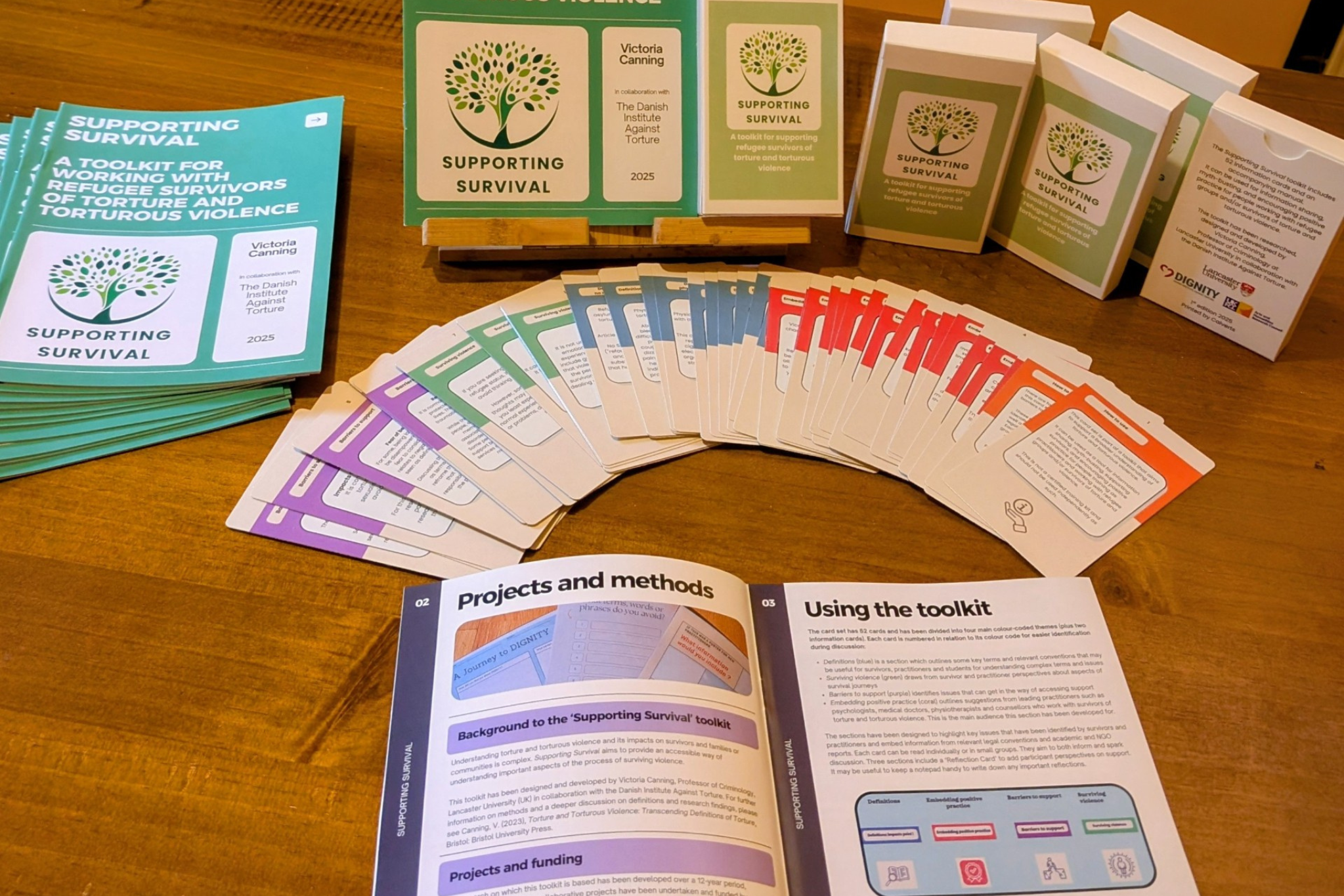
Understanding torture and torturous violence and their impacts on survivors and families or communities is complex. Memories of atrocities, cruel and inhuman treatment, acts of brutality and sexualised abuse are often personally intrusive, but socially silenced. The nature of torture and torturous violence therefore works to try and break people down, meaning survivors can experience stigma or shame.
At the same time, practitioners who work with refugee populations – such as social workers, psychologists, medical practitioners, teachers – are often confronted with the impacts of such violence without information about torture or asylum.
Given that the past decades have seen an ever-stretched support sector alongside the bolstering of anti-immigrant sentiment, evidenced information on the realities of torture, violence and refugee rights is crucial. In collaboration with the Danish Institute Against Torture (DIGNITY), we developed the Supporting Survival toolkit to help fill this gap to take key findings and examples of positive practice to wider survivor and practitioner-based audiences.
Bringing practice to research and research back to practice
For the past 12 years, I have collaborated with DIGNITY on four projects supported by my colleague Dr Andrew Jefferson. Each of the projects has explored the implications of intensified bordering on refugee survivors of violence and gendered gaps in responses to torture.
Across all the projects (spanning around 120 practitioner interviews as well as oral histories and grassroot action-based research) I asked participants what ‘best practice’ might look like to them. These answers, from experts as well as experts by experience, revealed incredible insights. Rather than leave them solely to textbooks or academic articles, we decided to translate that knowledge into tangible information that can be shared across sectors.
The Supporting Survival Toolkit – a card set and accompanying manual for survivors, practitioners and students – is the most recent example of this work. In designing it, ideation workshops were developed with DIGNITY practitioners and the Survivor Advisory Board, and each stage was presented and discussed for feedback to ensure co-development. This process also underpinned the predecessor of the toolkit, my 2023 book Torture and Torturous Violence. During the research process, I presented the key themes to survivor-led organisations and practitioners multiple times to embed reflexive insights and informed changes into the final manuscript. As a result of that consultation, we changed the name of the toolkit from ‘Torture in Transit’ to ‘Supporting Survival’ in consultation with the Survivor Advisory Board – the former being deemed a distraction from focus on the survival journey.
Determining content, deciding design
The set of 52 cards is divided into four main themes: definitions of violence and torture, surviving violence, barriers to support, and embedding positive practice. These themes were determined based on the outcomes of thematic analysis as well as priority areas for those affected:
- Cards in the Definitions section outline key terms and relevant conventions that may be useful for survivors, students and practitioners for understanding complex terms and issues such as forms of violence, relevant conventions and the myriad impacts of torture.
- Those in Surviving violence draw from survivor and practitioner perspectives about aspects of survival journeys.
- Barriers to support identifies issues that can get in the way of accessing support, such as immigration detention, dispersal, lack of funds, and cultural approaches to support.
- Embedding positive practice outlines suggestions from leading practitioners such as psychologists, medical doctors, physiotherapists and counsellors who work with survivors of torture and torturous violence. This is the main audience this section has been developed for.
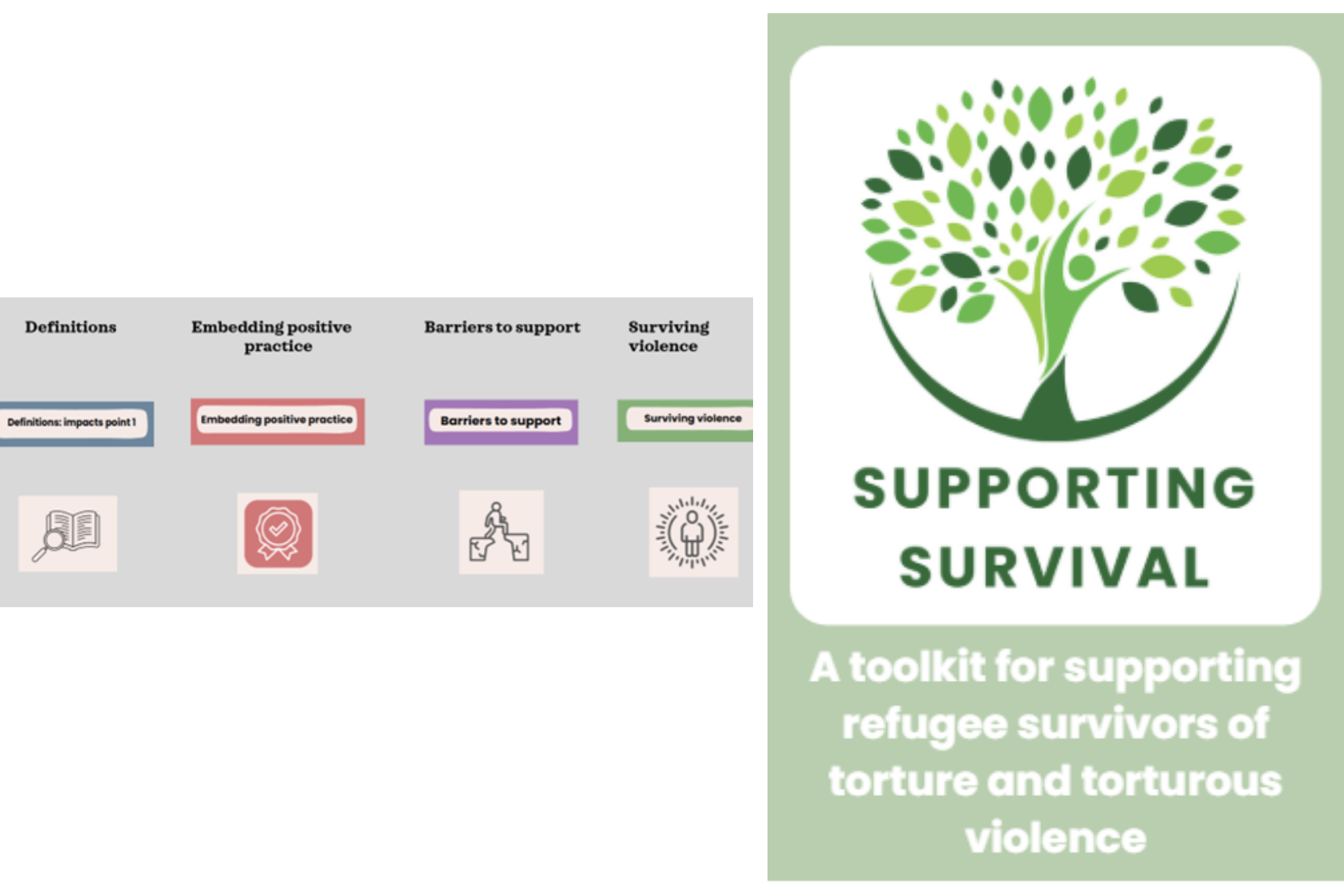
Each card is colour coded and has a small distinctive image to support memory for categories. All can be read individually or in small groups with content that can both inform and spark discussion. Three sections include a ‘Reflection Card’ to add participant perspectives on support. This item in the pack ensures participants can challenge, add, change or disagree with specific cards or examples – emphasising their own potential expertise beyond the information on the cards.
Deciding what would be included in the toolkit was not easy. As Border Criminologies often shows, societies, states and survivor experiences are not monolithic, and the barriers to support, or examples of positive practice don’t inherently map across differing contexts. This was a chance to highlight the role of survivor and practitioner centred knowledge development, as well as including reflexive questions to ask participants in the toolkit to expand with their own perspectives.
These issues were taken into consideration, as were the limitations that can exist in practice in terms of time, language and accessibility. Indeed, on the latter two, a key issue for the toolkit itself has been language, since it has been written in English and no funds were available for translation. However, addressing this is ongoing as the project recently received funding support from the School of Social Sciences at Lancaster University for translating to Arabic and Ukrainian – two key languages that DIGNITY clients work with, with a hope to expand further.
Reaching the field through practitioner expertise
Since the initial launches at the Annual Nordic Conference on Trauma Treatment and Lancaster University in November 2025, I have undertaken more than 15 workshops with NGOs, survivor-led organisations, student societies and universities. With the help of practitioners, cards are being distributed to regions where DIGNITY works, including Ukraine and Gaza, as well as to grassroots and non-governmental organisations. They are for use by survivors and practitioners, including medics and psychologists, volunteers, sexual violence organisations and torture response organisations. Nikolai Cerisier Roitmann, head of the Rehabilitation Clinic for DIGNITY in Denmark, also affirmed the importance of this work: “understanding the complex impacts of torture is crucial, and this toolkit is a fantastic step toward bridging gaps between survivor experiences, information sharing, and embedding positive practice”.
In this era of intensified misinformation, bordering and border violence, sharing knowledge and ensuring people know their rights is a crucial antidote to the stigma and silencing of torture and torturous violence. The Supporting Survival toolkit in no way solves these on its own, but we hope that it can be a step to collegial learning and consciousness raising in the fight for survivor and refugee rights.
The Supporting Survival toolkit was developed and designed by Victoria Canning in collaboration with the Danish Institute Against Torture, funded by UKRI Arts and Humanities Research Council, and printed by Calverts Coop.
Grassroot and non-governmental organisations can apply for a free copy by contacting Victoria on v.canning@lancaster.ac.uk
Individuals can purchase a copy by email via News From Nowhere bookshop with international postage available.
Any comments about this post? Get in touch with us! Send us an email, or find us on LinkedIn, Bluesky and Instagram.
How to cite this blog post (Harvard style):
V. Canning. (2026) Supporting Survival: Developing a toolkit for supporting refugee survivors of torture and torturous violence. Available at:https://blogs.law.ox.ac.uk/border-criminologies-blog/blog-post/2026/09/supporting-survival-developing-toolkit-supporting. Accessed on: 10/10/2026Keywords:
(Field) Research and Methods
Share:
With the support of