Systemic violence in Greek waters: No border security without deaths
A recent lethal collision off the island of Chios raises serious concerns about practices at EU borders, as well as Greece’s ability to provide independent monitoring
Posted:
Time to read:
7 Minutes
Emma Musty is the Project Coordinator at I Have Rights, a non-profit legal and political organisation which provides individualised legal information and support to people on the move on the Greek island of Samos while advocating for change to ensure the right to asylum, eliminate pushbacks, and fight against all detention of migrants and refugees.
Gemma Bird is a Senior Lecturer in Politics and IR at the University of Liverpool. As an activist-scholar, her research sits at the intersection between political theory and international relations, focusing recently on migration, humanitarianism and advocating for a radically different approach to global borders and displacement.
On 3 February, 15 people travelling to seek asylum in Greece were killed in a collision with a Hellenic Coast Guard (HCG) patrol boat off the coast of the island of Chios. Inconsistencies quickly emerged between the coastguard’s telling of the story and that of survivors. In testimonies published by We are Solomon, travellers said they had received no instructions from the HCG before the collision, which they believed was purposeful: “We would have stopped [our journey]. The coast guard came up from behind us. They wanted us dead. They killed us”. Conversely, the HGC had initially stated it was instead their vessel that was rammed by the smaller boat – but that their cameras were off so the incident was not recorded. At least four of those who died were minors, and more than two dozen people were hospitalised.
The majority of passengers were from Afghanistan, a country which had a 99.8% recognition rate in 2025, due to the ongoing and worsening crisis in the country. One of the passengers, a Moroccan national, was arrested the same day, and charged with transporting undocumented migrants and causing a shipwreck despite limited evidence. The charging of this individual takes place within a context of increasing criminalisation, with a recent report highlighting consistent and systematic problems with arrests and trials relating to smuggling across Europe.
In a TV interview a few days after the shipwreck, the Greek Minister for Migration and Asylum, Thanos Plevris, accused the lawyer of the prosecuted survivor of “defend[ing] the trafficker instead of the victims”. Plevris is known for his hardline, right-wing views on migration, and stated at an event in 2011, “border security cannot exist if there are no casualties — and, to be clear, if there are no deaths.”
By 4 February a statement had already been released by Greek authorities blaming ‘smugglers’ for failing to respond to instructions by the Hellenic coastguard and suggesting that this was what caused the lethal collision with the coastguard vessel. The BBC referenced Plevris praising the coastguard’s actions, suggesting that their actions stood in contrast to human rights activists who “saved no one”.
This is not the first time official narratives have not matched up with evidence, including eyewitness testimonies. In the Pylos disaster of 2023, in which 650 people lost their lives, the initial account of events by the HCG was quickly brought into question. Four senior figures, including the HCG’s current commander, now face criminal charges of negligent manslaughter, and 17 other members of the HGC have already been charged, though no prosecutions have so far been brought. The nine Egyptian nationals originally accused of smuggling and illegal entry have all been acquitted.
These events are not one offs. The EU Fundamental Rights Agency’s guidance on implementing national monitoring mechanisms states that “all people entering the EU should be treated with dignity and have their fundamental rights respected.” Despite this, lives continue to be lost in Greek waters and authorities remain under criminal scrutiny for their involvement. In the broader Mediterranean space, the first three months of 2026 were the deadliest in over a decade. Can EU states, especially Greece, really be trusted to provide an independent monitoring mechanism that respects fundamental rights given these ongoing investigations?
Continued evidence of border violence and pushbacks in Greece
Rights groups stated early on that these deaths must not be framed as tragedies but instead as “the foreseeable result of violent migration policies and deterrence practices that deliberately expose people to lethal risk, denying the most fundamental right: the right to life.”
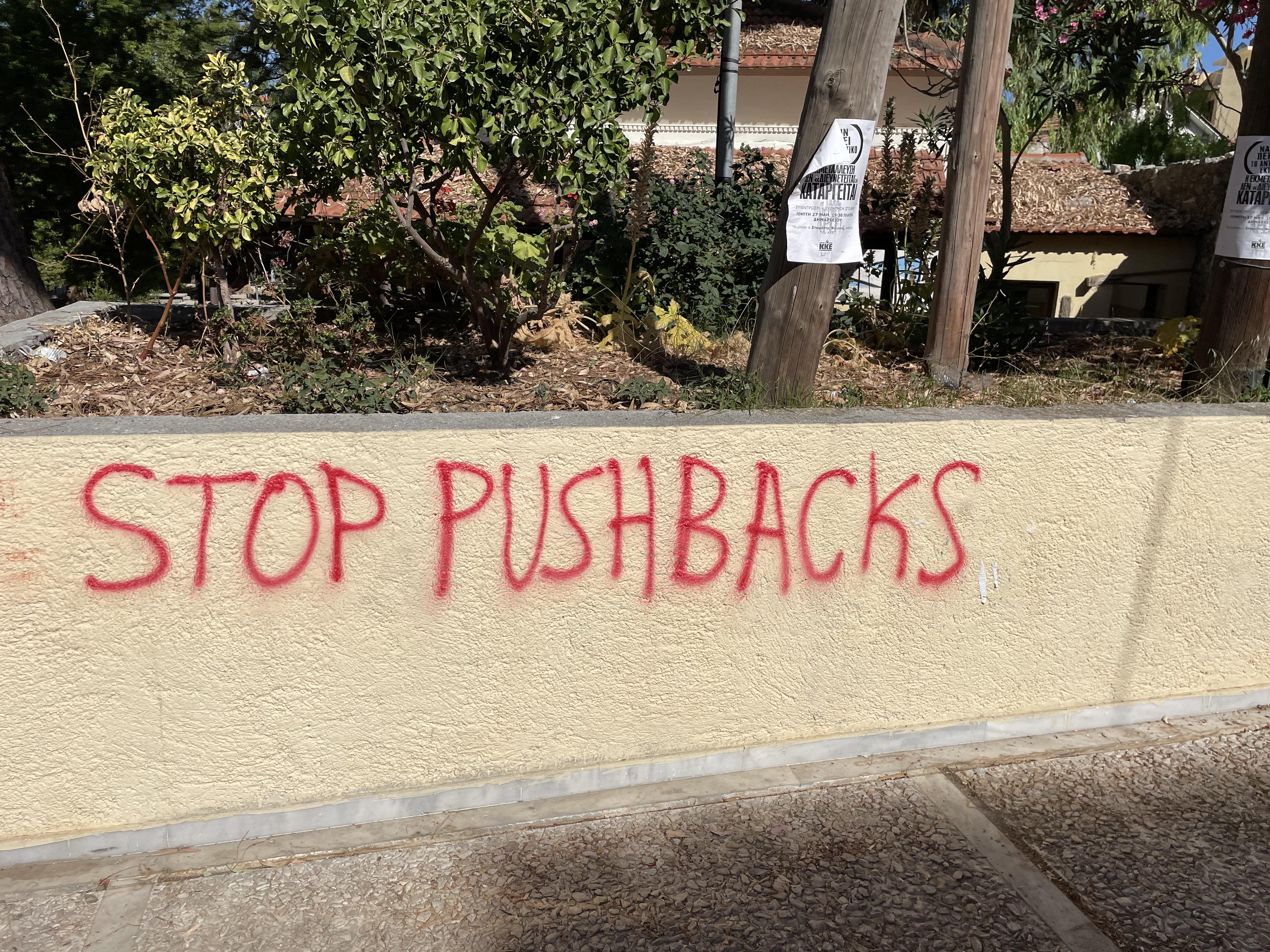
Although not always reported by international media, reports from asylum seekers and evidence gathered by journalists, academics and human rights groups, clearly show pushbacks to be an ongoing, government sanctioned policy with a high level of acceptance and few whistleblowers willing to come forward (key observers include Greek Council for Refugees, European Centre for Constitutional and Human Rights and Statewatch, among others).
Following the Chios shipwreck, a former captain of a HCG vessel spoke out about his involvement in systematic illegal pushbacks in the Aegean, stating that he could no longer continue in this role. Speaking to the Greek newspaper Rizopastis, he gave detailed descriptions of the tactics, orders, and systematic cover-ups that lie behind every shipwreck, and every death at sea. The former captain reported towing boats back across the border with Türkiye, throwing engines into the sea, and abandoning inflatable boats at sea in dangerous weather conditions – all despite knowing that these are crimes, and sometimes later hearing of a shipwreck in the same location.
These practices, at sea but also on land, have been documented for many years and have been repeatedly challenged by civil society. We also have evidence of pushback practices across Greek territory made public by Frontex through their Serious Incident Reports (SIR). The Frontex Fundamental Rights Office is “mandated with monitoring Frontex’s implementation of its fundamental rights obligations in accordance with EU and international law,” and producing SIRs is part of that mandate. Of its recent publications, SIR 10180/2025 documents an incident on the island of Rhodes on 16 January 2025, in which people on the move allege being confronted by masked men following arrival on the island.
The report states that “masked men allegedly fired two shots into the air” before reportedly stopping a group of 10 people with mobility difficulties and subjecting them to violence, “including beating, for approximately 10 minutes”. The people, hoping to seek asylum in Greece, were then ordered back on to their boat and towed out to sea by their assailants. They were eventually met by the HCG vessel and medical treatment was given, but the ordeal they faced should not be underestimated. In the SIR, the Frontex Fundamental Rights Officer (FRO) stated that they “consider it likely that migrants were ill-treated by the Hellenic Coast Guard Personnel during the interception and arrest… [and] the Hellenic authorities failed to cooperate fully in clarifying the incident.”
Such treatment not only violates human rights but also dehumanises and degrades those subjected to it. One further example of this is the recruitment of people on the move to forcibly push back others approaching Greece’s land border with Türkiye. The BBC reports having seen documents detailing how senior officers oversee the recruitment of “mercenaries” who are then expected to commit violence, often in exchange for residence papers. In another report, those recruited described their position as one of enslavement. Violence, then, remains a defining experience for those approaching EU borders.
Testimonies from Samos
We write this article on Samos, where the existence of pushbacks in the Aegean is common knowledge among those who have survived them and the groups that work with them. In order to reach this island, people may face multiple pushbacks and/or enforced disappearances from one of the smaller islands nearby. During these illegal acts of interception and return by authorities, people may lose friends and family members through death or disappearance at sea, if not their own lives. The documentation is extensive and continues up until the moment of writing. These pushbacks are illegal under international law, as a violation of Article 33 of the 1951 Convention Relating to the Status of Refugees and the principle of non-refoulement. The only evidence we do not have is that they will ever stop.
One young person from Yemen described the experience of being pushed back to a Border Violence Monitoring Network (BVMN) member on Samos as being treated like “trash” because the authorities, who he identified as wearing HCG uniforms, had so little regard for the lives of himself and his travelling companions. “I was trying to save my friends, throw a rope, but they were just watching us,” he said.
These pushbacks are sites of intersectional violence during which people often experience multiple forms of brutality, including beatings, racial slurs, insults, theft, deprivation of food and water. At least 372 people died in their attempt to cross the Eastern Mediterranean in 2025 according to IOM’s Missing Migrant Project. Over a hundred people have already lost their lives in the first three months of 2026.
The National Monitoring Mechanism
Article 10 of the Screening Regulation (EU) 2024/1356 sets out the provision of an independent monitoring mechanism for member states to monitor, among other things, compliance with the principle of non-refoulement. Former EU Home Affairs Commissioner Ylva Johansson even went so far as to promise that this mechanism would “make sure that there are no pushbacks at the borders”.
Yet, despite the establishment of a Fundamental Rights Officer and the Special Commission on Fundamental Rights Compliance in 2022, their integration within the Greek Ministry of Migration raises concerns about their independence. In a policy brief, Border Violence Monitoring Network, a coalition of organisations documenting EU border violence, stated “it is not only easy to foresee that an institutionally insufficient mechanism will be incapable of effectively monitoring, and therefore preventing, pushbacks, but, moreover, that it will be used to deny their existence, while states continue to practise them with impunity.”
More hostility to come
The EU New Pact on Migration and Asylum will come into force in June this year, heralding a regime of increased deterrence, detention and deportation. The Greek Prime Minister, Kyriakos Mitsotakis, has been very clear that he sees this as a personal win for Greece and that their policies have, he believes, inspired the EU. As the US and Israel's war in Southwest Asia continues, and numbers of people forced to flee are likely to increase, the Greek Government is promising even tougher border measures including further asylum bans. But it is unlikely to stop there.
Deaths in the Aegean could easily be prevented, but the Greek government, and the EU – which has long viewed Greece as their “shield” from those crossing the border to seek safety – do not, it would seem, see it as in their interests to do so. In this environment, it is unlikely that a national monitoring mechanism in Greece could ever be truly independent or effective. But given the embattled situation of Greek civil society, who or what will take its place.
Any comments about this post? Get in touch with us! Send us an email, or find us on LinkedIn and Bluesky.
How to cite this blog post (Harvard style):
G. Bird and E. Musty. (2026) Systemic violence in Greek waters: No border security without deaths. Available at:https://blogs.law.ox.ac.uk/border-criminologies-blog/blog-post/2026/05/systemic-violence-greek-waters-no-border-security. Accessed on: 22/10/2026Keywords:
Pushbacks
Share:
With the support of