Visualising confinement: Creating 3D models of Greek detention centres
Immigration detention facilities in Greece are often hidden from public view – a 3D modelling project brings new ways of documenting these spaces of confinement
Posted:
Time to read:
4 Minutes
Post by Andriani Fili. Andriani is a Wellcome Trust Postdoctoral Research Fellow at the Centre for Criminology, University of Oxford, and co-director of Border Criminologies.
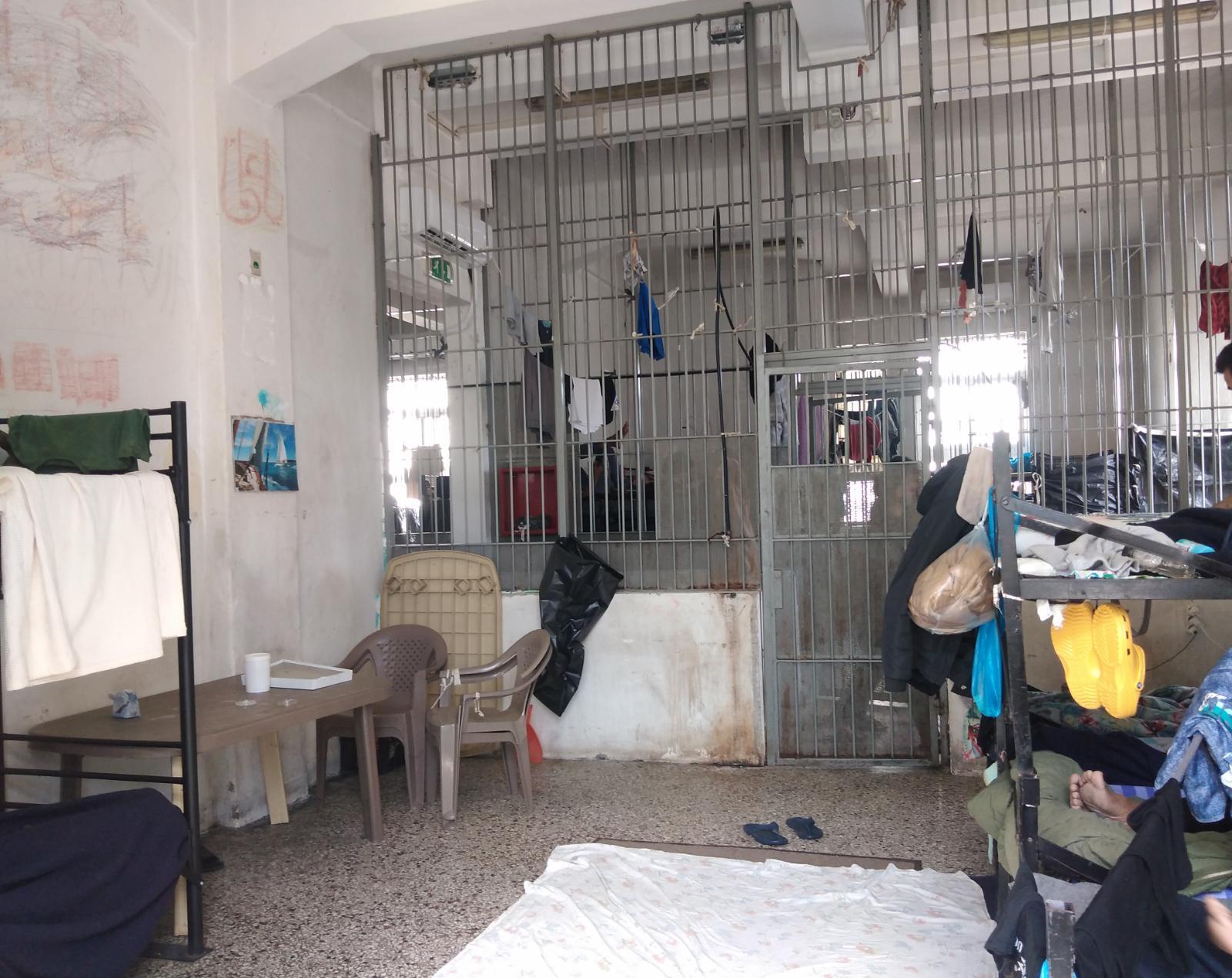
Immigration detention centres are some of the least transparent institutions of contemporary border control, in Greece and elsewhere. Access restrictions, even for lawyers and healthcare workers, combined with geographical isolation mean that even basic information about their architecture and daily operation often remains out of reach. A new 3D modelling project hosted on the Detention Landscapes platform responds to this opacity by developing new ways of documenting, visualising, and sharing knowledge about spaces of confinement in Greece.
Rather than approaching detention centres solely through textual description or statistical reporting, the project experimented with 3D modelling as a method of research, documentation, and public engagement. The aim was not to produce architectural blueprints or definitive representations, but to offer carefully constructed spatial interpretations that bring together disparate sources of information – such as satellite imagery, legal documents, witness testimonies, photographs, and videos – into navigable visual environments.
At the heart of the project is a strong commitment to collaboration and capacity building. The models currently available on the platform were developed through a structured training process involving seven volunteers from the Border Violence Monitoring Network (BVMN) and Border Criminologies. These volunteers took part in an intensive programme led by a 3D modelling specialist, learning to work with open-source software and OSINT-based techniques to reconstruct detention spaces that are otherwise inaccessible. In this sense, the project is as much about building shared technical skills within civil society and academic networks as it is about producing visual outputs.
Training and methodology
The training programme was designed to be accessible, modular, and replicable. Participants were introduced to the open-source software Blender and related tools through step-by-step modules – this allowed people with no prior experience in 3D modelling to contribute meaningfully. The team used Google Earth Pro and other satellite resources to establish accurate spatial references. Tools such as fSpy allowed the alignment of photographic images with 3D perspectives, ensuring that proportions and spatial relationships reflect observable reality as closely as possible. The models were constructed primarily in Blender, using a mix of modular and Boolean modelling techniques.
Each model was cross-checked for consistency with original images from detention, highlighting a commitment to quality even where precise verification was impossible. Crucially, the project team has made both the specialist-developed reference model and the training materials openly available, reflecting a broader commitment to free digital training and knowledge sharing. By relying exclusively on freely available software and resources, the project seeks to lower barriers to entry and support under-resourced organisations and researchers working on detention and border violence.
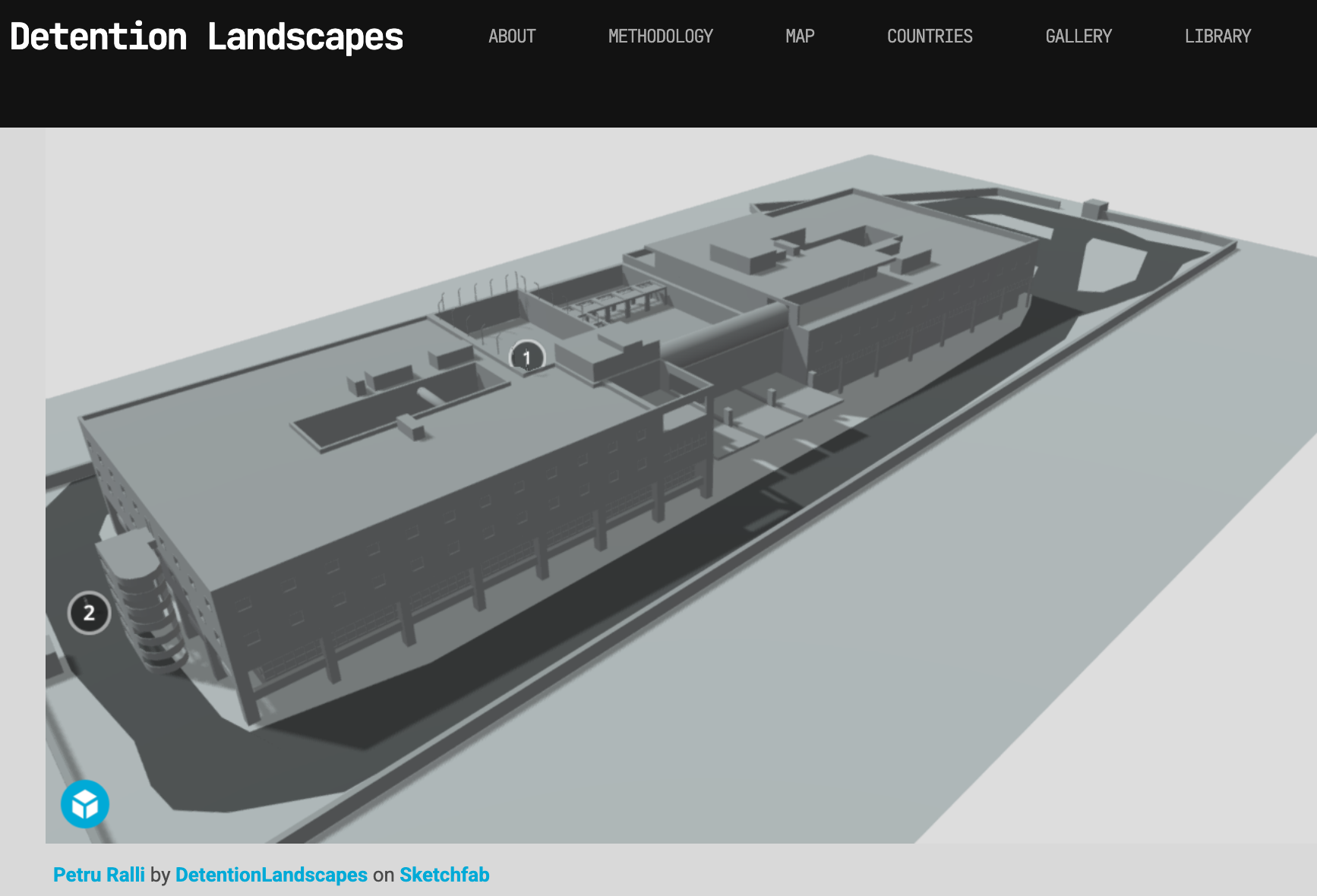
At the core of this project is also a robust methodological framework. Methodologically, the project draws on what the team conceptualises as a practice of ‘montaging’ detention landscapes. This involves assembling fragments of visual, legal, and testimonial data into a coherent spatial narrative, without claiming totality or completeness. Satellite imagery provides the basic spatial framework; photographs and videos taken from people with lived experience of detention help to establish scale, layout, and material details; testimonies and reports contextualise how these spaces are lived, experienced, and governed. The resulting models should therefore be understood as interpretive reconstructions, shaped by both the possibilities and the limits of available data.
Importantly, the Detention Landscapes platform does not present the 3D models in isolation. Each model is embedded within a wider archive that includes testimonies, NGO reports, and other documentation relating to immigration detention in Greece. This integration reflects the project’s broader ambition: to move beyond fragmented forms of evidence and create a multidisciplinary, publicly accessible repository that supports research, advocacy, and accountability work.
Visualising places designed to be hidden
At present, the platform hosts 3D models of the Petrou Ralli Pre-Removal Detention Centre in Athens, the Xanthi and Amygdaleza Pre-Removal Detention Centres, the Corinth Pre-Removal Detention Centre, and the Samos Closed Controlled Access Centre. The need for alternative forms of documentation becomes particularly clear when reading the testimonies and evidence associated with the sites currently modelled on the platform. Across these detention centres, people have consistently described spaces characterised by confinement, deprivation, and prolonged uncertainty. The spatial organisation of these sites, characterised by high-security fencing, internal segregation, and limited communal areas, plays a central role in shaping these experiences, yet remains largely inaccessible to public scrutiny. It is precisely this combination of restricted access, fragmented evidence, and persistent testimonies of harm that makes alternative forms of documentation, such as 3D modelling, both necessary and urgent.
While the current set of models focuses on selected detention sites in Greece, the project is explicitly conceived as iterative and expandable. The emphasis on training and capacity building means that the methodology can be taken up, adapted, and extended by others working in different geographical and political contexts. In this way, the project aims to foster a transnational community of practice around the visual documentation of detention, bridging gaps between academia, grassroots organisations, and investigative work.
The project invites users, researchers, students, advocates, journalists, and the wider public, to explore the models alongside the accompanying materials and draw their own connections. By making the spatial organisation of detention visible, the platform encourages critical reflection on how architecture, surveillance, and control are mobilised as tools of migration governance.
Ultimately, the 3D project on Detention Landscapes is an experiment in how we see, study, and share knowledge about places that are designed to remain hidden. By making visible the spatial logics of confinement, the Detention Landscapes project invites us to rethink how state power and violence materialise in places often hidden from public scrutiny. Through collaborative production, open training, and careful methodological reflection, it seeks to challenge the invisibility of immigration detention and to equip more people with the tools to document, question, and contest it.
Note: This is a collaborative project between Border Criminologies at the University of Oxford and the Border Violence Monitoring Network. The project was funded by the Independent Social Research Foundation under the title 'Illustrating the Hidden Architecture of Immigration Detention'. More information about using Blender for visual investigation can be found here. Detention Landscapes is an ongoing collaborative project between Border Criminologies, Mobile Info Team and the Border Violence Monitoring Network. The purpose of the project is to develop and maintain an open access database and knowledge hub collating evidence of violations inside immigration detention facilties across countries.
Any comments about this post? Get in touch with us! Send us an email, or find us on LinkedIn and Bluesky.
How to cite this blog post (Harvard style):
A. Fili. (2026) Visualising confinement: Creating 3D models of Greek detention centres . Available at:https://blogs.law.ox.ac.uk/border-criminologies-blog/blog-post/2026/02/visualising-confinement-creating-3d-models-greek. Accessed on: 26/10/2026Share:
With the support of