When a border becomes a backdrop: visibilities of division in Cyprus' Zahra Street
A busy street at the edge of the buffer zone in Nicosia shows how protracted borders can recede into mundanity, become invisibilised by, and invisibilise, border communities
Posted:
Time to read:
4 Minutes
Guest post by Ibrahim Ince. Ibrahim is a DPhil student in Anthropology at the University of Oxford interested in borders, material culture and social life in post-conflict settings.
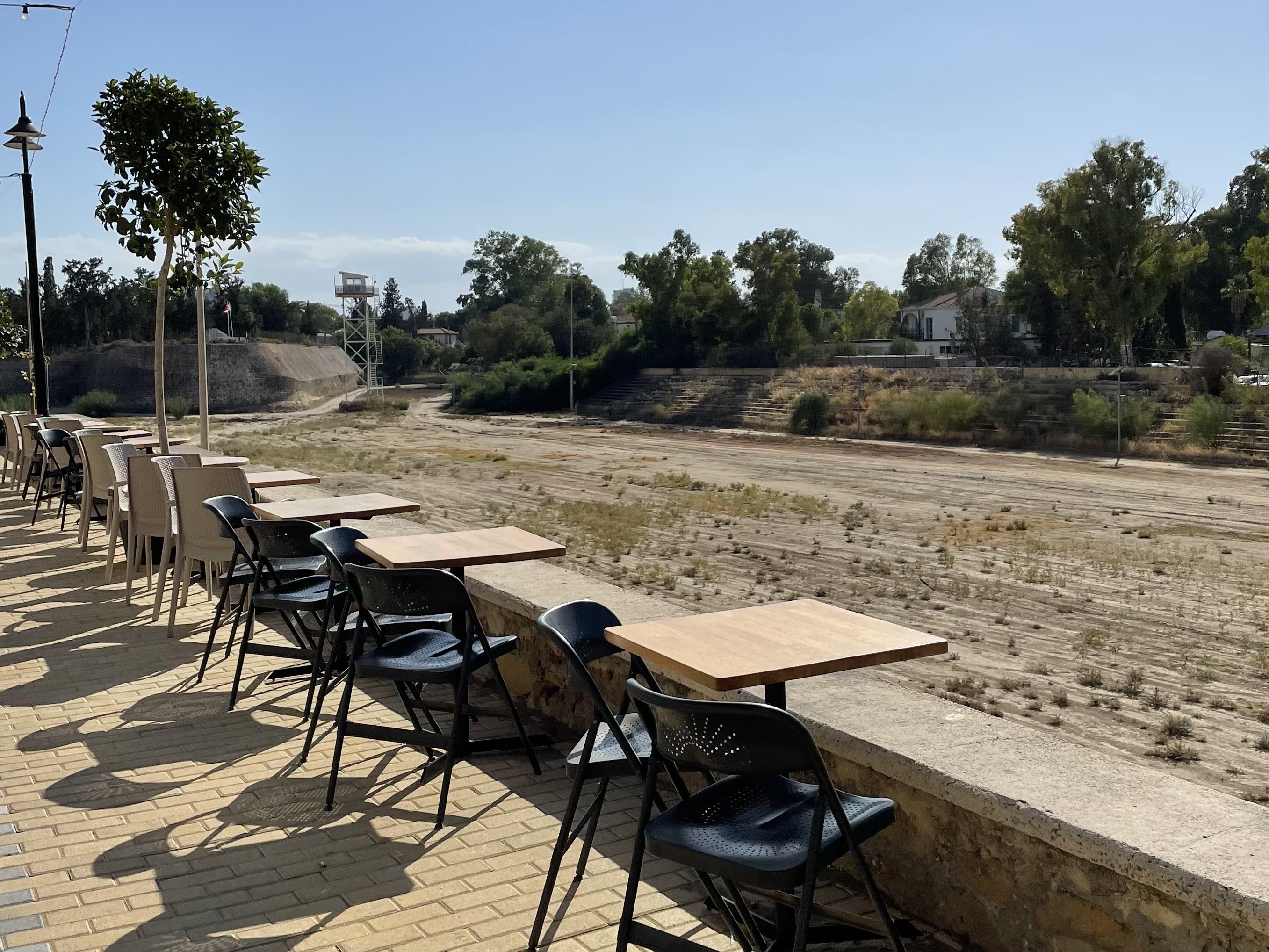
Sunset is the perfect time to go out in Cyprus in summer. The scorching sun dims, leaving humidity and hues of orange as its evening legacy. One of the most popular places to watch the sunset and sip coffee in northern Nicosia is Zahra Street. The empty and open panoramic view from the thoroughfare offers a breather away from the capital’s traffic. Young Turkish-Cypriots come to this street to drink, socialise and gossip. Local businesses line up their chairs alongside the view to maximise footfall. On busy summer weekends when all the chairs are full, people sit on the parapets of the Venetian Walls.
The historic Walls separate the street-here from the view-there. The view-there is not just another view. It is the Buffer Zone. The emptiness of the land, the UN watchtower in the corner, the barrels and derelict buildings in the distance are all choreographies of the border performance. Despite the panoramic dominance of the border landscape on Zahra Street, it is noticeably absent from conversations. As I argue in my recent article for the Journal of Borderlands Studies, an omnipresent and protracted border can fade into the background while other visibilities, such as local visibility produced through gossip and gazing, take centre stage.
As a Turkish-Cypriot from northern Nicosia, I regularly visited Zahra Street throughout my adolescence. Having completed my secondary education in southern Nicosia, I crossed a nearby checkpoint every school day. Over time, the border became unremarkable to me. This desensitisation shaped my central research question, which I explored through ethnographic interviews and participant observation with thirteen young adult frequent visitors and two business owners on the Street between April and June 2022.
The border backdrop
The works of Nicholas De Genova, Mette Catarina Skaarup, Shahram Khosravi, Samuel Singler highlight how borders function as stages on which states perform their sovereignty by acting their power upon bodies through security practices, materialities and technologies. I add that, in certain contexts, the perpetual continuity of such performances can lead borders to withdraw from cognition. This is especially the case for younger Turkish-Cypriot generations who grew up with the pre-established presence of the border. Born on a divided island, they did not experience a Cyprus other than the one in which checkpoints, military outposts, carrying two ID cards (Turkish Republic of Northern Cyprus and Republic of Cyprus) and pocket money in two currencies (Turkish lira and euro) were part and parcel of life.
Resultantly, young Turkish-Cypriots backdrop the border landscape in Zahra Street as “a strategy to de-internalise, through sensorial and social distractions, an omnipresent border that exists both internally and externally”. Their focus foregrounds the beautiful sunset, taste of the coffee, pop music surrounding the Street and gossip among the tables. The material signs of the border recede into the background as, in the words of a cafe owner on Zahra Street, ‘when, one sees something very often, one starts to not see it’. Such backdropping may be starkly different to how other individuals in Cyprus might perceive the border, such as older generations who have experienced violent conflict or migrants whose futures depend on fleeing from the north through the Buffer Zone into the ‘EU’ side.
Backdropping, as an active process, bears the possibility for the performance to come in and out of the foreground, highlighting borders to be volatile and dynamically perceived. Instead of flattening the violence of bordering, the term brings attention to how the experience of borders constantly fluctuates depending on where, when and who. Madeleine Reeves points to this as the social and temporal salience of borders. On Zahra Street, the backdropped border becomes temporarily visible in small fleeting moments, such as when the UN Peacekeepers patrol the area or when a local’s eye catches the watchtower tucked away in the corner. While border violence evokes trauma, victimhood and resistance among border communities across the world, it can also be normalised and adapted into mundanity. Such adaptations to borders, specifically in the Cypriot context, is the focus of my DPhil in Oxford.
Global invisibility and local hyper-visibility
I propose that the visibility of borders can be analysed in relation to the visibility of border communities, as they often have a bidirectional relationship. Everyday life on the northern side of the island, governed by the internationally unrecognised Turkish Republic of Northern Cyprus, is shaped by embargoes, limitations and inconveniences. These include, but are not limited to, sports teams and university degrees not being globally recognised; challenges in importing and exporting goods; and queueing at checkpoints to cross to the southern ‘EU’ side simply to access an internationally connected airport. As Rebecca Bryant & Mete Hatay emphasise, the conditions of division and unrecognition make Turkish-Cypriots ‘invisible to the rest of the world: this is the state that should not exist and so cannot be seen.’
In my article, I argue that there is a dialectic dynamic between this global invisibility and the local prominence of gazing and gossiping. Zahra Street is known as a popular space for piyasa, an emic term describing a social phenomenon of gazing and gossiping about each other, shared between young Turkish-Cypriots. Light whispers of chatter and eyes monitoring who-is-who fill Zahra Street, where piyasacılar (people who engage in piyasa) gather to watch each other. This form of sociality is not uncommon in the Mediterranean context where, as anthropologist Michael Herzfeld explains, coffeeshops are places ‘to see and be seen’. Beyond this regional cultural dynamic, the global invisibility of the community might be another factor contributing to the phenomenon’s intensity in the Turkish-Cypriot context. They render each other locally hyper-visible through a system of looking, perhaps as a result of their broader, global invisibility. As such, the border is invisibilised by and invisibilises young Turkish-Cypriots, while at the same time stimulating a local culture of visibilisation.
As a native researcher examining the ways people adapt to and backdrop the border’s slow violence (spanning more than half a century), I do not advocate for its normalisation. Rather, I hope to create an ethnographic archive that future generations can look back on, from a united Cyprus, to remember the violence and harm that we have been made to get used to.
Ibrahim's article is available to read in the Journal of Borderlands Studies: Ince, I. (2026). Border Backdrop: Shifting Visibility Along the Buffer Zone in Nicosia, 1–24.
Any comments about this post? Get in touch with us! Send us an email, or find us on LinkedIn and Bluesky.
How to cite this blog post (Harvard style):
I. Ince. (2026) When a border becomes a backdrop: visibilities of division in Cyprus' Zahra Street . Available at:https://blogs.law.ox.ac.uk/border-criminologies-blog/blog-post/2026/03/when-border-becomes-backdrop-visibilities-division. Accessed on: 28/10/2026Keywords:
Border
Share:
With the support of