Post by Ana Aliverti. This is the first instalment in the themed series on Policing, Migration and National Identity.
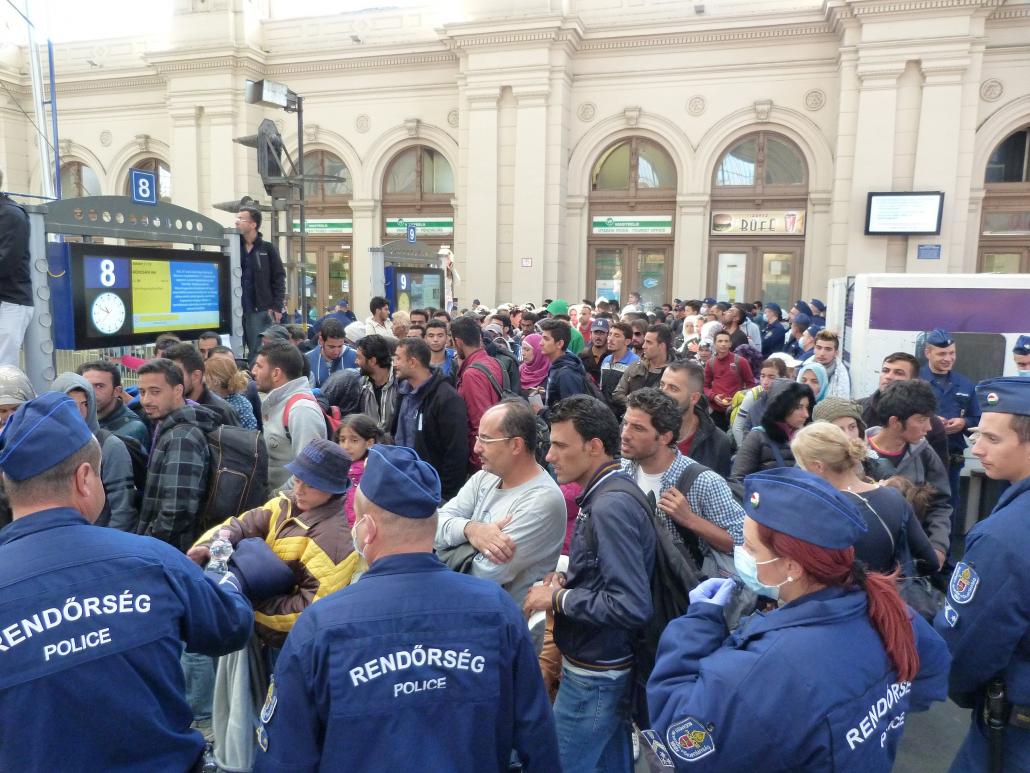
In this theme week, we devote our attention to the role of the police in immigration controls in various jurisdictions. Drawing on debates in the sociology and anthropology of policing, we explore the material and symbolic power of the police for creating and reinforcing social and territorial borders, focusing on various dimensions of this ‘bordering’ power. We first met to discuss them at a workshop at the University of Warwick in May 2017 which lent to the recent publication of a collection of articles in a special issue of Theoretical Criminology. In this theme week, contributors to the issue summarise their arguments and findings.
Policing scholars have long demonstrated how the police through daily, mundane interactions with civilians communicate whether they belong or not, and create social difference and hierarchies (Loader 2006; Fassin 2013). Loader and Mulcahy thus explain that police work, ‘whether oriented to maintaining order, controlling crime, or any other stated objective of policing [is] always at the same time cultural work…, an authoritative means of allocating risk and blame, of affirming lines of affiliation and exclusion, of constituting the boundaries and identity of cultural and political community’ (Loader and Mulcahy 2003, 304). Similarly, Vanessa Barker notes that ‘The police are creative agents in [the production of difference]. They do not simply reflect already given social relations but contribute to the production of those relations’ (Barker 2016, 212).
The posts reflect on how this function of the police, as mediator of national belonging, is put to work in the policing of global mobility and with what implications –institutional, social, global. As border and crime controls blend in contemporary forms of governance, what is the nature of the social and civil order that the police are called to enforce? How are they supposed to enforce that order? And at what costs? Who is the ‘public’ or the ‘community’ in whose name policing is carried out? How do border policing practices shape individual experiences and feelings of belonging? By investigating contemporary border policing practices in different jurisdictions, they shed light on how different societies construct, accommodate and reject difference differently, and how national communities imagine themselves.
The theme week opens up with two posts on the growing involvement of the police in immigration enforcement in the UK, under the remit of Operation Nexus. Operation Nexus was launched in 2012 by the Metropolitan Police and then rolled out nationwide. Its main objectives were to improve the identification of individuals brought into police custody, by systematically check their identity against immigration databases -either via remote checks or by embedding immigration officers in custody, and assess ‘removal opportunities’ at an early stage in the criminal process. In my post, I explore the drivers for this initiative. It places it within the broader social context where contemporary policing takes places, characterised by a growing blurriness between licit and illicit, order and disorder, and uncertainty about people’s identities. Immigration enforcement has been brought in to decipher the new geographies of crime and disorder, disentangle identities and extirpate risky outsiders.
Alpa Palmar’s post builds on her research on migration policing and racialisation in the UK. Through a detailed examination of police custody processes, she evidences how the growing involvement of the police in immigration has transformed citizenship into a disciplinary device to classify police suspects while unifying the treatment of racialised groups whose right to belong is questioned. She demonstrates the far-reaching implications of these practices on their sense of identity and citizenship.
In a different setting and adopting a slightly different approach, Leanne Weber scrutinises how the everyday operation of ‘internal bordering’ impacts on experiences of belonging. She draws on the accounts of young people from migrant background on police encounters in Australia to empirically document the role of the police as ‘arbiters and shapers of belonging’. Through their accounts, she demonstrates how feelings and experiences of (un)belonging are moulded through mundane interactions with ticket officers, security guards, shopkeepers and the public, and shows the centrality of police encounters in reinforcing ‘markers of non-belonging in a community’.
In their post, Giuseppe Campesi and Giulia Fabini examine how police officers in Italy instrumentalize immigration enforcement for public security and social defence. Immigration controls, they argue, is being retooled to govern marginal populations, not so much through deportation but through their banishment from urban spaces. Drawing on various police and judicial sources, they highlight the discursive construction of ‘migrant social dangerousness’ as the main ground for police coercion. Social dangerousness has a long vintage in positivist criminology. In its modern guise, they suggest, it captures how crime, race and national identity are increasingly interlinked.
Social dangerousness also entails a preventive logic to crime control, which is further explored by Helene Gundhus. Focusing on the growing role of police intelligence analysts in everyday policing in Norway, she observes that paradoxically in an effort to reduce uncertainty intelligence-led policing generates more complexity and amplifies anxieties about the unknown by constructing ‘insecure’ identities as dangerous. In this role, the police are not just preserving social order but actively reconfiguring notions of social order through anticipatory logic.
In the final instalment, Maartje Van der Woude’s article zooms out from the national sphere to examine the politics of border controls in its iterations between the local, the national and the supranational. By exploring ‘jurisdictional games’ by national border control bureaucracies, she argues that areas of incomplete EU regulation are exploited or actively created by Schengen member states to retain sovereignty. She demonstrates how, in operating within the space of discretion left by the multilayer governance within Europe, nation states strategically negotiate and calibrate the impact of globalization to preserve national sovereignty and national identity.
Collectively, the posts speak about continuities (historical and geographical) in policing practices and the distinct rationales and practices fostered (and enabled or thwarted) by the imperative to control global mobility.
Any comments about this post? Get in touch with us! Send us an email, or post a comment here or on Facebook. You can also tweet us.
__________
How to cite this blog post (Harvard style)
Aliverti, A. (2020). Policing, Migration and National Identity. Available at: https://www.law.ox.ac.uk/research-subject-groups/centre-criminology/centreborder-criminologies/blog/2020/03/policing [date]
Share:
With the support of