By Daniel E. Martinez and Robin C. Reineke
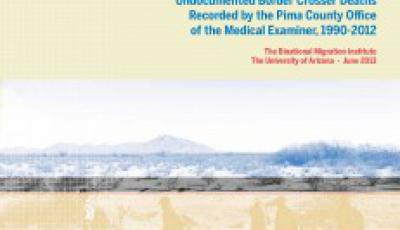
The first week of June, along with our colleagues from the Binational Migration Institute (BMI) at the University of Arizona and the Pima County Office of the Medical Examiner, we released a report with updated figures on undocumented border crosser (UBC) deaths in southern Arizona, USA. The state of Arizona shares a nearly 630-kilometer border with the northern Mexican states of Baja California and Sonora. According the U.S. Border Patrol, nearly a third of all the agency’s apprehensions occur in the Tucson Sector, an area that encompasses the eastern three-fourths of Arizona.
Our report builds on research conducted by BMI researchers since 2005 on data from the Pima County Office of the Medical Examiner (PCOME), the agency charged with investigating migrant deaths in most of southern Arizona. When the first report was released in 2006, entitled “The Funnel Effect,” we had hoped that an end to the deaths along the border was near. That has not been the case. Seven years later, the deaths have not decreased, and we were compelled to update our work.

We strongly believe that the dissemination of this information is important, especially considering that media coverage of migrant deaths has dwindled in southern Arizona over the past several years. Despite the fact that the number of migrant deaths in the region remains high, the deaths have become normalized, almost even expected, year-after-year. More attention must be paid to migrant deaths not just along the Arizona-Sonora border, or even the U.S.-Mexico border, but worldwide. Migrant deaths have become a global humanitarian crisis. Markets have become increasingly globalized while laborers have become increasingly restricted. Neoliberal economic policies have led to the displacement of thousands of peasants and working-class people around the world, who then face heightened securitization of political nation-state boundaries when they attempt to migrate.
The release of this report is also very timely. U.S. policy makers are now debating what is arguably the single most important piece of immigration legislation in thirty years. Ominously, no mention of deaths along the border is made in the Border Security, Economic Opportunity, and Immigration Modernization Act (S. 744). The last time that the federal government made overhauls to immigration policy on this scale, in the mid 1990s, the U.S.-Mexico border saw historic increases in enforcement that led to the death of hundreds of migrants each year (Eschbach et al. 1999; Eschbach et al. 2003; Cornelius 2001, 2005; Rubio-Goldsmith et al. 2006; Jimenez 2009).
The aim of border enforcement efforts of the era was to redirect unauthorized migration flows away from urban areas and into remote and dangerous regions of the border. Policy makers had hoped that this process would deter would-be migrants from attempting unauthorized crossings while also giving U.S. authorities a tactical advantage when apprehending border crossers.
Some may argue that the increase in migrant deaths in southern Arizona is simply a function of increased migrant traffic in the area—that more people are dying because more people are crossing. However, when Border Patrol apprehension statistics are taken into account, the death rate has actually increased exponentially since 1999. Figure 2 from our report (below) illustrates the number of migrant deaths per year standardized to 100,000 apprehensions. Although not a precise measure of unauthorized crossings, previous research has demonstrated that apprehension statistics are highly correlated and fluctuate with true unauthorized migration flows (see Epenshade 1995).

The full report can be found here.
Works Cited and Further Reading
-
Andreas, Peter. 2009. Border Games: Policing the U.S.-Mexico Divide. Ithica, NY: Cornell University Press.
- Andreas, Peter. 1998. “The U.S. Immigration Control Offensive: Constructing an Image of Order on the Southwest Border.” In Marcelo M. Suarez-Orozco (ed.) Crossings: Mexican Immigration in Interdisciplinary Perspectives, pp. 341-356. Cambridge, MA: Harvard University Press.
- Cornelius, Wayne A. 2005. “Controlling ‘Unwanted’ Immigration: Lessons from the United States, 1993-2004.” Journal of Ethnic and Migration Studies 31(4):775-794.
- Cornelius, Wayne A. 2001. “Deaths at the Border: Efficacy and Unintended Consequences of US Immigration Control Policy.” Population and Development Review 27(4):661-685.
- Dunn, Timothy J. 1996. The Militarization of the U.S.-Mexico Border, 1978-1992: Low-Intensity Conflict Doctrine Comes Home. Austin, TX: University of Texas Press.
- Dunn, Timothy J. 2009. Blockading the Border and Human Rights: The El Paso Operation that Remade Immigration Enforcement. Austin, TX: University of Texas Press.
- Eschbach, Karl, Jacqueline Hagan, and Nestor Rodriguez. 2003. “Deaths during Undocumented Migration: Trends and Policy Implications in the New Era of Homeland Security.” In Defense of the Alien, Volume 26. New York: Center for Migration Studies.
- Eschbach, Karl, Jacqueline Hagan, Nestor Rodriguez, Ruben Hernandez-Leon, and Stanley Bailey. 1999. “Death at the Border.” International Migration Review 33(2):430-454.
- Espenshade, Thomas J. 1995. “Unauthorized Migration to the United States.” Annual Review of Sociology 21:195-216.
- Jimenez, Maria. 2009. “Humanitarian Crisis: Migrant Deaths at the U.S.-Mexico Border.” ACLU of San Diego and Imperial Counties and Mexico’s National Commission of Human Rights. Report, October 1.
- Nevins, Joseph. 2002. Operation Gatekeeper and Beyond: The War on “illegals” and the Remaking of the U.S.-Mexico Boundary. Routledge: New York, NY.
- Rubio-Goldsmith, Raquel, M. Melissa McCormick, Daniel Martinez, and Inez Magdalena Duarte. 2006. The “Funnel Effect” and Recovered Bodies of Unauthorized Migrants Processed by the Pima County Office of the Medical Examiner, 1990-2005. Tucson: Binational Migration Institute, Mexican American Studies and Research Center, University of Arizona. Report, October.
About the authors:
Daniel E. Martínez recently successfully defended his dissertation in the School of Sociology at the University of Arizona and was hired as an Assistant Professor in the Department of Sociology at The George Washington University in Washington DC. His areas of research interest include immigration, criminology, and the sociology of race and ethnicity.
Robin Reineke is a doctoral candidate in the School of Anthropology at the University of Arizona. Her dissertation, “Naming the Dead: Identification and Ambiguity along the U.S.-Mexico Border,” is about institutional and family efforts to identify the bodies of deceased migrants along the Arizona-Sonora portion of the U.S.-Mexico border. For the past seven years, she has worked at the Pima County Office of the Medical Examiner, where she co-founded the Missing Migrant Project.
Want to start a discussion about this topic? Post a comment here or on our Facebook page. You can also tweet us.
__________
How to cite this blog post (Harvard style):
Martinez, DE and Reineke, RC (2013) Undocumented Border Crosser Deaths in Southern Arizona. In: Border Criminologies. Available at: http://bordercriminologies.law.ox.ac.uk/border-crosser-deaths/ (accessed [date]).
Share:
With the support of