
‘Stability and Change in Modern Property Law’ (Hart, 2025)
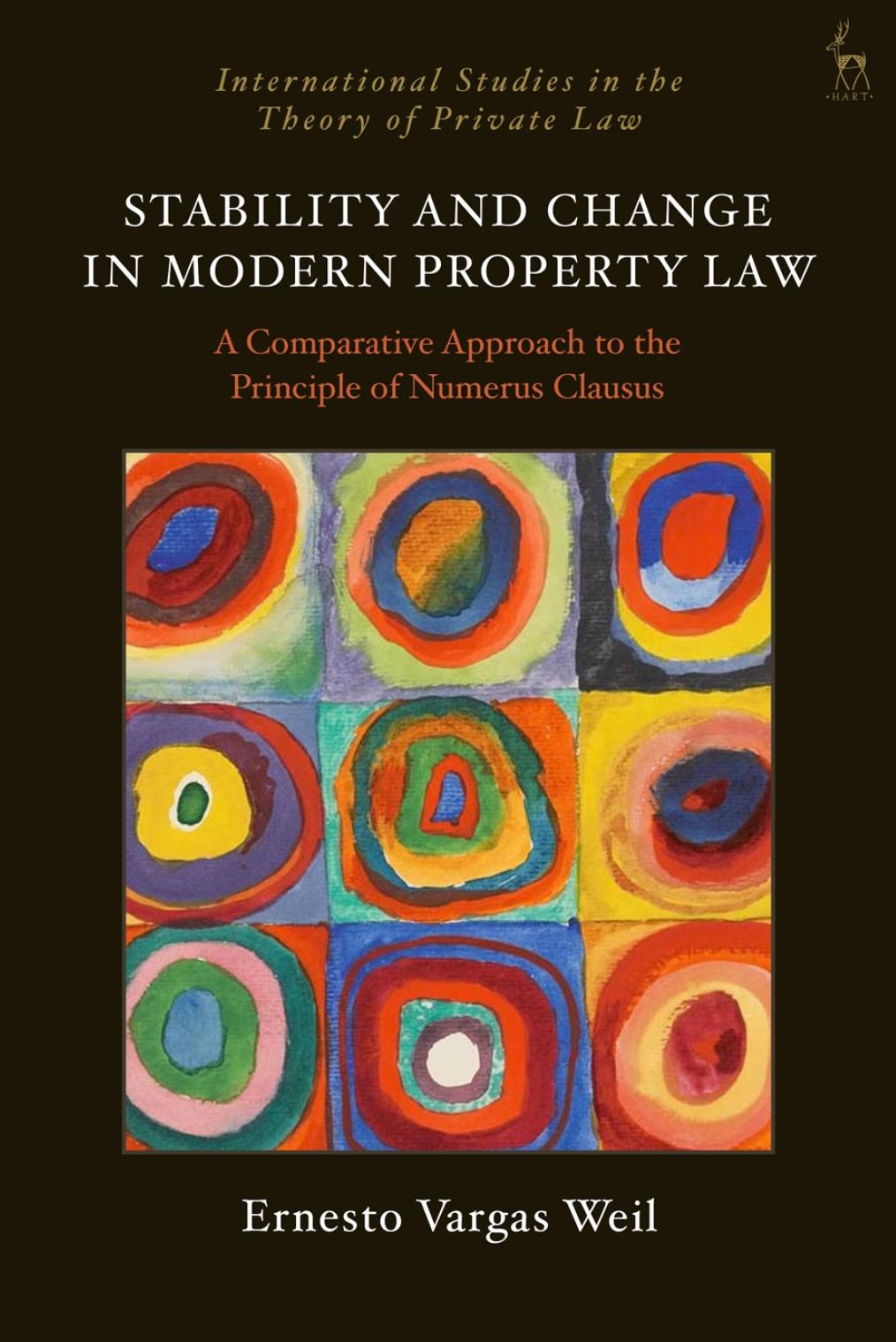
Dr Ernesto Vargas Weil is the Spencer Fairest Teaching Fellow in Law at Selwyn College, Cambridge. In this blog post he introduces his recent book Stability and Change in Modern Property Law: A Comparative Approach to the Principle of Numerus Clausus (Hart, 2025).
Posted:
Time to read:
7 Minutes
Aim of the book
A century ago, the American judge Benjamin Cardozo famously observed that ‘the law, like the traveller, must be ready for the morrow. It must have a principle of growth.’ Common wisdom takes this to mean that the law must remain flexible and subject to constant reform. Yet there is one area at the core of most modern legal systems that seems not to live up to this maxim: across jurisdictions, contemporary property law is frequently described as static, rigid, formalistic and, above all, obsessed with certainty.
Despite this reputation, modern property systems appear largely capable of accommodating the demands generated by profound social, economic, and technological change, often without undergoing visible structural transformation. How is this apparent paradox possible? One response is to deny the paradox altogether: either property law is not as rigid as commonly assumed, or it is rigid and therefore failing to keep pace with social change. Another option is to embrace the paradox and explain how contemporary property systems can respond to changing realities while retaining a high degree of structural stability.
My recent book, Stability and Change in Modern Property Law. A Comparative Approach to the Principle of Numerus Clausus (Hart, 2025), pursues the second path. It does so by focusing on a doctrine that lies at the heart of property law’s reputed rigidity: the numerus clausus principle of property rights. To this end, the book addresses a narrow question from a broad perspective: how do English and German property law—two systems built around a limited number of standardised property types—accommodate social, economic, and technological change? This focus enables an ambitious approach that combines a rich contextual account of the numerus clausus in both systems with an interdisciplinary analysis of its interaction with changing realities.
Functional transformation
The central finding of the book is that the numerus clausus principle is not an obstacle to adaptability, but rather one of the key doctrinal features that enable modern property systems to deal with new realities. The monograph shows that, by restricting the free creation of new property types, this principle ensures that modern property systems retain what Henry Smith has described as a ‘modular design’; that is a structure composed of relatively self-contained units that can absorb high levels of complexity inside them, without interfering with others. Building on the work of Ben McFarlane, the book shows that a central implication of this design is that it limits the imposition of non-consented duties on others, including other owners. Thereby the numerus clausus preserves the Hohfeldian liberty of these owners to ‘functionally transform’ the existing property types, that is, to apply its old structures to new uses without changing their black letter rules, a process already observed by the Austrian jurist Karl Renner in the early 20th century.
Understanding how the numerus clausus facilitates the functional transformation of property rights requires recognising that these rights can generate two distinct types of legal effects. As explained by James Penner, first, they may impose liability on the public at large for breaching a general duty to keep off the property (trespassory liability); and, second, they may impose liability on successors in title for infringing more specific duties that ‘run with’ the asset (successor liability).

© Claus Grünstäudl
The effect of the numerus clausus on the creation of new forms of trespassory liability is close to absolute. Absent legislative authorisation, private parties cannot generally create new duties that bind the world at large. In this way, the numerus clausus functions as a ‘normative firewall’, preventing the complexity developed within one module of property from spilling over into others. This ensures that owners are not burdened with duties and liabilities that would compromise their liberty to adapt their property to new realities. In the narrow cases in which non-consensual duties imposed on third parties are permitted (for example, limited property rights), the doctrine ensures that they can be managed through relatively straightforward legal mechanisms that enable parties to reach efficient Coasean bargains. The book illustrates this dynamic through cases in which the numerus clausus enables owners to escape liability when redeploying established property modules to meet new demands. In England, classic examples include Hill v Tupper (1863), which charts the transformation of a canal from a Georgian transport facility into a Victorian leisure venue, and Hunter v Canary Wharf Ltd (1997), which traces the evolution of a nineteenth-century dock area into a twenty-first-century financial hub. Relying on German tort law, the book then rationalises these outcomes as a manifestation of a broader principle-based protection of the ‘freedom of action’ of third parties.
The impact of the numerus clausus on successor liability is more nuanced. On the one hand, the principle limits the creation of idiosyncratic (i.e., non-standardised) duties running with the asset that would unduly restrict the ability of future owners to functionally transform the property. The book illustrates this mechanism through English cases such as Keppell v Bailey (1834)—where alienation freed property from a covenant that had become an obstacle to adapting an industry from the First Industrial Revolution to the age of railways and steam engines—and then accounts for its broader conceptual underpinning using German doctrine. On the other, the numerus clausus ensures that any enduring limitation on the liberty of owners is justified by policy benefits likely to withstand the test of time, a point exemplified by the operation of the English and German law of servitudes. Finally, in that context, the book shows that the limited property rights contained in the modern numerus clausus rely on open-ended concepts that can accommodate new fact patterns within established categories. This allows property rights to evolve incrementally inside preexisting frameworks without breaching the numerus clausus, a point illustrated by Regency Villas v Diamond Resorts (Europe) Ltd (2018) and the German debates on so-called ‘eternal servitudes’.
Finally, the book also shows that the rights contained in the modern English and German ‘closed list’ of property rights were never intended to operate in the vacuum but in the context of a wider system that allows certain forms of targeted state intervention that do not undermine the principle. Long before the emergence of modern property law, private allocations of property rights were supplemented by their forced relocation through expropriation, compulsory purchase, and takings. These directed or planned reallocations of property modules are crucial for overcoming holdout problems made possible by the broad liberties enjoyed by owners under a numerus clausus system. However, these ‘external’ interventions do not alter the structure of the property system itself, as they only rearrange individual and isolated entitlements. Historically, this form of state intervention ‘outside’ the numerus clausus has been instrumental in adapting pre-existing property rights to new realities, as with the transition from agricultural to industrial economies in 19th century Britain and Germany, and nowadays, with their vital role in enabling large-scale infrastructure projects.
Structural transformation
The book acknowledges that functional transformation—even when supplemented by expropriation—does not have unlimited capacity to respond to new realities. At certain moments, reforming the existing building blocks or creating new ones becomes unavoidable. The book describes this process as structural transformation.
Structural transformation takes place in three main ways. The first is the legislative creation of new property rights (re-modularisation). This was the path taken in Germany with the 1900 BGB and the 1951 Flat Ownership Act (WEG), and in England with the Law of Property Act 1925 and, more recently, the commonhold reforms. This mode of development is inherently compatible with the numerus clausus principle and represents the most straightforward and legitimate route for reform: only legislatures possess the democratic legitimacy, systemic overview, and technical capacity required to redesign property rights.
The second form of transformation developed primarily over the 20th century as part of the modern regulatory state’s effort to control negative externalities and other problems arising from the broad liberties enjoyed by individual owners under a numerus clausus system. These tools—including zoning, planning, and environmental regulation—are often better suited to addressing contemporary challenges. They operate by reshaping property modules from the outside, without undermining the core logic of the numerus clausus.
The third and most complex form of structural transformation is judicial innovation, which typically arises when legislators and regulators fail to keep property law in step with social demands. In this context, the book argues that the numerus clausus can accommodate a certain form of judicial discretion that builds upon existing legal patterns without dismantling the system’s basic formal architecture, a process that, borrowing from Alan Watson, can be described as legal scaffolding. In England, equity exemplifies this approach: it does not displace the common law but develops it by adding duties and constraints. In Germany, attempts to channel the horizontal effects of human rights through the conceptual categories of private law reflect a similar effort to contain judicial discretion within established forms. This stands in contrast to pure ‘remedialism’, namely courts bypassing the formal structure of property law to reach substantively desirable outcomes, thereby placing the modular integrity of the system at risk.
Concluding remarks
The book’s findings have important implications for how modern property law can—and should—evolve. To begin with, keeping property law aligned with social change does not require abandoning the numerus clausus principle. On the contrary, protecting the liberty of the general public—including other owners—and of successors in title to functionally transform their property in response to changing circumstances requires limiting the freedom of private parties to create rights with third-party effects. In this respect, property law is not unlike chess: it operates with a small number of pieces, each capable of moving only in strictly defined ways; yet the intelligent combination of those pieces by skilled players can generate an almost unlimited variety of games.
This should not be read as a defence of the status quo. Functional transformation does not have unlimited capacity to respond to new realities. Rather, the book highlights the importance of channelling the creation of new property rights and regulation of the existing ones through institutions that possess both democratic legitimacy and technical capacity to do so, principally Parliament and government. Timely action by these bodies is essential to avoid placing undue pressure on the judiciary to sacrifice the forms of law to achieve immediate substantive outcomes. Otherwise, the limited capacity of courts to respond to new realities might end up eroding the basic modular architecture of property law.
Ultimately, the book seeks to show that the beauty of modern property law lies in its quiet adaptability. The numerus clausus does not imprison property law in a rigid cage; instead, it provides it with a stable structure through which evolution can occur. Stability is not the opposite of change—it is what makes change possible over time.
Share: