
The academic literature typically assumes that fund families vote in a centralized way, with every fund in the family casting its proxy votes as part of a single, unified bloc. The same assumption underlies recent efforts to decentralize proxy voting at large asset managers. The largest managers have launched ‘voting choice’ programs that shift voting power from fund managers to the funds’ end investors, and several policy proposals would go further by requiring decentralized voting at large fund families. For example, the INDEX Act would require advisers of passive funds holding over 1% of a company’s voting shares to vote as fund investors instruct. In late 2025, the White House reportedly weighed a similar requirement for the largest index-fund managers. But do fund families actually vote as a bloc in practice? Using ISS proxy voting records for US equity mutual funds over the 2006–2023 proxy seasons, we provide the first large-sample examination of voting decentralization within fund families. We document how prevalent decentralized voting is, identify what drives it, and study its implications for corporate governance and for fund clients.
Why centralization looks like the norm. At first glance, the data seem to support the conventional view that asset fund families speak with a single voice: funds within the same family disagree in only about 4.2% of institution–proposal observations. However, this low baseline mainly reflects the non-controversial nature of typical proxy ballots. Most are either routine management items with overwhelming support (a 98% median approval) or poorly constructed shareholder proposals facing near-universal opposition. On these clear-cut items, unanimity happens organically, regardless of how voting authority is structured. But once we isolate issues that leave room for legitimate debate, a different picture emerges. For highly contested votes where the pass-or-fail is a close call, within-family disagreement jumps to 15–20%. This internal divergence also rises across other contentious dimensions: it reaches 15% for shareholder proposals, 18% for environmental and social (ES) issues, and to 13.2% when ISS recommends voting against management.
Decentralization is widespread and long-standing. We classify a family as centralized if the average voting agreement between any two of its funds is at least 99.5%: a threshold that allows for occasional recording errors or idiosyncratic votes. By this measure, roughly 40% to 60% of fund families vote in a decentralized way in a given year. Decentralization is not a recent phenomenon: already since 2006, between 35% and 70% of families have shown internal disagreement in a year. This long predates the recent spread of pass-through voting and Vanguard’s 2019 decision to delegate voting authority to its external fund managers. The timing varies across families. BlackRock and State Street show some decentralization throughout the sample, whereas Vanguard begins to decentralize only in 2019.
What drives decentralization. A family’s choice to decentralize is a trade-off between three forces. First, there is an information channel: fund managers may have specialized information, especially at active funds where managers do research before selecting a stock, thus decentralization allows fund managers to use this firm-specific knowledge when voting. Second, there is a cost channel: centralization may help economize on costly stewardship resources due to economies of scale. Third, there is a client channel: decentralization may allow funds to cater to the heterogenous preferences of clients.
We find some evidence for all three forces. Consistent with the information channel, decentralization is more common in families with a smaller share of index funds. Consistent with the cost channel, robo-voters—institutions that mechanically follow proxy advisor recommendations—disagree less within the family. Consistent with the client channel, we find that fund flows increase for funds that deviate from the voting policies of other funds in their family. Beyond these strategic trade-offs, decentralization also reflects a family’s organizational structure. For instance, families that use external sub-advisors show more decentralization, suggesting that voting authority is delegated along with portfolio management.
We also examine whether funds that share characteristics vote more alike, measuring alignment as the similarity of two funds’ votes within a proxy season. These pair-level results reinforce the family-level evidence. Funds sharing the same investment style or the same sub-advisor vote much more similarly to one another than to the rest of the family. We also find support for the client preferences story: funds with the same environmental or social (ES) orientation vote more alike than mixed ES/non-ES pairings.
Consequences for corporate governance. A central concern about decentralized voting is that it may weaken institutional monitoring. When a fund family opposes a director as a single, centralized bloc, it delivers a clear mandate for accountability. But when a family splits its internal vote, the message becomes diluted. This internal division provides the corporate board with a convenient excuse to dismiss the dissent and maintain the status quo—just like a child who, sensing their parents are not on the same page, simply ignores the one saying ‘no’ and proceeds with the approval of the other.
To see whether boards are less responsive to dissent when disagreement within fund families is present, we look at director elections. Votes against directors are common, visible, and happen at nearly every firm every year, which makes them a natural way to measure how boards respond to shareholder pressure. As we show in the figure below, shareholder dissent is most strongly associated with directors leaving the board when fund families vote as one unified bloc (blue dots), and the link weakens significantly when the family’s funds disagree (red dots).
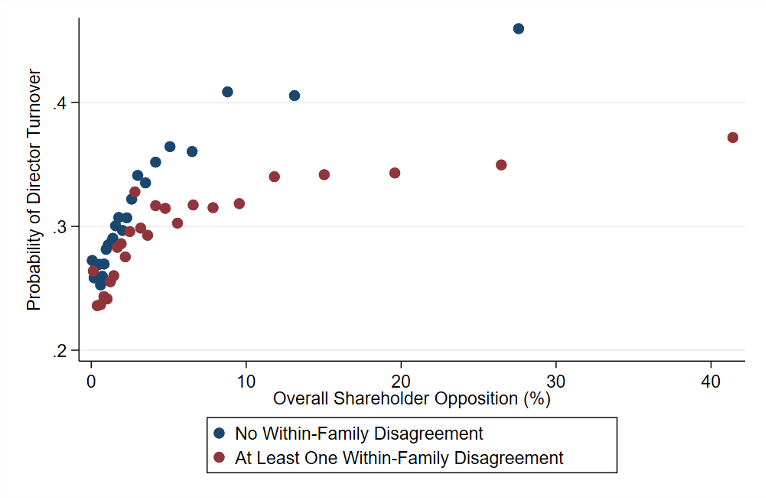
Our evidence from Vanguard’s 2019 move to decentralized voting suggests a causal interpretation. After the change, a Vanguard vote against a director became significantly less likely to be followed by that director’s departure. In short, centralized voting appears to make monitoring more effective. As pass-through voting becomes more popular, institutional oversight may weaken. More voices may sound more democratic, but they leave boards free to be selective in how they respond.
Consequences for fund investors. Does decentralization affect fund investors? We find that deviating funds charge higher expense ratios but do not earn higher gross or net alpha. This pattern is hard to reconcile with deviation reflecting superior information. It fits better with funds catering to clients’ preferences. Indeed, deviating funds attract significantly higher flows from institutional clients, who appear to reward voting that can better reflect their governance priorities.
Why it matters. Our findings challenge the ‘one institution, one voice’ assumption behind much of the debate over the power of large asset managers. Decentralized voting has been a pervasive feature of the fund industry for nearly two decades. The evidence also suggests that decentralization works mainly as a form of product differentiation, letting families cater to clients with different governance preferences. While this may serve as an effective product differentiation strategy, it comes with a cost: a fragmented shareholder voice inherently reduces board responsiveness. We believe policymakers pushing for decentralization should evaluate this fundamental trade-off.
The authors’ article is available here.
Roni Michaely is a Professor of Finance and Entrepreneurship at the University of Hong Kong.
Matthew C. Ringgenberg is a Professor of Finance at the University of Utah.
Silvina Rubio is an Assistant Professor of Finance at the Nova School of Business and Economics.
Irene Yi is an Assistant Professor of Finance at the University of Toronto.
Share:
With the support of
