Militarigration: the ‘adjusted’ response to people on the move at Eastern European border
Militarigration constitutes a stage of securitisation of migration, specific to the eastern EU border, effectively merging border security and national defence
Posted:
Time to read:
7 Minutes
Guest post by Witold Klaus and Magdalena Kmak. Witold Klaus is a professor at the Institute of Law Studies, Polish Academy of Sciences (head of the Department of Criminology and of the Migration Law Research Centre) and a research fellow at the Centre of Migration Research at the University of Warsaw. He serves as editor-in-chief of the oldest Polish criminological journal, ‘Archiwum Kryminologii’ (Archives of Criminology). He has held scholarships from: the British Academy (UK), the Max Planck Institute, Bielefeld University (both Germany) and the US government. His main areas of academic interest include refugee and immigrant rights, deportation studies, crimmigration, victimology and the victimisation of marginalised groups in society. He is a member of European Society of Criminology where he co- leads the Working Group of Immigration, Crime & Citizenship.
Magdalena Kmak is a professor of Public International Law, with a specialisation in Migration and Minority Research, at Åbo Akademi University. Magdalena received her PhD in 2009 from the Institute of Law Studies, Polish Academy of Sciences. She holds the title of Docent in law and globalisation (University of Helsinki). Her current research focuses on the multifaceted relationship between law and mobility, in particular in the context of global migration and minority regimes. Magdalena is a PI and Consortium Director in a project ‘Diversity, Trust and Two-Way Integration (Mobile Futures)’ funded by the Strategic Research Council established within the Research Council of Finland (2021–2027). She is also co-founder of the Nordic Network on Climate Related Displacement and Mobility.
The year 2021 was a turning point in EU asylum policy. This was the moment when the so-called eastern European Route opened up, and people on the move arrived in numbers at the borders of Poland, Lithuania, and Latvia with Belarus. The emergence of this route led to the creation of new instruments by authorities on the EU’s eastern flank and contributed to a shift in the EU’s approach to asylum policy, reflected in new legal regulations, both at the EU and country levels.
Eastern member states framed these developments as an unprecedented phenomenon, frequently describing the movement of people as a “hybrid war”, requiring exceptional tools to manage. This framing proved influential at the EU level and contributed to the adoption of the force majeure regulation, which introduced the notion of the “instrumentalisation of migration” and allowed derogation from several rights of people seeking asylum. Some member states, including Poland and Finland, went even further, formally suspending the right to seek asylum at their borders. Greece eagerly followed in their footsteps, showing the potential for the spread of instruments created in the east.
While restrictive and often violent land border practices are not new, they have traditionally been implemented at relatively short land borders (e.g. Greece or Bulgaria and Türkiye). By contrast, the EU’s eastern border stretches for thousands of kilometres, making it far more difficult to control. Consequently, practices that existed in southern Europe, such as pushbacks or the construction of fences, have been significantly expanded, both legally and operationally, at the eastern border. Indeed, many of the “innovations” implemented there represent an intensification of earlier approaches rather than an entirely new departure.
We analyse these developments through the novel concept of ‘militarigration’, which, as we argue, constitutes a stage of the securitisation of migration, currently specific to the eastern EU border, with a potential to spread. By militarigration we understand the multifaceted process of deploying military forces and armed personnel to the border and constructing militarised border infrastructure to regulate migration flows, effectively merging border security and national defence. This merger includes both material measures – such as fences and intensive electronic surveillance – and operational strategies, including military patrolling and the use of the environment. The concept highlights that this particular form of border control transforms migration governance into an even more security-oriented, state-centric practice, in which the management of human mobility is inseparable from the nation's response to external existential threats.
Defining militarigration
Militarigration comes directly from and is a development of the securitisation of migration. The latter concept has, in our view, recently been overused and has begun to serve as an all-encompassing term, yet it’s used rather descriptively. We argue that it is helpful to describe the situation observed at the eastern EU border using a novel terminology to better understand and conceptualise this development.
Militarigration follows the logic of securitisation, being its specific form. First, it similarly sees migration movements (especially irregular or illegalised migration) as a threat, and primarily targets the figure of the (racialised) immigrant. It also similarly functions as a political technology that affirms the role of state authorities as providers of protection and security. In practice, militarigration framework further empowers states to intensify migration control and restrict the rights of people on the move, relying on pre-emptive measures. In accordance with securitisation logic, the interventions occur not in response to actual harm, but based merely on the suspicion that migrants may pose a risk. This justifies measures such as border closures, denials of entry and pushbacks, which effectively prevent access to the territory.
Militarigration, however, is a concept intended to describe novel developments. Its main focus is external threats and national defence. States frame migration as a danger not only to internal security and public order but first and foremost to their external security, often articulated through the language of “hybrid war”. The important element here, therefore, is state-created narratives that the country is ‘under attack’, which leads to the deployment of measures beyond routine border protection practices. This deployment is usually carried out by the army (supported by law enforcement agencies) with firearms, supplemented by military infrastructure, which includes walls or fences along borders equipped with surveillance systems (cameras, including thermovisual ones, and other electronic sensors). Military infrastructure is paired with the exploitation of the environment (rivers, swamps) and nature (weather, including cold or rain), just as militaries have often done to their benefit. Moreover, even though they are justified by the rationale of war or a military threat, it is irrelevant whether those physical structures would genuinely fulfil their defensive role in military conflict, as the real “war” is waged not against a military attack. The ‘enemy’ in this context is rather a civilian population – primarily people on the move.
Finally, the main legal reasoning in the context of militarigration is based on special legislation: emergency law and the state of exception. These frameworks suspend the regular legal order and undermine the rule of law. In such a situation, safeguards that people on the move may have enjoyed are entirely eliminated. In this context, not only can the right to asylum be suspended, but violence is normalised, accepted, or even expected within the practice of border control.
Militarigration at Poland’s border with Belarus
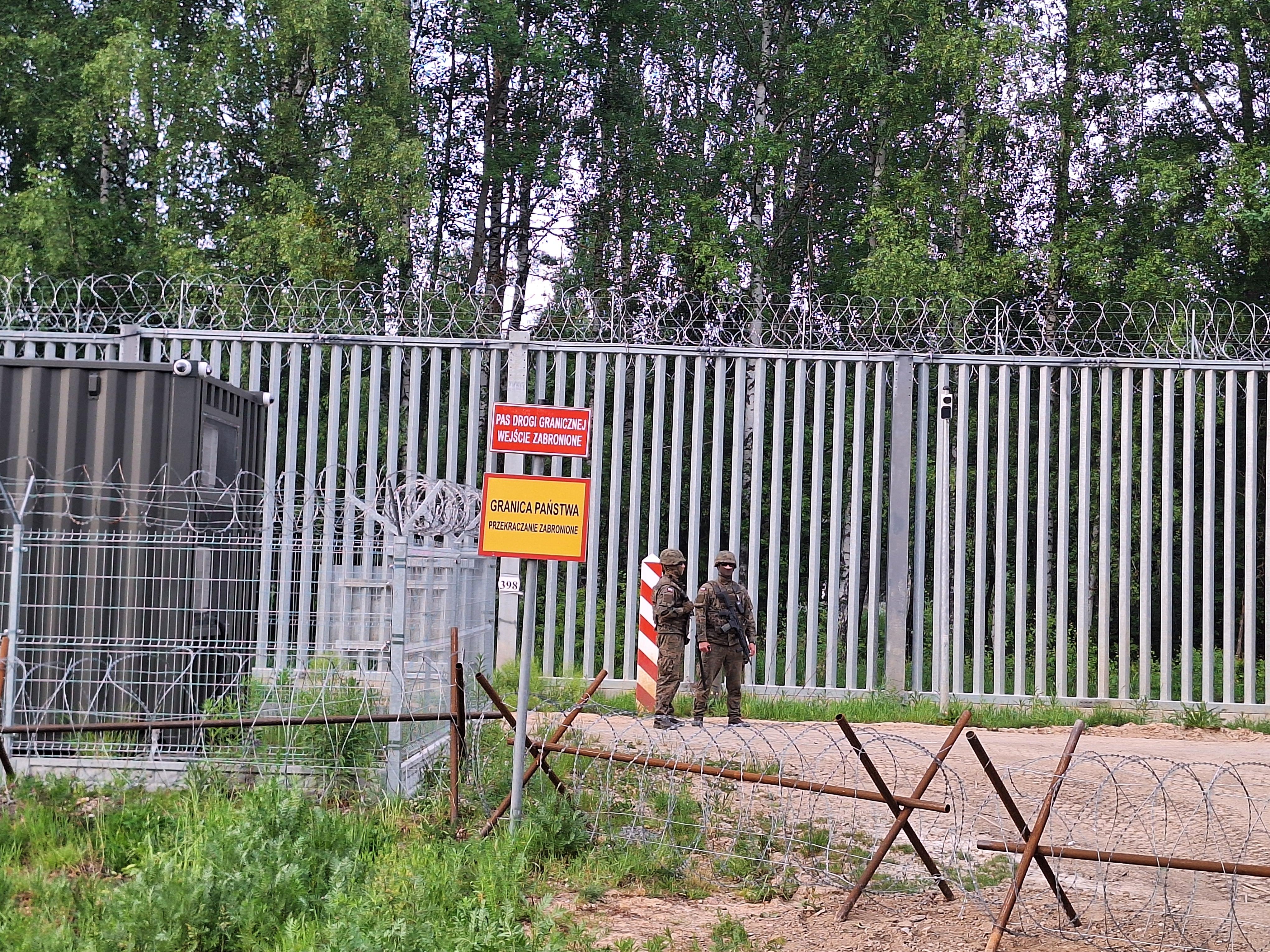
Militarigration is particularly useful to conceptualise the border protection measures deployed at Poland’s border with Belarus in response to the irregular movement of people on the move. The first dimension of militarigration was the declaration of a state of exception on 2 September 2021, which remained in force until the end of November. To circumvent constitutional limits on the use of exceptional measures, this was followed by a new legal mechanism, identical in practice – a “state of emergency at the border”, lasting from December 2021 until the end of June 2022. Both created a restricted “no-entry zone” with access tightly controlled and limited to select groups. Local residents, law enforcement, and military personnel were granted entry, while others, including journalists, humanitarian actors, lawyers, and even UNHCR, required special permits (which were not issued), with violations punishable by fines. The Polish Ombudsman and members of parliament constituted the only formal exceptions. Initially, the zone covered the entire border area, extending approximately three kilometres inland. Although the Polish Supreme Court ruled in January 2022 that movement restrictions were unconstitutional, the judgment had little practical effect. Emergency-type measures were reintroduced in June 2024 alongside an 80-kilometre “buffer zone”. These frameworks facilitated systematic pushbacks, grounded in domestic legislation. As a consequence, access to asylum was curtailed along the entire border.
Physical fortifications, the second dimension of militarigration, also played a role: temporary razor-wire barriers were erected in September 2021, followed by a permanent 5.5 metre steel fence extending 186 kilometres, completed in mid-2022. This was complemented by an extensive surveillance system, including cameras, sensors, and detection cables, which became operational in 2023. Additional measures addressed difficult terrain, with razor wire installed in riverine and swampy areas, and a second defensive line added in 2023. Further upgrades under the “Eastern Shield” programme include enhanced surveillance, reinforced fencing, and drone deployment. Polish construction resembles, to some extent, the Spanish solutions in Ceuta and Melilla, both of which have layers of fences, although the Polish wall is much larger in scale.
The third dimension is the deployment of military forces. Although border management formally falls under the responsibility of border authorities, military troops have been present at the Poland-Belarus border since September 2021, despite the legal framework being highly contested. The number of troops has fluctuated, ranging from approximately 20,000 at the peak in 2021 to around 6,000 in 2024. Following the death of a Polish soldier in May 2024, new legislation was adopted, granting officers immunity from criminal liability for firearm use under perceived necessity.
An urgent need for accountability
Militarigration has been used here to describe and conceptualise a significant transformation in the governance of migration that has characterised the eastern EU border since 2021. These developments show a particular new dimension of securitisation of migration and borders. This phenomenon can be clearly observed at the EU’s eastern border (with some facets appearing also elsewhere), where migrants are framed as instruments of “hybrid warfare” that legitimise implementing extraordinary measures. These include a combination of exceptional legal frameworks, militarised infrastructure, and the deployment of armed forces. Together, they reconfigure migration governance into a system where humanitarian considerations are subordinated to defence imperatives.
The consequences for human rights are profound. Practices such as suspension of asylum protection (first de facto, and then de jure) reflect the fragility of legal safeguards in contexts dominated by existential security narratives. These developments underline the urgent need for transparency, oversight, and accountability in the governance of Europe’s borders. Without such mechanisms, militarigration risks entrenching a model of border control in which the protection of people on the move is systematically derogated due to the priorities of state security.
Any comments about this post? Get in touch with us! Send us an email, or find us on LinkedIn, Bluesky and Instagram.
How to cite this blog post (Harvard style):
W. Klaus and M. Kmak. (2026) Militarigration: the ‘adjusted’ response to people on the move at Eastern European border. Available at:https://blogs.law.ox.ac.uk/border-criminologies-blog/blog-post/2026/07/militarigration-adjusted-response-people-move-eastern. Accessed on: 17/10/2026Keywords:
Poland
Share:
With the support of