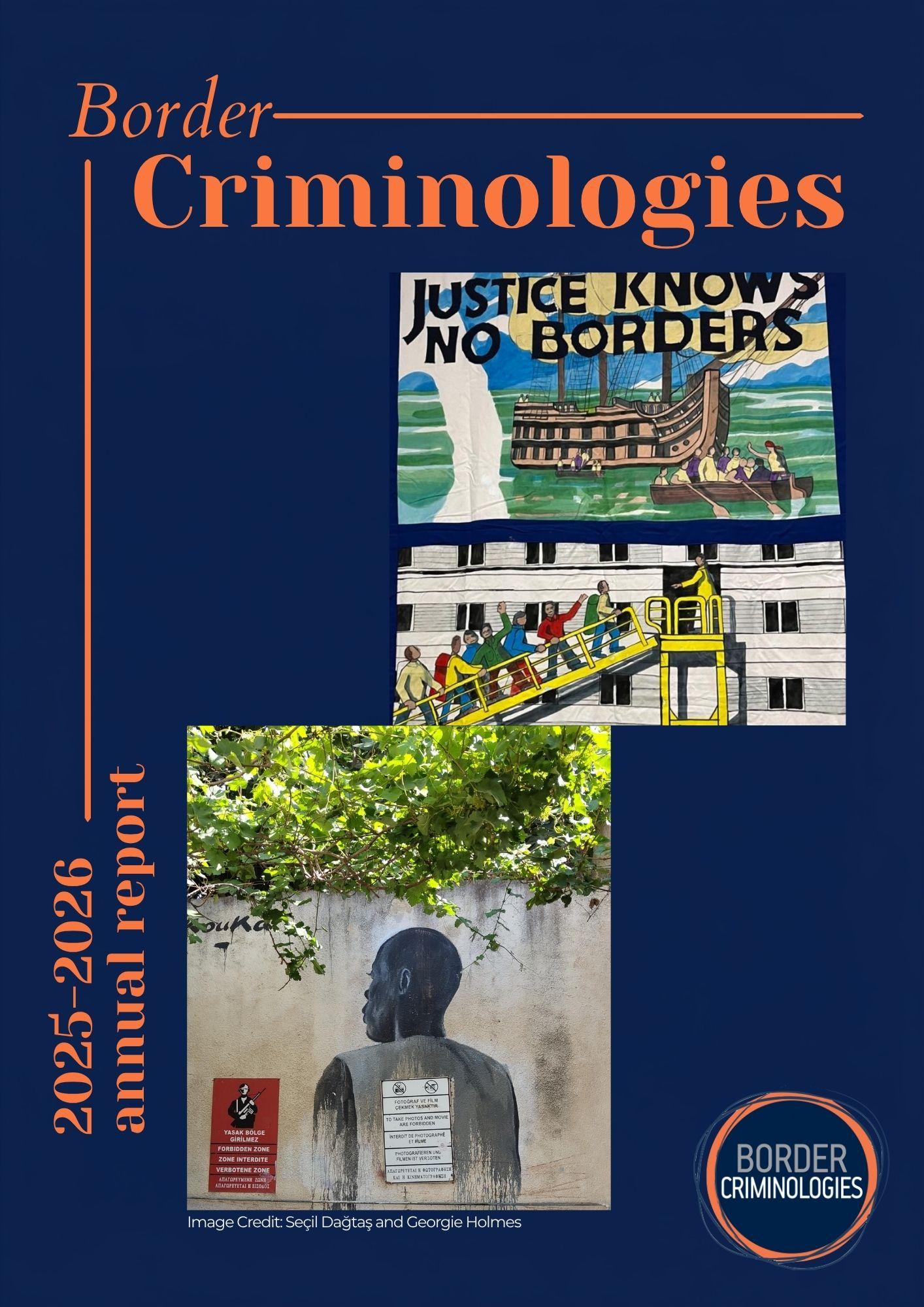
As the 2025-2026 academic year starts to wind down it is our pleasure to look back over the past twelve months to reflect on what Border Criminologies has achieved. This community of students, scholars, policy makers, and people with lived experience remains strong and vital. Despite the ever-intensifying politics around border control we continue to welcome new members from around the world and learn from one another.
The year began with a farewell to Sanja Milivojevic, who stepped down from her role as co-director to concentrate on the Technology and Digital Futures research strand. Diana Volpe, who will have been familiar to many members in their previous role as managing editor of the website and blog, graciously agreed to join us, despite moving to another country and job at the same time. Melissa Pawson took up the managing editor role in addition to communications. We are very grateful for her work.
This year we have also benefited from a group of student interns and volunteers. Supporting early-career researchers remains central to our mission as we continue to create opportunities for them to contribute to critical debates on borders and migration. Anna Tsui has rapidly become irreplaceable as our events manager, while Antonia Brillembourg and Maria Cecilia Smurr-Ferrer assisted with our newsletters and social media accounts, allowing us to return to Instagram. Michel Viner has worked with Mary and Gee Manoharan as the Border Criminologies-AVID intern, and we recently welcomed Hillary Coker as our second summer UNIQ +intern. We also welcomed Nabila Arab, Isabella Crispino, Filippo Reato and Rebecca Valerio, who are supporting our research and communications over the summer. Andriani Fili and Alice Troy-Donovan will additionally work with two teams of interns, one over the summer and one in autumn, to develop the Detention Landscapes platform.
This year Border Criminologies has expanded its academic and policy engagement reach with two new thematic strands: Beyond Smuggling and Criminalisation, and, most recently, one on Climate and Mobility Justice. Both are working on a targeted set of questions designed to influence law and policy.
While Border Criminologies members meet regularly in their separate groups, we also come together at the annual meeting and other in-person events. This year, we packed two annual workshops in the span of one! In September 2025, we were gracefully hosted by Dr Alpa Parmar at Clare College, Cambridge, where we looked for silver linings and glimmers of hope while discussing Border Resistance and Utopian Futures. We even made a little video out of it. In 2026, we switched around timings and hosted the event in May back in Oxford, focusing on Bordered Care: Practices, Power, and Resistance at the Edge. We are now working on a publication to bring together the perspectives and conversations shared at the workshop. Next year, the workshop will get back on the road in Brussels, where Diana will host us at Université Libre de Bruxelles (ULB). Keep an eye out for more information coming soon!
The year has been a very busy one, between several book launches, film screenings, private workshops and events hosting activists, practitioners, and experts by experience. Our website and blog continue to provide a space for critical conversations on migration and borders. Throughout the year we published contributions from researchers, practitioners, activists, and people with lived experience across multiple continents, maintaining our commitment to accessible scholarship.
As border control increasingly shapes universities and academic life itself, many of us are experiencing the dynamics we seek to understand and challenge through our research. Across many countries, universities have become increasingly entangled in migration governance through visa regimes and security logics. For many students and scholars, bordering practices are no longer an object of study but an everyday reality that shapes who can travel and collaborate. These developments reinforce the importance of maintaining spaces, like Border Criminologies, for critical scholarship and collective reflection.
As Europe’s ‘era of deportation’ begins, and that in the US continues apace, the strength of our convictions and of our network becomes ever more important. We welcome all ideas for initiatives, collaborations and further support, as the funding landscape for this type of work continues to dwindle.
We would like to close by extending our gratitude and solidarity to our members, collaborators, supporters and followers, for continuing to show up for each other and bringing in renewed strength and commitment to critical scholarship. As we challenge the deportation machine, we are constantly reminded of the importance of joy and care in sustaining the relationships and communities that make this work possible. Until we meet again, we wish you a restful, and dare we say even uneventful break.
Mary, Andriani, Diana
Share:
With the support of