The permanently provisional: Living on a militarised border in south Lebanon
At the Israel-Lebanon border, regimes govern through bombardment, restricted zones, and the constant anticipation of return or renewed flight
Posted:
Time to read:
6 Minutes
Guest post by Hucen Sleiman. Hucen is a researcher at the Institute for Migration Studies at the Lebanese American University and the École des Hautes Études en Sciences Sociales (EHESS), Paris. His research focuses on displacement, borderlands, and spatial governance in the Middle East, with particular attention to south Lebanon and militarised frontier regions.
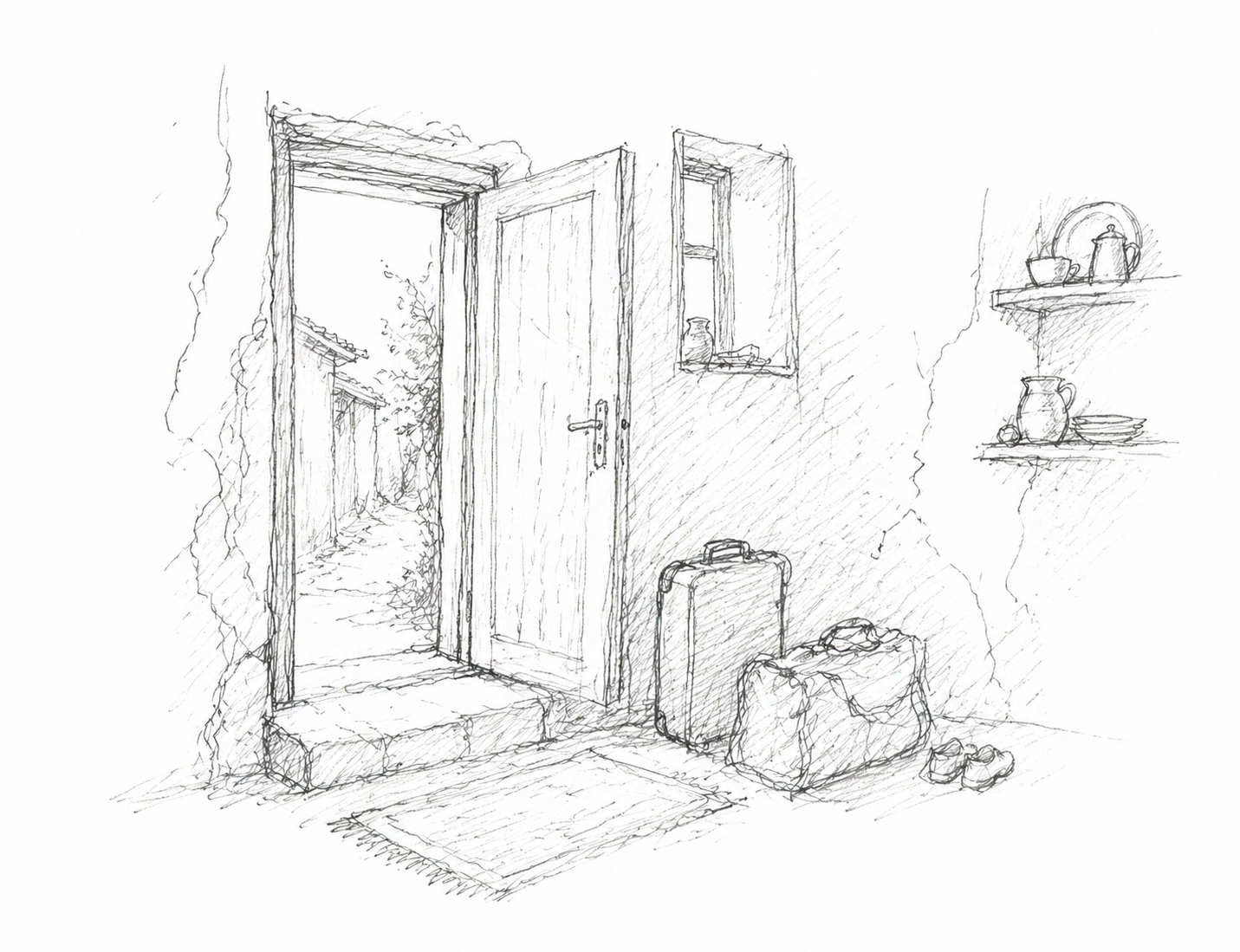
"I don't unpack anymore when the shelling stops. My bags stay ready."
This is how a farmer from Aita al-Shaab described life near the Israel–Lebanon border during an informal phone call following the 2024–2026 hostilities between Israel and Hezbollah in Lebanon, which involved repeated shelling, evacuation orders, and civilian displacement. His words capture a condition shared by many residents of southern Lebanon: displacement is no longer an exceptional event, but a permanent possibility.
The militarisation of the Israel–Lebanon frontier produces a specific kind of civilian subject — one who lives in a state of permanent provisionality. Residents retain legal residence and formal citizenship, yet live under persistent uncertainty about whether they can remain in their homes, access basic services, or rebuild their lives without renewed threat of displacement. Some families flee temporarily to other parts of Lebanon, while others remain in their villages for significant periods despite shelling and evacuation warnings. Although many therefore experience internal displacement, their repeated movement, return, and renewed evacuation often fall outside stable legal or policy protections associated with protracted displacement. And unlike refugees who cross international borders or migrants detained by immigration regimes, these residents remain formally within their own state, yet their everyday lives are shaped by bombardment, restricted zones, and the constant anticipation of return or renewed flight.
Border criminology has shown how states govern through institutions such as detention centres, deportation regimes, and policing practices that regulate mobility. Scholars including Mary Bosworth and Katja Franko have demonstrated how border control operates at the intersection of criminal justice, migration law, and state sovereignty, as documented in the recent Handbook on Border Criminology. In south Lebanon, however, governance works differently: not by holding people at the border, but by ensuring that they can never securely remain where they live.
Displacement as a recurring condition
Since October 2023, hundreds of thousands of civilians in southern Lebanon have been displaced as hostilities between Israel and Hezbollah escalated. By March 2026, the UN reported that nearly 700,000 people had been forced from their homes, including around 200,000 children. Entire villages close to the border were emptied following evacuation warnings and heavy bombardment. Many residents returned after ceasefires only to leave again weeks or months later when fighting resumed. The UN has noted that many of those fleeing in 2026 were also displaced during the 2024 conflict.
This pattern is not new. Similar cycles occurred during the wars of 1993, 1996, and 2006 . For many families, displacement has become a repeated experience across generations.
During the latest escalation, testimonies published by The New Humanitarian described evacuation as a familiar routine for many displaced residents. Families spoke of knowing escape routes, temporary shelters, and which documents to carry before leaving. As Nour, a displaced resident featured in The Lebanon Displacement Diaries, explained, “the feeling of leaving is like tearing your soul from your body… the safe place is the one you left behind.”
These accounts show how repeated conflict transforms displacement from an exceptional rupture into an anticipated interruption of everyday life. Following the ceasefire on 17 April, some residents returned overnight through makeshift crossings after bridges over the Litani River had been destroyed, while others left again amid fears the truce would collapse, causing heavy traffic in both directions.
This familiarity reflects what can be described as ‘border competence’ — a learned ability to navigate life in a space where violence can resume at any moment. Such competence is not cultural habit but the result of living under a militarised border regime in which displacement is expected rather than exceptional.
Governing through evacuation
Border criminology often focuses on detention, deportation, and policing as tools of border control. In south Lebanon, however, control frequently operates through Israeli military evacuation orders and restricted zones imposed on civilians living in frontier villages. During hostilities, such directives can compel flight without any formal change in legal status. Evacuation warnings, restricted zones, and security instructions issued during hostilities carry practical force even when they do not create a formal legal status. The UN has raised serious concerns about these evacuation orders, noting that they are "unprecedented in their scope" and "very difficult for the population to comply with," raising questions under international humanitarian law. Residents who remain may be treated by Israel as violating military instructions, yet those who leave are not recognised as refugees or evacuees in any formal sense.
This produces a form of governance without clear legal category. Fleeing civilians remain citizens, but their ability to inhabit their own homes depends on shifting security decisions made by military and political authorities. They exist in a gap between ordinary rights and emergency rule. The result is not expulsion across a border, but the creation of a population that can be displaced repeatedly without ever leaving the territory of the state. Unlike more conventional forms of internal displacement, movement in this case is often cyclical rather than one-directional: many residents return repeatedly, while others never leave for extended periods despite protracted insecurity.
The legal and social limbo of return
Return after displacement rarely restores stability. Many residents come back to damaged houses, destroyed farmland, or villages where electricity and water remain unreliable. Reconstruction is slow and uneven, and the possibility of renewed conflict shapes decisions about whether to rebuild. The Lebanese government has secured $360 million for reconstruction, including World Bank loans and European grants, but estimates suggest the full cost of damage exceeds $5 billion.
One resident repairing his home from Ansar told me via a phone call after the latest ceasefire: "we fix what we can, but we know it may not last. You rebuild because you have nowhere else to go."
He was standing in front of a partially repaired concrete house, its windows still covered with plastic sheets. The roof had been hit during the previous escalation, repaired once, and damaged again months later.
Such situations illustrate the condition of the permanently provisional. People living in south Lebanon are not refugees, but they cannot live with the security normally associated with citizenship. They rebuild, knowing that rebuilding may only prepare the ground for the next evacuation.
Border violence without crossing
The experience of living in southern Lebanon challenges the tendency to associate border violence only with migration control. In many cases studied by border criminologists, harm occurs when people attempt to cross borders — through detention, deportation, or dangerous journeys. Here, harm occurs without crossing at all.
Civilians remain inside their country, yet the border still governs their lives through insecurity, destruction, and forced movement. Military operations intended to secure the frontier frequently produce the displacement of those living closest to it, transforming entire villages into temporary zones of habitation. In villages such as Alma al-Shaab and Qulay'a, residents have faced bombardment and evacuation warnings despite having no affiliation with Hezbollah. As Father Toni Elias of Rmeish told The New Arab in March, many residents chose to remain despite evacuation pressures: "we decided to stay on our land because we are attached to it and we love it. We would rather die here than be humiliated on roads in unknown places.”
In militarised borderlands, the burdens of security policy fall most heavily on those who live nearest the boundary, regardless of whether they intend to move. Comparable dynamics can be seen elsewhere, including among Kurdish communities living near the Turkey–Syria frontier and residents of the occupied Golan Heights, where everyday life is similarly shaped by military logics, surveillance, and the possibility of renewed conflict.
Living with the next evacuation
For many residents, the most striking aspect of life near the border is not a single episode of displacement but the expectation that another will come. Families keep documents ready, avoid long-term investments, and rebuild houses quickly because they know stability may not last. The UNHCR has observed that people are not waiting to see what happens next — they leave immediately when warnings come.
As a displaced schoolteacher from al-Khiyam, whom I interviewed by phone in March, explained: "you never feel that the war is finished. You only feel that it has stopped for now."
This constant readiness produces a form of existence that is neither temporary nor secure. People remain in their homes, yet they live as if departure were always imminent – because it could be.
Rethinking border criminology from the frontier
The Israel–Lebanon border shows that military practices, conflict dynamics, and uneven state governance do not only regulate movement; they also govern who can remain in place, and under what conditions. They produce subjects who remain at home, but whose lives are structured by the continual possibility of forced movement.
The permanently provisional resident of south Lebanon challenges the usual focus of border criminology on detention, deportation, and migration control. It reveals a different form of border violence — one that operates through repeated displacement, uncertain return, and the inability to live securely even without crossing a frontier. Both forms of bordering seek to consolidate political power, but through different logics. Migration-control regimes do so by regulating mobility and differentiating insiders from outsiders. Militarised frontier regimes do so through territorial domination, the projection of force, and the management of civilian presence in contested space. Recent developments in south Lebanon, where ceasefire violations have continued alongside Israeli military positions and new access restrictions, suggest that provisional life near the border is likely to endure for some time.
Any comments about this post? Get in touch with us! Send us an email, or find us on LinkedIn and Bluesky.
How to cite this blog post (Harvard style):
H. Sleiman. (2026) The permanently provisional: Living on a militarised border in south Lebanon. Available at:https://blogs.law.ox.ac.uk/border-criminologies-blog/blog-post/2026/05/permanently-provisional-living-militarised-border-south. Accessed on: 16/10/2026Keywords:
Border control
Share:
With the support of