Guest post by Laura Lambert. Laura is a political anthropologist working on asylum, migration and citizenship in West Africa. She is currently a postdoctoral researcher in the European Research Council project “Doing Digital Identities” at Leuphana University where she focuses on digital identification in Sierra Leone. Her prior research addressed the everyday externalization of refugee protection to Niger.
Resettlement has recently come increasingly under attack in a wider right-wing backlash against refugee protection and human rights. The United States and Germany as two major resettlement countries have reportedly just suspended refugee resettlement.
Such attacks risk closing the space for critically rethinking durable solutions in what they do for refugees and their host communities in the Global South. As a durable solution, resettlement has been rightly criticized in academia for benefiting only a select few. Less than one percent of refugees worldwide receive it.
In this blog post, I argue that resettlement should also be criticized for being a temporal border that contains refugees in transit states. It promises a better future and thus motivates refugees in transit states like Niger to abandon migration and wait there for this better future to realize. This temporal containment may be reinforced or subverted by different modes of remaking the future.
This blog post summarizes an article I recently published in Comparative Migration Studies in a Special Issue on future-making and containment. It draws on ethnographic field research on the humanitarian border in Niger, an important transit country between West Africa and North Africa.
Containment via Promises
Researchers have so far framed resettlement as a filtering border that selects few candidates in a highly opaque and discretionary way while most others are compelled to stay in the Global South.
Beyond spatial containment, I argue, resettlement can also be a temporal border. Many refugees in the Global South hope for resettlement despite the scarcity, because it promises a safe and legal pathway to a more hopeful future in the Global North. Such options are often blocked by violent border controls, impossible visa regimes, and costs of thousands of dollars.
Martina Tazzioli discusses how temporal borders govern migration through the “control over and through time”. I suggest that resettlement mobilizes promises of a better future in the Global North that require migrants to wait for an eventual delivery of this promise in the transit state. Other alternatives to reach brighter futures like irregular migration are sidelined. Such resettlement promises are not necessarily intentional. They are conveyed by resettlement infrastructures and different actors.
No one forces migrants to wait for resettlement. Rather, its promises of a better life entice them to do so. Resettlement gently ties migrants to transit spaces and thus complements border controls that violently hold them back.
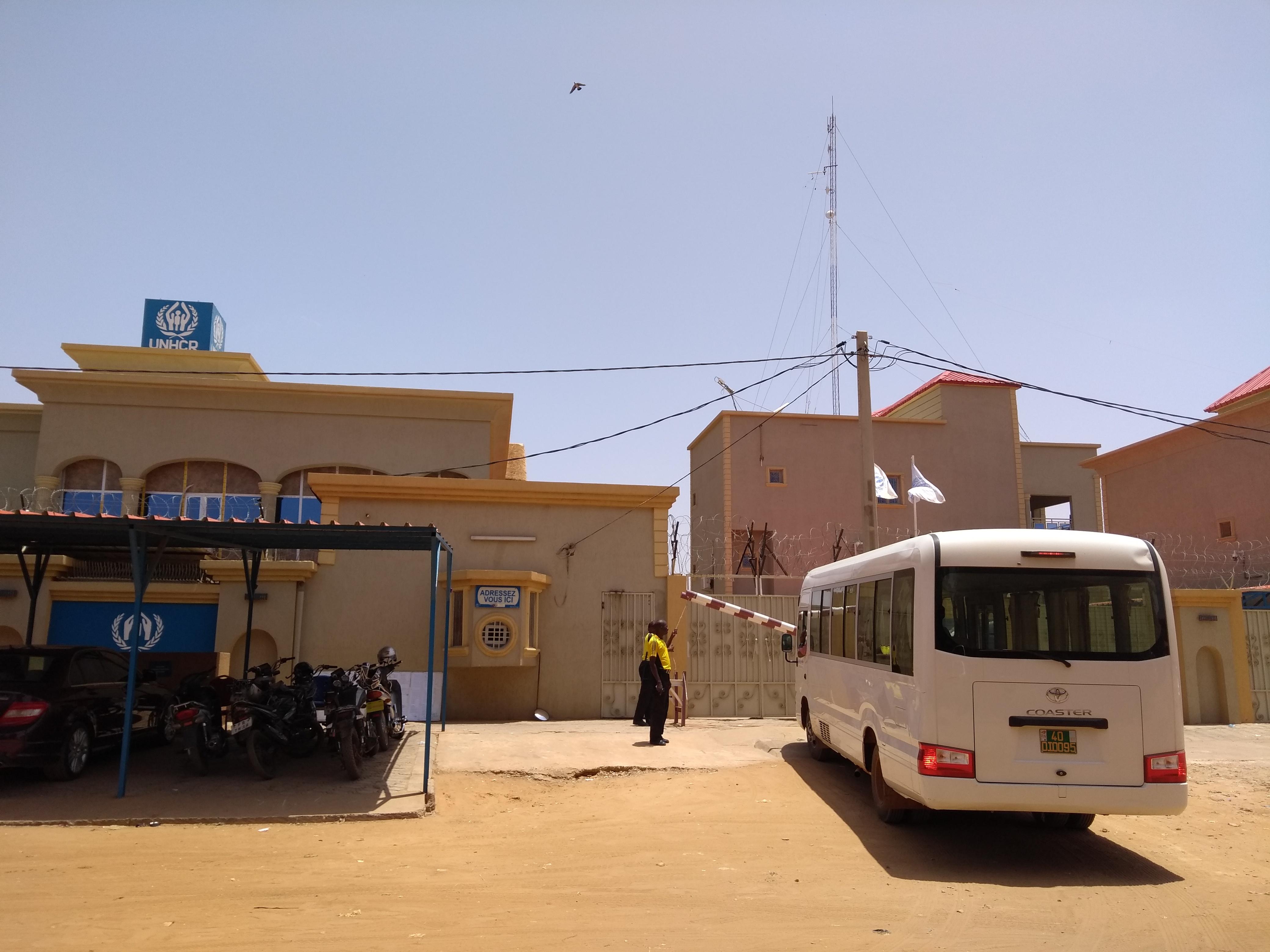
Niger: Resettlement as Disincentive
In Niger, resettlement was established as one dimension of a plethora of border control policies funded by the European Union (EU) to prevent African migrants from reaching Libya and European shores.
The United Nations Refugee Agency (UNHCR) introduced resettlement with EU funding in 2017. For both, it was a disincentive for refugees to travel to Europe. In the words of an official, UNHCR offered services in Niger to prevent that potential refugees would “go to that dangerous road” through the Sahara. They should rather apply for asylum in Niger “with a possibility if you have the profile to depart” for resettlement. Migrants only needed to abandon their voyage, enter the asylum procedure in Niger and wait – often for years – for refugee status and resettlement. In 2017, alone the waiting time for the refugee status was 19 months.
Niger: Tensions over Resettlement Futures
Resettlement certainly improved refugee protection in Niger, but it had many unintended consequences for refugees and for their relations with officials. Refugees felt stuck in Niger and struggled to endure the waiting for resettlement. They weighed the risks of losing time while waiting against the risks of irregular migration that would provide a way out of feeling stuck. Many abandoned their asylum cases and opted for irregular journeys to North Africa through the Sahara. Refugees also tried to influence officials to process their cases, by arousing their compassion or protesting in front of offices.
Resettlement also sparked jealousy and mistrust among Nigerien officials. They found asylum seekers abandoned their cases and fabricated lies to get out. They suspected applicants of seeking resettlement from UNHCR rather than protection from their own state. In response, officials sometimes refused applicants early on by claiming they were only interested in resettlement. In shifting to refugees’ future wishes, officials lost sight of their history of persecution.
When resettlement eschewed, refugees and officials struggled to experiment with creating viable alternative futures. They hoped to make a case for legal migration and complementary pathways or building a decent life against the odds in Niger.
These examples suggest the different and contested practices of future-making by refugees and officials in response to resettlement. Resettlement promises prompted refugees to weigh the risks of pursuing different futures against each other and officials to foreclose these privileged futures for them, but it also inspired shared practices of experimenting with alternative futures. In these different practices, refugees and officials actively sought to reinforce or subvert resettlement promises as a temporal border.

Abandoning Resettlement?
In times of a conservative backlash against migration, criticizing resettlement could be used to further undermine it as a durable solution. As Max Pichl has suggested, safeguarding human rights against a far-right backlash is important in today’s political climate. Following this thinking, pro-migrant alliances should publicly support the continuation of resettlement as one of the few legal pathways available to refugees. At the same time, refugees may continue to contribute better alternatives to resettlement. Their future-making can be the starting point for more inclusive policies. These would be alternatives that do not replicate the logic of resettlement as a highly selective and temporal border with dire consequences for refugees and even officials in the Global South.
Any comments about this post? Get in touch with us! Send us an email, or find us on LinkedIn and BlueSky.
How to cite this blog post (Harvard style):
L. Lambert. (2025) Resettlement as a Temporal Border . Available at:https://blogs.law.ox.ac.uk/border-criminologies-blog/blog-post/2025/06/resettlement-temporal-border. Accessed on: 18/10/2026Share:
With the support of