
In the early hours of 16 November 2025, a court in Bangladesh sentenced the country’s former Prime Minister, Sheikh Hasina, to death in absentia. Many in Bangladesh celebrated this sentence as the ultimate form of accountability: a brutal leader finally held legally responsible and given the harshest penalty available. This post asks what kind of justice Bangladeshis wish to see and argues that, while the death penalty offers powerful symbolic and communicative censure, it makes genuine legal accountability for Hasina far less likely.
The sentence was awarded by Bangladesh’s International Crimes Tribunal (ICT), a controversial domestic court which was originally established by Sheikh Hasina herself to prosecute those who had collaborated with the Pakistan Army during Bangladesh’s War of Independence in 1971. Hasina swiftly denounced the verdict and asserted that the Tribunal’s ‘distasteful call for the death penalty’ revealed ‘the brazen and murderous intent of extremist figures within the interim government to remove Bangladesh’s last elected prime minister.’ Given that Hasina had previously weaponised the same Tribunal and legal apparatus to sentence many of her political opponents to death, some of whom were also executed, this verdict is a striking example of the master’s tools being used against their architect.
In convicting Hasina, the Tribunal characterised the crackdown by security forces on unarmed protesters during Bangladesh’s July 2024 revolution as a campaign of crimes against humanity under section 3(2)(a), (g) and (h) of Bangladesh’s International Crimes (Tribunals) Act 1973. It held that Hasina in her capacity as Prime Minister and President of the then ruling party, Awami League, incited, ordered and then, through omission, permitted a widespread and systematic attack on the civilian population in which security forces and ruling-party auxiliaries used helicopters, drones and live fire in roughly 50 districts, killing an estimated 1,400–1,500 protesters and gravely injuring about 25,000. On the basis of both direct liability and superior/command responsibility, the Tribunal convicted her on multiple counts of crimes against humanity, and imposed sentences under two distinct charges.
Under the first charge, which covers Hasina’s incitement, order to kill and failure to prevent or punish the month-long nationwide crackdown, the Tribunal imposed a single sentence of imprisonment ‘till natural death.’ The death sentence arises under a separate charge, and for three linked counts: her order to deploy drones, helicopters and lethal weapons against protesters, and the implementation of that order in the killings of six unarmed protesters at Chankharpul and the killing and burning of six unarmed protesters at Ashulia. Those three counts were aggregated into one capital sentence.
Although there is certainly overwhelming evidence suggesting Hasina’s involvement in the brutal crackdown against unarmed protesters, if Bangladesh truly intends Hasina to be extradited to actually face punishment, this death sentence is arguably counter-productive. This prompts us to ask a harder question: what kind of justice do Bangladeshis wish to see, and to what extent can the death penalty really help to achieve it?
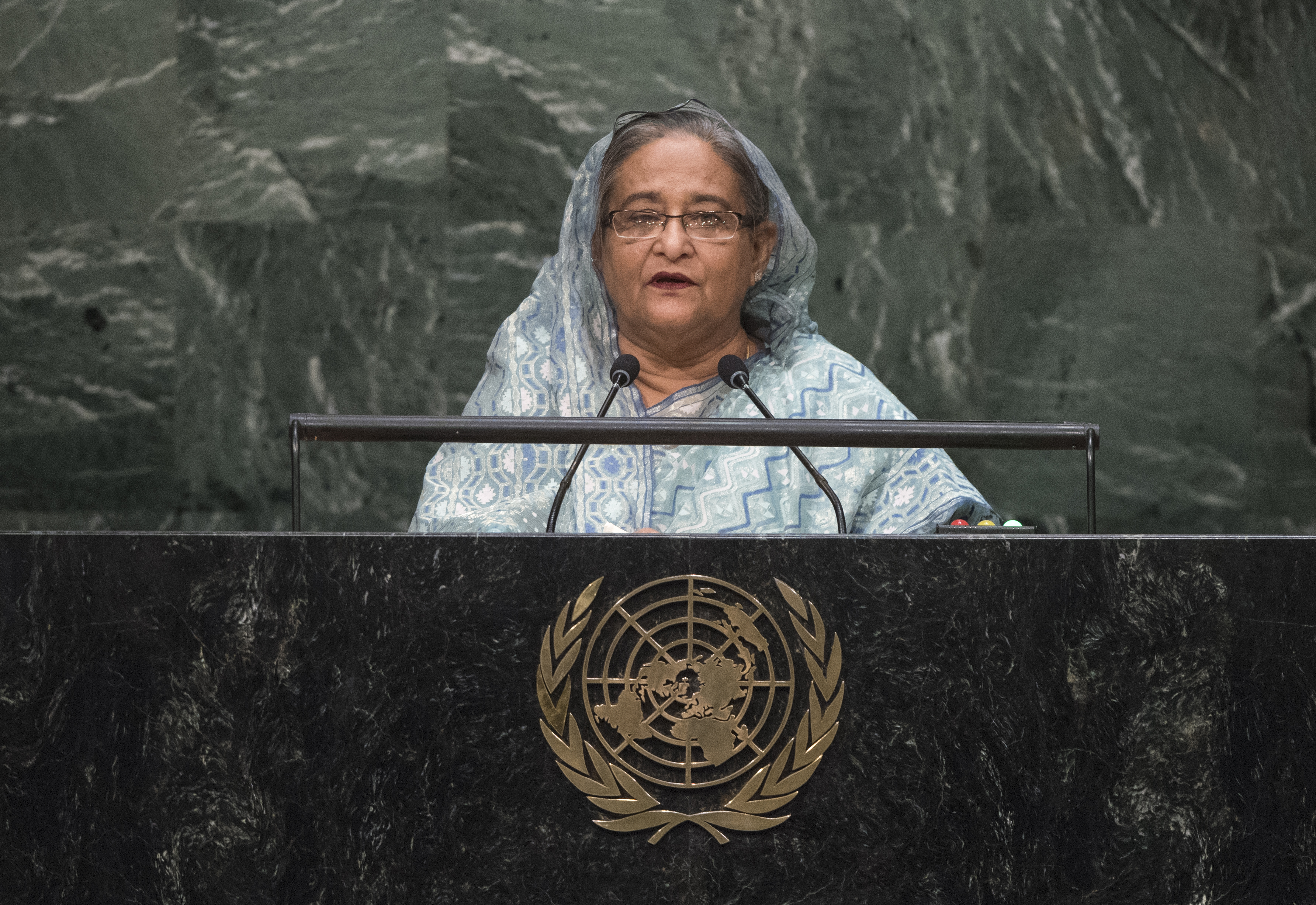
If the goal is simply to bar Hasina from returning to Bangladesh by issuing a symbolic death sentence that is almost entirely impossible to carry out, then this verdict will succeed in doing just that. It will end her political career at home, at least for now, and many will feel that this is enough. The 453-page verdict was read out in a widely televised hearing, which was also livestreamed on social media. As soon as Hasina was sentenced to death, the audience inside the courtroom, including family members of those killed by security forces during the revolution, broke into a euphoric cheer. For victims and witnesses of the brutal crackdown under Hasina, there is a real sense of moral vindication in seeing a brutal dictator held legally responsible for the mass killings that occurred during a popular uprising. In that sense, the death sentence has an important communicative dimension of the kind Antony Duff writes about, in that it publicly condemns the shootings of students and civilians in the July 2024 revolution as state-sponsored crimes against humanity under international law, rather than unfortunate excesses. The highest penalty in law therefore offers the strongest form of censure.
To this end, the verdict reveals a court less concerned with the technicalities of international extradition treaties and more focused on moral and historical reclamation. The Chief Prosecutor, for instance, did not merely list crimes; he reframed the political history of the nation, stating that the aspirations of independence had been ‘doomed to ashes’ by the ‘fascist’ Awami League. When the Attorney General demanded the ‘maximum punishment... so that no other prime minister or the head of state recurs such atrocities,’ he was appealing not only to the death penalty’s symbolic power as the ultimate signal of state disapproval but also to its perceived deterrent effect. The Tribunal’s language was emotive and visceral, designed to mirror the trauma of the streets. In reading the order, the Chairman of the Tribunal, Justice Golam Mortuza Majumdar, noted that after hearing the accounts of victims who ‘lost their skull, eyes, nose, hands and legs, any human being will fail to be in the normal state of mind' and therefore ‘such atrocities must be brought to an end at any cost’. As such, the trial culminating in the death penalty was in many ways a ritualized condemnation intended to delegitimise the former regime and validate the suffering of the victims.
However, if the vision of justice extends beyond symbolism, if the goal is to drag Hasina out of her safe haven in India and into a dock in Dhaka, the death penalty makes that outcome far less likely. India, where Hasina is likely to remain for the foreseeable future, will be able to argue that, under the principle of non-refoulement (the prohibition on sending a person back to face execution or ill treatment), it has a legal duty not to return her, particularly following a trial held in absentia which international observers, such as Human Rights Watch, have found failed to meet international fair trial standards.
The UN High Commissioner for Human Rights called the verdict ‘an important moment for victims of the grave violations committed during the suppression of protests last year,’ but stressed that accountability proceedings for international crimes must ‘unquestionably meet international standards of due process and fair trial,’ especially where trials in absentia and capital punishment are involved. The High Commissioner also stated ‘We also regret the imposition of the death penalty, which we oppose in all circumstances’.
A majority of all countries in the world now effectively oppose the use of the death penalty. The International Criminal Court (ICC) and other international criminal tribunals have also excluded its use in all cases. One may or may not agree with these international norms, but they exist and they shape the behaviour of governments and international institutions whose cooperation Bangladesh needs if Hasina is to ever be brought before a court.
Consequently, the death sentence also generates diplomatic sympathy. Instead of a fugitive fleeing responsibility for a massacre, Hasina, with the full support of Indian media, is now actively recasting herself as the victim of a political show trial with gallows waiting at the end. It effectively creates several legal and political impediments against her return.
At the same time, the fastest way to strengthen the asylum claim of a fugitive ruler is to have a domestic tribunal that has long faced criticism over fair trial standards hand down a death sentence in absentia. During Sheikh Hasina’s tenure, the ICT handed down death sentences to leaders of the opposition political parties Jamaat-e-Islami and the Bangladesh Nationalist Party (BNP). Many of those opponents sought—and received—asylum in the United Kingdom and Europe, precisely because Western courts refused to deport individuals to face ‘death-eligible' trials in Bangladesh that were criticised for lacking due process. Under the European Convention on Human Rights (ECHR), after Soering v United Kingdom (1989), extraditing or deporting someone to face a real risk of execution, or of harsh ‘death row’ conditions following an unfair trial, is treated as a breach of Article 3 (prohibition of inhuman or degrading treatment). Now, the tables have turned. Hasina may well utilize the same human rights frameworks she once decried to protect herself.
Bangladesh remains a retentionist state with a high sentencing rate, even as executions have stalled. According to Amnesty International’s 2024 report on death sentences and executions, courts in Bangladesh imposed at least 165 new death sentences in 2024 (down from at least 248 in 2023), including three for drug offences, 12 for rape and the remainder for offences involving intentional killing; five were handed down in absentia and 32 by special courts such as Speedy Trial Tribunals. For the first time since 2018, no executions were recorded, yet more than 2,000 people remain on death row. This combination of steady sentencing, special tribunals, in absentia proceedings and a growing condemned population with few or no executions entrenches the ‘death row phenomenon’ that those opposed to capital punishment view with deep concern, and suggests that the death penalty in Bangladesh functions less as a sanction reserved for the ‘rarest of the rare’ and more as a routine, often symbolic, tool of penal control.
If Bangladesh wants Hasina to face genuine accountability, it needs a different strategy. The authorities should seek international assistance, for example from the United Nations and credible international justice mechanisms, to support a trial that meets recognised fair trial norms and excludes the death penalty. Only a rights-respecting process will undercut any asylum claim and produce a judgment that can be used to press India either to extradite her, or to prosecute her there, or at the very least to stop providing her with safe haven.
Undoubtedly, the international system is deeply flawed and has failed victims of mass atrocities more often than it has served them. But it is the only system we have. An expedited trial and death sentence will make bold headlines but deliver no lasting accountability. It will instead hand Sheikh Hasina exactly what she needs for a lasting asylum claim.
If one views the death sentence against Hasina as the ‘best option’ simply because they believe India would never hand her over anyway, then arguably that is defeatist. Even if there is only a small chance of compelling her return, Bangladesh owes it to the victims of the July 2024 revolution to pursue a justice process that maximizes that possibility.
 | Taqbir Huda is a DPhil in Law candidate (Clarendon Scholar) at the University of Oxford, examining the right to reparation for human rights violations under international law, and a Senior Fellow at the Tech Global Institute. He has a decade of experience in the human rights sector, including as a Regional Researcher for Amnesty International. Taqbir holds an LLB from SOAS, University of London, an MSc in Criminology and Criminal Justice from Oxford and an LLM from Harvard Law School. |
Share: