
Introduction
“The majesty of our Constitution lies not in the might of the State but in its restraint”: these observations were made by Justice Vikram Nath (Supreme Court) on 25 August 2025, while reversing a death sentence originally imposed in 2010. In India, a death sentence awarded by a trial court must be upheld by the High Court and is almost always appealed to the Supreme Court. Astonishingly, out of the 70 trial court death sentences confirmed by High Courts between 2016 and 2025, the Supreme Court has adjudicated upon 38, and confirmed none. Such a protracted judicial process, which spans years of confirmation, appeal, review and curative proceedings, is a period in which the prisoner may undergo substantial psychological changes, including those directly relevant to rehabilitation and reform. This piece therefore examines the fundamental question of whether an irreversible punishment can remain justified when it was imposed based on an assessment of the possibility of reform that, by the time the sentence is carried out, may no longer hold true. It argues that while the law recognises that people might change over time, it does not offer a settled forum in which that change can be appropriately evaluated. As a potential solution, a single, final and mandatory review before execution is proposed.
Temporal limits to psychological evaluations
In a series of judgements, the Supreme Court has stressed the importance of an appropriate psychiatric evaluation of the accused before pronouncing a sentence. Such an evaluation examines the possibility of the accused’s reform or rehabilitation. This is because the basis of the ‘rarest of the rare’ doctrine rests upon the presumption that, for certain cases, life imprisonment is inadequate. Such a method of assessment is not unique to India. Several other countries like Kenya and the United States of America use mirror principles like the ‘worst of the worst’ doctrine, which reserves capital punishment for ‘a narrow category of the most serious crimes.’ Prima facie, such procedure is in conformity with the twin principles of penal sentencing, which are proportionality, or the requirement of the punishment to correspond to the gravity of the offence, and individualised sentencing, which requires the court to appreciate the unique circumstances and characteristics of each case. By default, however, such assessments are a snapshot of the person’s state of mind at the time of sentencing. In India, no further assessments are required prior to execution, therefore precluding consideration of the cognitive changes which take place during the subsequent years of incarceration. The irony, therefore, lies in the juxtaposition of the law’s thorough scrutiny of the accused’s mental state before sentencing, in contrast to the absence of a mandated need for reassessment before a belated execution.
Judicial recognition of changing circumstances
Such tension is hardly a recent aberration. The judiciary has long recognised that the circumstances surrounding a death sentence are not static, and has carved out limited exceptions to its finality. Most recently, in Vasanta Sampat Dupare v Union of India (2025), the Supreme Court set aside the death sentence of a prisoner whose appeal, review and mercy petitions had all been rejected. Invoking Article 32 of the Constitution, the court held that the sentence had been passed without conformity to the mandatory procedure in Manoj v State of Madhya Pradesh (2019), which requires psychiatric and prison-conduct related evidence to be presented before a court sentences a person to death. As the fresh hearing on sentence must follow Manoj, it will inherently assess the prisoner as they are today. Similarly, Shatrughan Chauhan v Union of India (2014) held that supervening circumstances cannot be disregarded merely because a sentence has attained finality. While both decisions uphold that a death sentence can be revoked on the grounds of changing circumstances, neither offers a stipulated remedy post reform, as Dupare is limited to breaches of mandatory procedure, and Chauhan to specific supervening events. For a prisoner who has simply changed for the better, the mercy petition is the only recourse left.
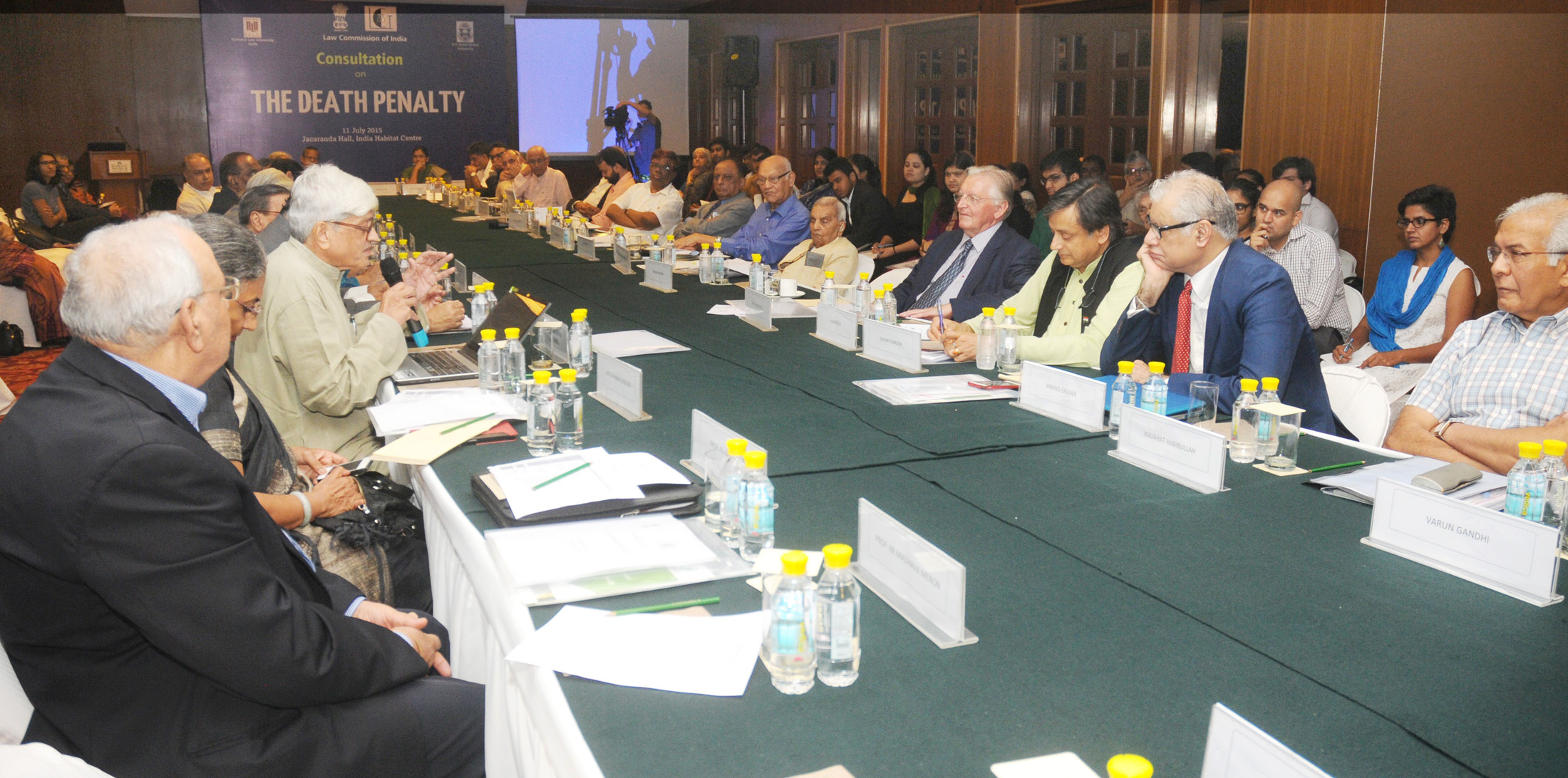
Image made available by the Ministry of Law & Justice, Government of India, via Wikimedia Commons (GODL-India).
The Hobson’s choice of mercy petitions
After all of the judicial avenues are exhausted, the last resort for the prisoner is to file for a mercy petition under Articles 72 and 161 of the Constitution, which give powers to the President and Governors to pardon a sentence. Austin Sarat has traced the classical idea of mercy as a plenary pardon by way of compassion, and not to an assessment of transformation. This notion by itself shows us how mercy petitions are unsuitable to appreciate reform, as they hinge upon ex gratia amnesty rather than demonstrated change. Theoretically speaking, this discretionary power is broad, as the executive might reduce the sentence of a prisoner. However, due to the nature of the remedy, the prisoner’s choice is illusory: to present evidence of reform via a discretionary plea that was never designed to weigh it in the first place, or to present it nowhere at all. Courts can later review the President’s or Governor’s decision, to either reduce the death sentence or uphold it, but only on limited grounds such as non-application of mind or arbitrariness. Therefore, in the event that this last resort fails, the state may take the life of someone who is no longer the person that it originally condemned, in order to uphold the principle that taking a life is wrong. The contradiction is difficult to defend.
Global parallels
This difficulty is not peculiar to India, nor to the death penalty. In Vinter v United Kingdom (2013), the Grand Chamber of the European Court of Human Rights held that a life sentence remains compatible with Article 3 of the European Convention (prohibition of torture and inhuman or degrading treatment or punishment) only if it offers both a prospect of release and a possibility of review. The Grand Chamber did not forbid whole-life orders, and accepted that a prisoner who remains a risk may be detained for life. What it rejected was detention with no inquiry into whether it is still justified, since that denies the prisoner the ‘inherent dignity of the human person’. This comparison has limits, as Vinter contemplates periodic reviews where the death penalty, due to its unalterable nature, makes room for only one final review. Its value, however, lies in the principle that a sentence imposed at one moment must remain subject to subsequent evaluations and malleable to the findings of such reviews.
U.S. law offers a closer, if narrower, parallel. The Eighth Amendment bars the execution of a prisoner who lacks a rational understanding of why the state seeks to execute them, an inquiry directed at the prisoner’s mental state prior to execution, not their condition at trial (see Madison v Alabama (2019), applying Ford v Wainwright (1986) and Panetti v Quarterman (2007)). That is a test of competency, not of reform, but it shows that a legal system can accept that the psychological condition of a prisoner may change after a sentence, and an examination at the time of execution is imperative.
A case for pre-execution review
A balanced approach to this dilemma must respect a sentence but simultaneously accommodate for psychological change. A workable solution could be a mandatory single review of the prisoner at the time of execution. The prisoner would bear the burden of demonstrating verifiable evidence of mental reform, along with documented conduct and an expert psychiatric opinion. This is an extension of the kind of material Manoj already requires at sentencing. The prerogative of courts at this stage would strictly concern the sentence and not reopen guilt. The question before the court would only be whether life imprisonment is now adequate, and the outcome would be final. This review would effectively give the process a definite end point while filling the gap left by mercy petitions, which are not designed to assess reform.
However, this proposal is not free of tension. Another procedural step would further burden a judiciary already carrying over 56 million pending cases, and may prolong the process for victim’s families. It could also extend the ‘death row phenomenon’ it seeks to resolve and favour prisoners able to afford experts.
A further difficulty arises by virtue of the delay itself. Project 39A’s study of death row prisoners, Deathworthy, found that 62.2 per cent of the prisoners studied had been diagnosed with at least one mental illness, and found a correlation between the conditions of incarceration and ill-health. Therefore, a prisoner whose mental health has declined under sentence may struggle to present as reformed, through no fault of their own, so the review must be built around that reality. Signs of mental deterioration should accordingly be viewed from the lens of them being a byproduct of incarceration and therefore not be evaluated at the disadvantage of the prisoner. Several other countries have created stringent legislative safeguards after taking into account the traumatising nature of prolonged confinement on death row, most notably the Judicial Committee of the Privy Council’s decision in Pratt and Morgan v Attorney General for Jamaica (1993), which renders any execution delayed for more than five years unlawful altogether.
Furthermore, prisoners seeking to demonstrate reform through the proposed review could rely on material evidence such as each inmate’s ‘history ticket,’ the conduct record that prison authorities maintain under section 3(6) of the Prisons Act 1894 and the state rules framed under section 59 of that Act. The same records are already used to reduce prison terms through remission and premature release, and could potentially extend to reviewing a death sentence. This ensures that the assessment rests on years of documented behaviour rather than a single evaluation, so that the review does not reproduce the ‘snapshot’ problem it is meant to cure. Independent evaluations should be funded by the state, which also answers the concern about prisoners who cannot afford experts. While these drawbacks are relevant concerns, the important broader objective would ensure that an irreversible penalty – the most serious punishment that the state has the power to impose – is only imposed on those who still meet the legal criteria for it.
Conclusions
India’s jurisprudential history is testament to how a death sentence can outlast its justification. First, assessments conducted during trials are mere snapshots, whose accuracy may fade as people change. Second, Article 32 of the Constitution and mercy petitions address procedural failure and other supervening circumstances, but not specifically reform. Third, a single judicial review before execution, built around the toll that death row takes on prisoners, could close that gap, without displacing the case for abolition. Where a sovereign claims the power to take a life, the question is not only whether death was the appropriate sentence at the time of sentencing, but whether it can still be justified by the time of execution.

| Tisha Manek is a fourth-year B.A. LL.B. student at The SVKM’s Pravin Gandhi College of Law, Mumbai, and the Executive Editor of her college’s annual Law Review. She is interested in academic writing and legal research. |
Share: