
Restricting the Death Penalty: Strategies Beyond Abolition — Panel Discussion
Posted:
Time to read:
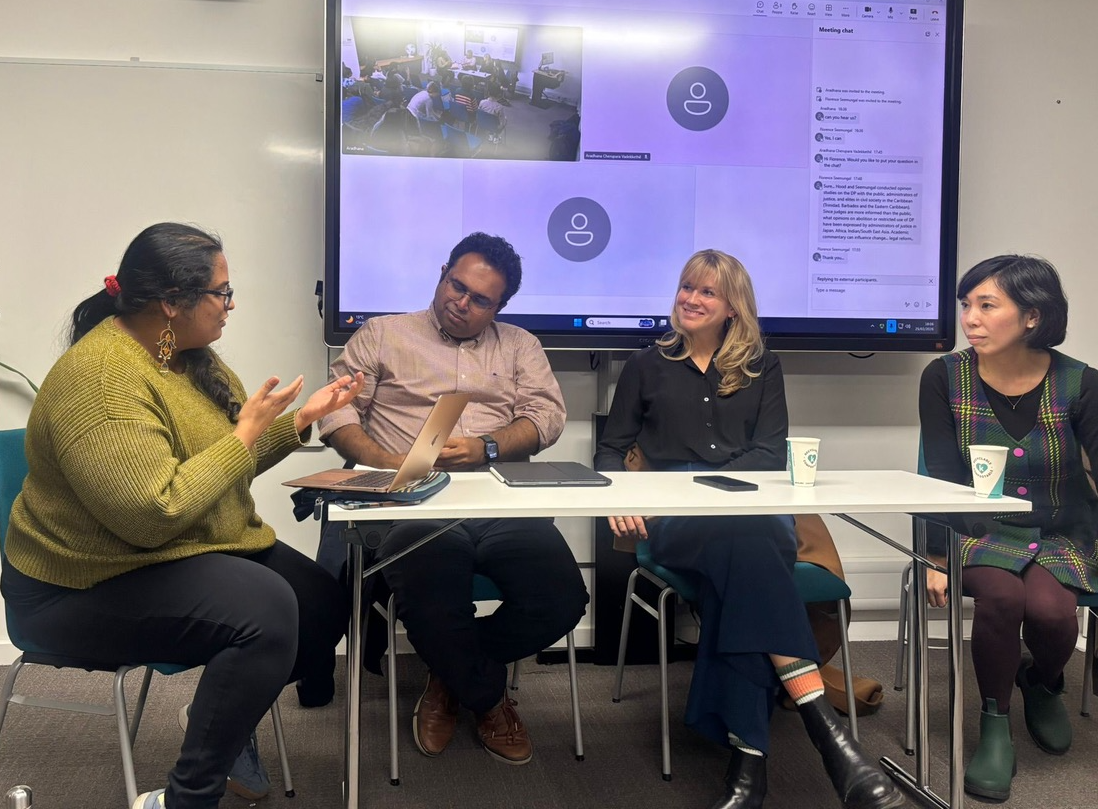
On 25 February 2026, the Death Penalty Research Unit (DPRU) and the Oxford Human Rights Hub co-hosted a panel discussion titled 'Restricting the Death Penalty: Strategies Beyond Abolition'. The discussion was moderated by Dr Aradhana Cherupara Vadekkethil, Research Director at the Oxford Human Rights Hub, and brought together Professor Mai Sato (Director, Institute for Crime and Justice Policy Research, Birkbeck, University of London), Professor Anup Surendranath (Executive Director, The Square Circle Clinic, NALSAR University of Law, Hyderabad) and Katie Campbell (Head of Death Penalty Projects - Africa & South East Asia, Reprieve) to examine what ‘restrictionist’ strategies can achieve in retentionist jurisdictions and what their practical and normative trade-offs may be. ‘Restrictionist’ refers to approaches to narrow the scope or use of the death penalty in retentionist countries.
Rather than revisiting abolition as an endpoint, the panel focused on the idea of ‘constraint’ in different jurisdictions: heightened procedural safeguards and stricter standards of proof; limiting eligibility through sentencing doctrines, like adopting judicial frameworks that can narrow the use of the death penalty (e.g. heightened mitigation requirements); proportionality review, ensuring adequate judicial scrutiny is present to assess whether capital punishment is a proportional response to the specific offence; and constitutional litigation, which refers to strategic challenges that invoke constitutional rights and standards to restrict the scope and administration of the death penalty (for example by contesting sentencing frameworks, conditions on death row, clemency processes or the legality of execution practices). A recurring theme throughout the discussion was the concern that reforms that reduce execution or death sentences in practice may risk legitimising capital punishment by presenting it as increasingly ‘fair’ and ‘administrable’. This post summarises the key themes from the discussion.
Southeast Asia and Africa
Katie Campbell opened with an overview of reform trajectories across parts of Southeast Asia and Africa, describing the latter as a ‘region of hope.’ She located this optimism in the region’s recent legislative momentum, with several African states abolishing the death penalty in law in the past few years. Chad abolished the death penalty in April 2020, followed by Sierra Leone in October 2021. The abolitionist trend continued in 2022, with the Central African Republic in June, followed by Zambia in December. Ghana abolished the death penalty for ordinary crimes in 2023 and Zimbabwe outlawed the death penalty for all crimes in 2024. In the African context, Campbell highlighted the continuing influence of S v Makwanyane (1995). This South African Constitutional Court decision struck down the death penalty as incompatible with the rights to life and human dignity and the prohibition on cruel, inhuman and degrading punishment, as a constitutional reference point for human dignity and punishment.
Campbell’s examples highlighted the diversity of restriction pathways across jurisdictions. In Malawi, the abolition of the mandatory death penalty has operated as a profound restriction even while capital punishment remains in law. Following the end of mandatory capital sentencing in 2007, a nationwide resentencing exercise reopened cases to consider mitigation and culpability. This required courts and counsel to examine the individual circumstances of defendants and, in some instances, to confront concerns about the safety of convictions. In Malaysia, reform has similarly proceeded through legislative change which removed mandatory death sentences while retaining the death penalty for certain offences. Campbell emphasised a central difficulty in this model, namely that death sentences may continue to be imposed where mitigation and culpability are not meaningfully considered, illustrating how formal legal reform can outpace courtroom practice. Lastly, she discussed Indonesia’s new probationary approach in which those sentenced to death are not executed for 10 years, with commutation to life imprisonment where specified conditions are met.
Across these examples, Campbell noted that making the use of the death penalty genuinely difficult requires an enabling legal framework and institutional capacity: well-resourced defence lawyering; judicial preparedness to receive and assess mitigation; and prison and probation services able to support investigation and reporting. In her account, where the system takes the individual seriously—‘360 degrees’, across life history, vulnerability and social context—the normative case for imposing a death sentence can become harder to sustain. But doctrinal changes without systemic commitment have little impact. For instance, Campbell highlighted the absence of routine psychological assessment in Malaysia, which leaves lawyers and judges without structured tools to identify and respond to mental impairment amongst death row defendants.
Japan
Professor Sato discussed Japan as a jurisdiction in which the death penalty persists, with limited domestic momentum towards restriction. Japan continues to carry out executions, typically in single-digit numbers annually, by hanging. Although the death penalty remains in law for 19 capital offences, Sato noted that it is imposed primarily for murder, particularly in cases involving multiple killings. Conditions on death row are marked by isolation and secrecy. People under sentence of death are held in solitary confinement under 24-hour surveillance and have limited contact with family and others outside prison. When executions occur, prisoners are typically given only a few hours’ notice, and families and lawyers are informed only after the execution has taken place. As a result, death row prisoners live with the constant fear of imminent execution and may experience severe psychological harm associated with prolonged confinement under these conditions. Death row prisoners in Japan challenged the practice of providing only a few hours’ notice before execution and sought compensation for the psychological harm caused by this practice. However, Sato emphasised that the relevant court dismissed the petition. She also noted that challenges to hanging as a method of execution on grounds of torture have been dismissed. Notably, the Osaka District Court in 2011 acknowledged that, in some cases, hanging may take over two minutes for a person to lose consciousness and that the person may continue to suffer pain. But it ultimately concluded that hanging did not amount to a ‘cruel punishment’, without providing any concrete basis for that assertion.
Against this backdrop, Sato characterised Japan’s official position as one of compliance with international safeguards, particularly by presenting the death penalty as limited to the ‘most serious crimes’ and as a safe, carefully administered system. But ratification of the International Covenant on Civil and Political Rights is also associated with an obligation to move towards abolition, and Sato observed that no domestic shift in that direction is evident. In her view, this is partly because capital punishment has limited political visibility and because civil society infrastructure is comparatively weak and under-resourced. Moreover, the claim that the death penalty is administered safely in Japan is deeply questionable. The acquittal of Iwao Hakamada in September 2024 after 46 years on death row offers a stark illustration of the system’s fallibility. In acquitting Hakamada of robbery and multiple murder charges, the court found that the evidence relied upon against him had been fabricated.
Iran
Drawing on her perspective as the United Nations Special Rapporteur on Iran, Professor Sato observed that secrecy operates in Iran at a more severe level than in Japan. Public data are scarce and contested, while estimates by civil society organisations indicate very high execution numbers. However, unlike Japan, Sato noted that Iran has a comparatively robust civil society ecosystem, much of it operating from outside the country. Sato distinguished media and international attention on politically salient cases (such as political activists) from the larger volume of executions linked to drug offences and homicide cases involving qisas, where victims’ families may decide between execution, ‘blood money’ or forgiveness.
Sato highlighted a significant reform episode in 2017, when changes to drug laws reduced executions for drug-related offences. She suggested that this shift was prompted in part by external pressure linked to international cooperation and funding. The panel highlighted this as an illustration of a pragmatic restriction strategy in which reform efforts focus on categories of offences where change is politically feasible. This may therefore produce reductions, even when structural reform is much harder to achieve, particularly where it would require reworking entrenched legal and religious frameworks. However, it must be noted that the decrease in drug-related executions in Iran was short-lived; the trend was reversed by subsequent bills to widen the scope of the death penalty.
India
Professor Surendranath argued that the global death penalty debate can become overly homogenised, obscuring how the penalty functions in jurisdictions like India. India retains a discretionary death penalty regime and has a large and growing death row population, despite relatively few executions. In this context, he suggested, the lived reality of capital punishment is often the experience of death row itself—prolonged uncertainty, repeated litigation and sustained suffering. Surendranath described India’s distinctive procedural architecture. Capital cases involve multiple layers of judicial scrutiny, including the Supreme Court’s review of its own decisions in open court, which is unique to death penalty cases in India. But these layers of scrutiny coexist with a flawed criminal justice system with structural problems in investigation and prosecution that are rarely acknowledged.
Surendranath discussed the Indian Supreme Court’s 2022 decision in Manoj v State of Madhya Pradesh, which mandated sentencing courts to call for three kinds of reports from the state to collect mitigating information about the defendant, in addition to an independent report on mitigation by the defence team. In 2025, the Supreme Court in Vasant Sampat Dupare v Union Of India elevated the status of the guidelines in Manoj by holding that non-compliance with the ruling in Manoj constitutes a violation of a fundamental right of the defendants. While this was a big win, Surendranath highlighted that trial courts rarely comply with the guidelines in Manoj. Using this data point, Surendranath identified a strategic conundrum: if procedural demands are pitched so high that trial courts cannot or will not meet them, judges may simply impose death sentences on the assumption that appellate courts will ‘fix’ deficiencies years later. This exposes a recurring trade-off in restriction strategies: they can reduce executions and increase scrutiny, while also generating delays and entrenching death row as an enduring condition.
Surendranath also discussed clemency as a site of restriction through judicial review of administrative decision-making. At the same time, he flagged a broader normative risk: exceptionalising capital punishment—by building ever more elaborate safeguards—can sustain the narrative that the death penalty is becoming ‘fairer’, thereby making the abolitionist argument politically and legally harder. He further cautioned against treating reduced death sentences as an unqualified ‘victory’ where restriction is accompanied by an expansion of life without parole outcomes. Finally, Surendranath located the debate within a wider landscape of state violence, warning that the declining use of formal execution does not necessarily indicate declining state lethality, particularly where extra-judicial killings rise in prominence.
Takeaways
Across jurisdictions, the panel returned to a set of shared questions. The panellists asked what restriction is ultimately for: whether the objective is to minimise executions, reduce death sentences, improve procedural justice or render capital punishment practically unusable. They emphasised that restriction is not only doctrinal, meaning it is not achieved merely by changing legal rules or standards on paper. It also depends on institutional capacity, including adequately resourced defence representation, judicial willingness and training to receive and assess mitigation, access to independent experts and prison and probation services able to support investigation and reporting. The discussion also underscored the trade-offs that accompany procedural intensification. Heightened safeguards may reduce executions and increase scrutiny, but they can also extend time spent on death row, deepen litigation burdens and risk legitimising the death penalty by presenting it as ‘safe’ or increasingly fair.
Photo credit: Ayan Gupta

| Neetika Vishwanath is a DPhil candidate at the Centre for Criminology, Faculty of Law, University of Oxford. She is the co-founder of The Square Circle Clinic at NALSAR University of Law, which provides pro bono legal representation to individuals sentenced to death and conducts research on the administration of the death penalty in India. |
Share: