

Making the Invisible Visible: Women in Immigration Detention Centres in Spain
Posted:
Time to read:
Guest post by Anna Morero Beltrán, Ana Ballesteros Pena, and Elisabet Almeda Samaranch, COPOLIS Welfare, Community and Social Control Research Group, University of Barcelona. In this post, the authors summarise their current findings from the first phase of their research on detention of women migrants in Spain.
Over the last few years, and more extensively in the context of the global economic crisis, Spain has tightened its immigration policies. These changes include promoting ‘voluntary return,’ regulating the entry and residence of migrants in the country, and Directive 2008/115/CE, commonly known as the ‘Outrageous Directive’ which earned its name due to the extremely strict measures designed to reduce irregular immigration. Additionally, the government passed the controversial The Royal Law-Decree 16/2012 for sanitary regulation that denies access to health care and preventive services to irregular migrants except in emergencies and for those who are pregnant and under 18 years of age. Finally, the Royal Decree 162/2014 of 14 March established new and updated standards for the confinement of foreigners in immigration detention centres (Centros de internamiento de extranjeros or CIEs) prior to deportation.
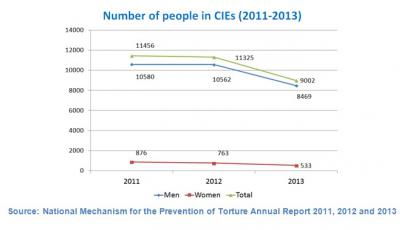
From 2011 to 2013, the Defensor del Pueblo, in the annual reports National Mechanism for the Prevention of Torture, indicates that 31,783 immigrants were detained in Spain’s CIEs, 2,172 of whom were women (see graph below). In 2013, the first year in which the report includes this information, the five most common sending countries for women were Nigeria, Morocco, Brazil, Cameroon, and Paraguay. These are the only official data available that is broken down by gender.
According to several reports, the women detained in Spain’s CIEs share the following characteristics:
- Women with social roots in Spain, including relatives and even children. In some cases, young women brought up in Spain are deported to countries where they have no social roots.
- Over-representation of women that have regularly or occasionally been involved in prostitution.
- Victims of trafficking, mainly for sexual exploitation, that are not being detected. On the one hand, the authorities believe the women are lying in order to avoid deportation, and on the other hand, at times, the women don’t receive the adequate information about their rights.
- Sexual abuse, rape, and gender-based violence, both in the past and in the present.
In terms of the CIEs themselves, reports indicate that women’s living conditions differ from that of men. Specifically, their facilities are usually smaller and more poorly equipped than those for men, women have less time on the patio (outdoor areas), and in some cases, are responsible for cleaning their own spaces. Such conditions can also be found in the typical living experience in women’s prisons.
Additional issues have been flagged about the detention of women migrants in Spain:
- Limited and poor nutrition, which is of particular concern in the case of pregnant women, and a shortage of basic products, such as those for intimate hygiene.
- Poor health care services, especially regarding sexual and reproductive health. The medical services are often outsourced and decisions about medical care are under the control of the centre manager or guards (which in Spain are the police).
- Lack of information about the conditions of detention as well as legal and asylum issues. Women detainees don’t receive information about the duration of their confinement nor the services provided. Additionally, they face serious impediments to receiving information about their legal situations, which are more complex when there are linguistic barriers. Legal aid is often absent or weak.
- Abuse, including shouting and lack of attention by the police; disrespectful, aggressive attitudes on the part of guards; and mistreatment, along with physical abuse, during the process of deportation. Until recently, detainees weren’t informed about the date they would be deported. Now, the law requires that detainees must receive notice 12 hours prior to their removal.

It’s clear that more research in this field is needed to develop the necessary theoretical tools and to collect empirical evidence, from a feminist perspective, in order to understand immigration detention in Spain. Of particular interest in our research is the relationship between immigration detention centres and prisons for women as expressions of penal power in contemporary Spanish society. The worrying evidence coming from the little research carried out so far, as well as the link with the basic human rights of women migrants, reminds us of the commitment in our role as feminist researchers, and that we urgently need to tackle this reality. It's time to make the invisible once again visible regarding the administrative detention of irregular women migrants.
Any comments about this post? Get in touch with us! Send us an email, or post a comment here or on Facebook. You can also tweet us.
__________
How to cite this blog post (Harvard style):
Morero Beltrán A, Ballesteros Pena A and Almeda Samaranch E (2014) Making the Invisible Visible: Women in Immigration Detention Centres in Spain. Available at: http://bordercriminologies.law.ox.ac.uk/women-in-detention-in-spain/ (Accessed [date]).
Share: